

Archive · 28 Jul 2025
India's DEW Advancement: Leading the Future of Weaponry
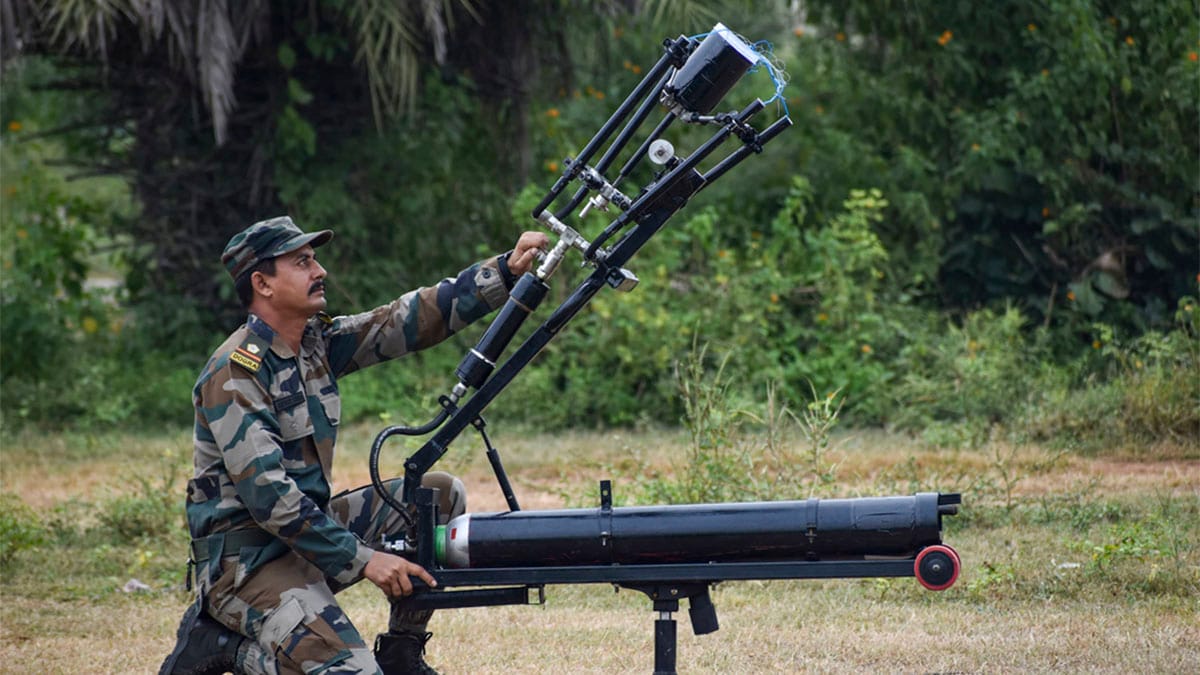
Imagine weapons that use energy beams like lasers or microwaves to zap targets instead of bullets.
India has developed one called Mk-II (A) that can take down drones.
These weapons are super fast, accurate, and could be cheaper to use than traditional ones.
They work by melting or disrupting their target with concentrated energy.
While cool, they can be affected by weather and might cause problems with health or equipment.
Many countries and companies are now investing heavily in making these weapons better, with India leading the charge.

India successfully tested the Mk-II (A) Laser-Directed Energy Weapon (DEW) designed to neutralize aerial threats.
DEWs use concentrated energy (lasers, microwaves, etc.) to damage or disable targets, offering advantages like high speed and precision.
DEWs can be used discreetly and are cost-effective, but face challenges like atmospheric interference.
Several countries and companies are investing in and developing DEW technology for various military applications.
DRDO's Mk-II (A) system, designed for ground and naval deployment, aims to be operationally ready by 2027.
- Who
- The Defence Research and Development Organisation (DRDO) designed the Mk-II (A).
- What
- India tested a Laser-Directed Energy Weapon (DEW) called Mk-II (A).
- When
- The Mk-II (A) was tested this April.
- Where
- The test took place at the National Open Air Range (NOAR) in Kurnool, India.
- Why
- DEWs offer advantages like speed, precision, and cost-effectiveness over traditional weapons, aiming to neutralize aerial threats.
Advantages
Challenges
Cost vs. Risk
Advantages
DEWs are cost-effective and efficient
Challenges
Potential negative effects on friendly forces and unknown long-term health impact.
- Weapon Type
- Laser-Directed Energy Weapon (DEW)
- System
- Mk-II (A)
- Developer
- DRDO (India)
- Primary Target
- Drones and aerial threats
- Operational Goal
- 2027
- Technology
- 30 kW High-Energy Laser