

Archive · 31 Oct 2025
India's Opposition Faces Coalition Dilemmas, Drawing Lessons from JNU Student Politics
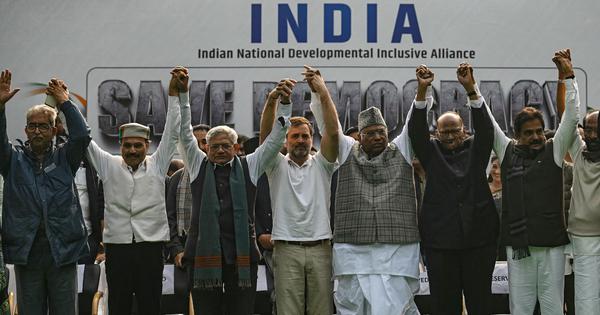
Imagine different groups of friends who want to play a game together and stop another group they don't like from winning.
Sometimes, these friends have small arguments about how to play, but they know they need to work together.
In India, big political parties sometimes need to team up to face a strong rival party.
This article looks at how student politics at a university called JNU shows us how to do this.
Even though the students have different ideas, they learn to make choices together, just like the political parties need to.
The article says it's important for these groups to talk about their differences but also to find ways to cooperate.
It also stresses that voters need to understand these different ideas and make smart choices, not just follow the loudest voices.
It's like learning to share and compromise to achieve a common goal, even when you don't agree on everything.

India's opposition blocs face pressure to unite against a dominant right-wing party, a dynamic mirrored in JNU student politics.
Pre-poll unity can suppress important substantive disagreements, potentially leading to fragile coalitions and a less robust public discourse.
The first-past-the-post electoral system creates structural incentives for coalition-building to prevent vote fragmentation.
JNU student politics illustrates how ideological differentiation can coexist with strategic cooperation, emphasizing the importance of both debate and pragmatism.
Effective opposition requires not only strategic alliances but also voter education to navigate ideological diversity and make informed choices.
- Who
- Indian political parties and student political formations, particularly those on the left and center-left.
- What
- Discusses the challenges and lessons learned from forming opposition coalitions, using JNU student politics as a case study to understand realpolitik, ideological coherence, and voter engagement.
- When
- Contemporary Indian politics and historical trends in student elections.
- Where
- India, with a specific focus on Jawaharlal Nehru University (JNU) in Delhi.
- Why
- To explore how opposition blocs can effectively counter a dominant right-wing party by learning from the strategies of political contestation and coalition-building within student politics.
- Core Issue
- Balancing electoral efficacy with ideological differentiation in opposition coalitions.
- Key Example
- Jawaharlal Nehru University (JNU) student union politics.
- Electoral System Context
- First-past-the-post system incentivizes coalition-building to avoid vote splitting.
- JNU Student Politics Dynamics
- Left and progressive student formations navigate ideological debates while forming alliances.
- Voter Engagement
- Importance of educating voters to engage with ideological diversity and strategic choices.