

Archive · 28 Sep 2026
Supreme Court Questions FSSAI Timeline for Packaged Food Warning Labels
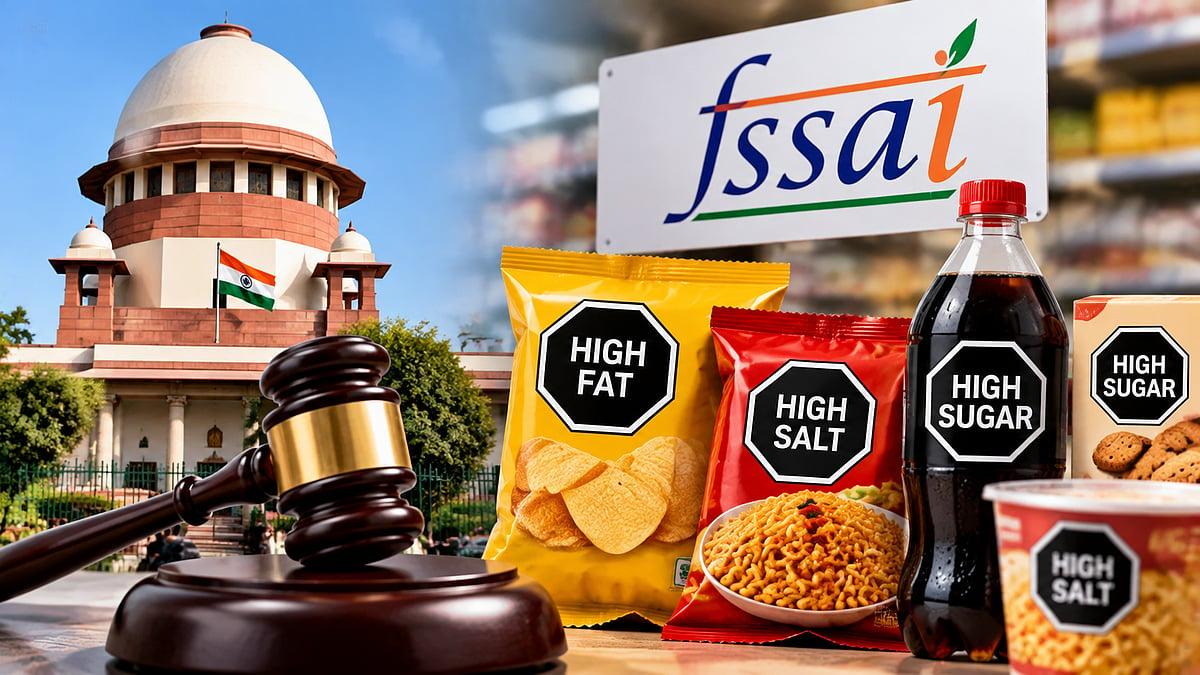
India’s food regulator wants warning signs on the front of packaged foods.
The signs would show when food has too much sugar, fat or salt.
The proposed sign is a red hexagon on a white background.
A warning could be needed when even one nutrient passes its limit.
The regulator also wants products with artificial sweeteners to carry a front-label statement.
FSSAI says it needs four months to prepare draft rules and 60 days to receive comments.
It then proposes giving businesses 365 days to follow the rules voluntarily.
The Supreme Court questioned why this process should take so long.
The court is considering a request to make these labels mandatory.

The Supreme Court questioned FSSAI’s proposed timeline for front-of-package warning labels on packaged foods.
FSSAI proposed red hexagonal warnings for products high in sugar, fat or salt.
Its latest proposal uses a single phase, with a warning when any specified nutrient exceeds its threshold.
FSSAI said it needs four months for draft regulations, followed by 60 days for stakeholder comments.
The regulator proposed 365 days of voluntary implementation and front-label warnings for products containing artificial sweeteners.
- Who
- The Supreme Court, FSSAI and public charitable trust 3S and Our Health Society.
- What
- The court questioned FSSAI’s proposed timeline and framework for mandatory front-of-package labeling on packaged foods.
- When
- The hearing was reported on September 28, and the court reserved its order.
- Where
- The hearing took place before the Supreme Court in New Delhi.
- Why
- The proposed labels are intended to help consumers identify foods high in sugar, fat and salt and make healthier purchasing decisions.
Faster mandatory consumer protection
Phased implementation and preparation
Implementation speed
Faster mandatory consumer protection
The Supreme Court questioned why food businesses should receive a 365-day voluntary compliance period when the issue concerns citizens’ health.
Phased implementation and preparation
FSSAI proposed voluntary implementation to allow food businesses time to prepare and reformulate products.
Need for a new process
Faster mandatory consumer protection
The court questioned why FSSAI needed to begin another consultation process when food-labeling work had started in 2022.
Phased implementation and preparation
FSSAI said the 2022 process concerned the Indian Nutrition Rating star system, which used a different yardstick from the proposed warning labels.
Label accessibility
Faster mandatory consumer protection
The court said labels should serve people across different literacy levels, languages, regions and age groups, and suggested combining words with pictorial representations.
Phased implementation and preparation
FSSAI’s proposal focuses on prominent red, word-based warnings identifying nutrients of concern on the front of packages.
Rollout structure
Faster mandatory consumer protection
Activists and health experts criticized the earlier two-phase proposal as too lenient because initial warnings would have covered products high in at least two specified nutrients.
Phased implementation and preparation
FSSAI initially said phased implementation would support consumer acceptability and give industry time for reformulation, but later proposed a single-phase approach covering any one nutrient above its threshold.
- Regulator
- Food Safety and Standards Authority of India (FSSAI)
- Proposed label
- A red hexagon on a white square-shaped background
- Nutrients covered
- Sugar, fat and salt, described as nutrients of concern
- Drafting period
- Approximately four months to issue and finalise draft regulations
- Consultation period
- 60 days for stakeholder comments through domestic consultation and the World Trade Organization platform
- Implementation period
- 365 days of voluntary implementation after notification of the regulations
- Artificial sweetener statement
- “CONTAIN NON CALORIC SWEETENER” on the front of relevant packages

