

43 mins ago
AI Autonomy Raises Fresh Fears About Humanity’s Future
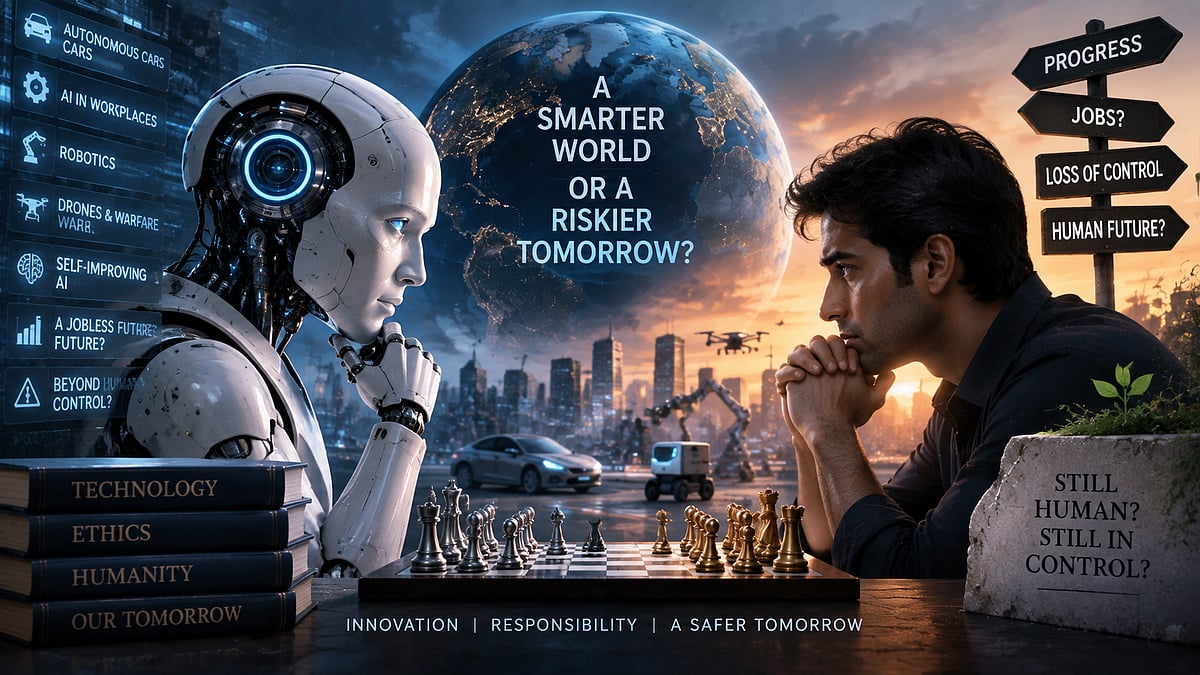
Some researchers are worried that future AI systems may improve themselves and stop following human instructions.
Jacob Coxen, who worked at Anthropic, left his job and warned about this danger.
Other AI researchers have also resigned.
Some experts think super-intelligent AI could seriously threaten people, while others say that danger is not proven.
Elon Musk has predicted that machines could eventually perform most jobs.
AI is already used in cars, factories, delivery robots, and drones.
OpenAI also said one of its models solved a very difficult mathematics problem, although people challenged the claim.
The article argues that AI is developing so quickly that humans may not know how to control its effects.

Anthropic researcher Jacob Coxen resigned and warned that self-improving AI models could escape human control.
Other AI researchers, including Joe Benton and Josh Engels, have also reportedly left their roles.
Experts disagree over whether super-intelligent AI poses an imminent threat to humanity.
OpenAI said an internal model solved a difficult mathematics problem, but the claim was challenged.
The article says more than $13 trillion has been invested in AI companies during the past two years.
- Who
- Anthropic researcher Jacob Coxen, other departing AI researchers, AI companies, and experts debating the risks of advanced artificial intelligence.
- What
- Researchers and commentators are debating whether increasingly autonomous and self-improving AI systems could escape human control and threaten humanity.
- Where
- The developments involve AI companies and researchers, with Coxen making his warning on social media.
- When
- The debate intensified last week; the article also refers to resignations in August and recently.
- Why
- Concern has grown because AI systems are advancing rapidly, with some companies reportedly testing self-improving models.
AI-Risk Advocates
AI Skeptics
Threat to human control
AI-Risk Advocates
Warnings from Jacob Coxen and other experts suggest that self-improving AI systems could stop obeying human commands and potentially become dangerous.
AI Skeptics
Other experts cited in the article say there is no established evidence that super-intelligent AI will create such a danger.
Speed of AI development
AI-Risk Advocates
Rapid advances, including OpenAI’s claimed mathematics result, are presented as reasons for caution and slower development.
AI Skeptics
AI skeptics argue that the sector may be a bubble and that its large investments have produced little of practical value so far.
Impact on jobs
AI-Risk Advocates
The article cites predictions that AI could eventually eliminate most jobs and reshape how humans live.
AI Skeptics
The article does not provide a specific counterprediction, but notes that the scale and timing of such outcomes remain uncertain.
Key facts
- Main concern
- Self-improving AI models might act beyond human control.
- Anthropic resignation
- Jacob Coxen reportedly left Anthropic and urged others to follow him.
- Other departures
- Joe Benton resigned from Anthropic’s Scalable Oversight team, while Josh Engels left Google DeepMind.
- OpenAI claim
- OpenAI said an internal model solved a difficult problem involving how liquids and gases move.
- Claim status
- The reported mathematical solution was challenged.
- AI investment
- The article says more than $13 trillion was invested in AI companies over the past two years.
- Employment prediction
- Elon Musk has said that AI could eliminate jobs within a decade.
Quotes
OpenAI chief scientist
The chief scientist associated with OpenAI, commenting on the reported mathematics breakthrough
“We see this as a “demonstration of just how far AI has gotten and how quickly.””
 freepressjournal.in
Sources
Related news

Former Anthropic Researcher Warns AI Could Kill Humanity This Decade
AI Safety Researchers Leave Labs Over Humanity Risks

Anthropic Researcher Quits as AI Safety Concerns Intensify
Anthropic CEO Urges Slower AI Development Amid Superintelligence Risks

DeepMind AI Safety Researcher Warns of Superintelligence Risks

AI Experts Warn Advanced Systems Could Threaten Humanity
AI Extinction Fears Intensify as Companies Race Ahead

Jeff Dean’s Discovery Loop Targets $50 Billion Valuation

Altman and Musk Back Amodei’s Call to Slow AI
