

Archive · 18 Jul 2026
AI Camera Reconstructs Particle Paths
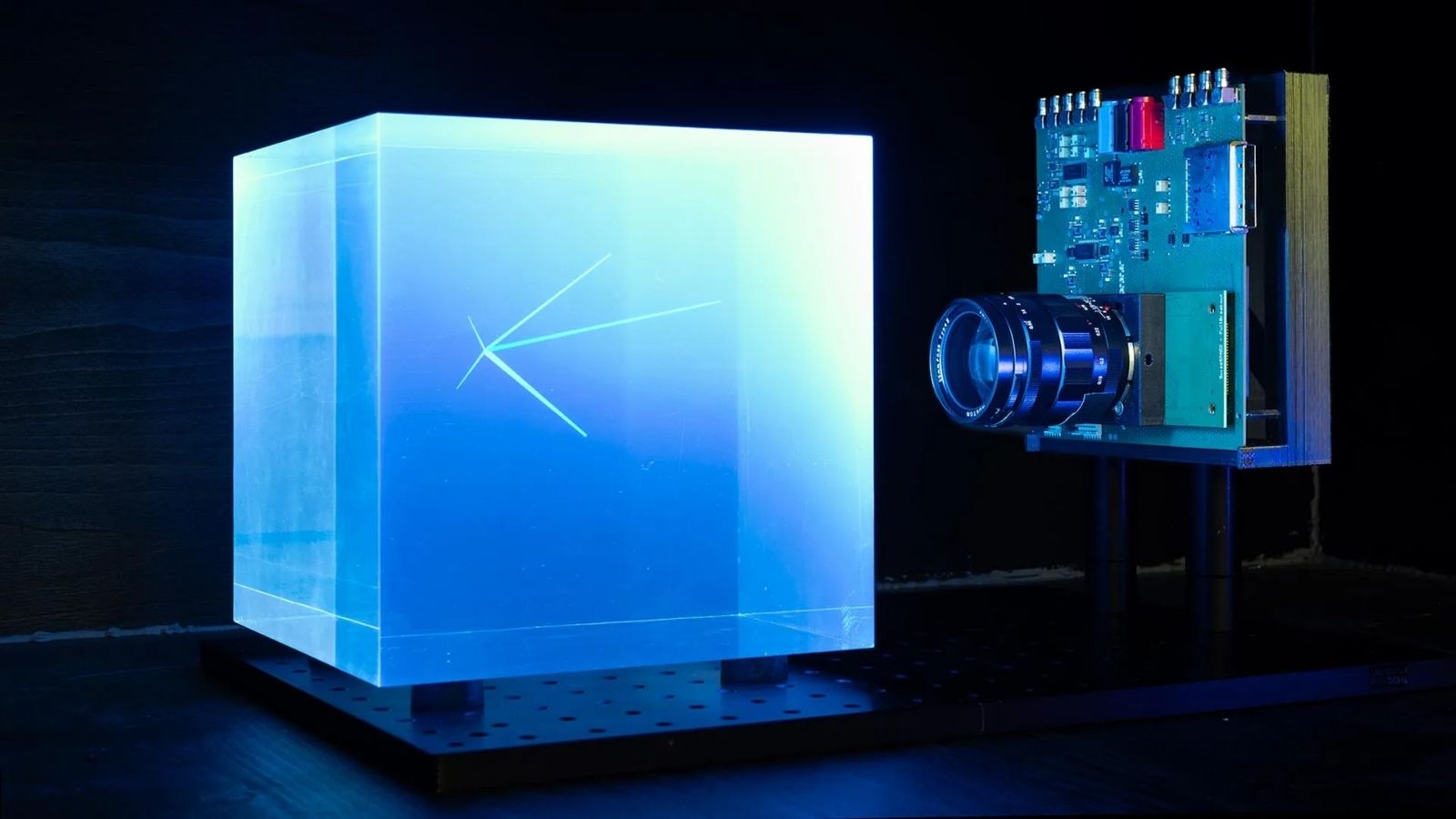
Scientists have created a new way to detect tiny particles using a special camera and AI.
Instead of using millions of small parts, they use a single block of material that glows when particles hit it.
The AI camera then figures out the paths of these particles in 3D.
This could make particle detectors easier to build and possibly better than what we have now.
It might also help improve machines used in hospitals to look inside the body, like PET scanners.

Researchers at ETH Zurich and EPFL developed PLATON, a new particle detection system.
PLATON uses a single block of light-producing material and AI to reconstruct particle paths in 3D.
The technology could match or outperform current particle detectors while being easier to build.
Published in Nature Communications, the findings suggest potential applications in medical imaging.
PLATON replaces millions of tiny detector components with a simpler, scalable design.
- Who
- Researchers at ETH Zurich and EPFL
- What
- Developed a new particle detection system called PLATON
- When
- Recently published in Nature Communications
- Where
- ETH Zurich and EPFL
- Why
- To transform particle detection and potentially improve medical imaging
- Researchers
- ETH Zurich and EPFL
- Technology
- PLATON
- Publication
- Nature Communications
- Potential Applications
- Particle physics, medical imaging (PET scanners)
- Advantage
- Simpler construction, potential for better performance