

Archive · 18 Dec 2025
Ethiopian Skull Reveals Primitive Homo Erectus Traits
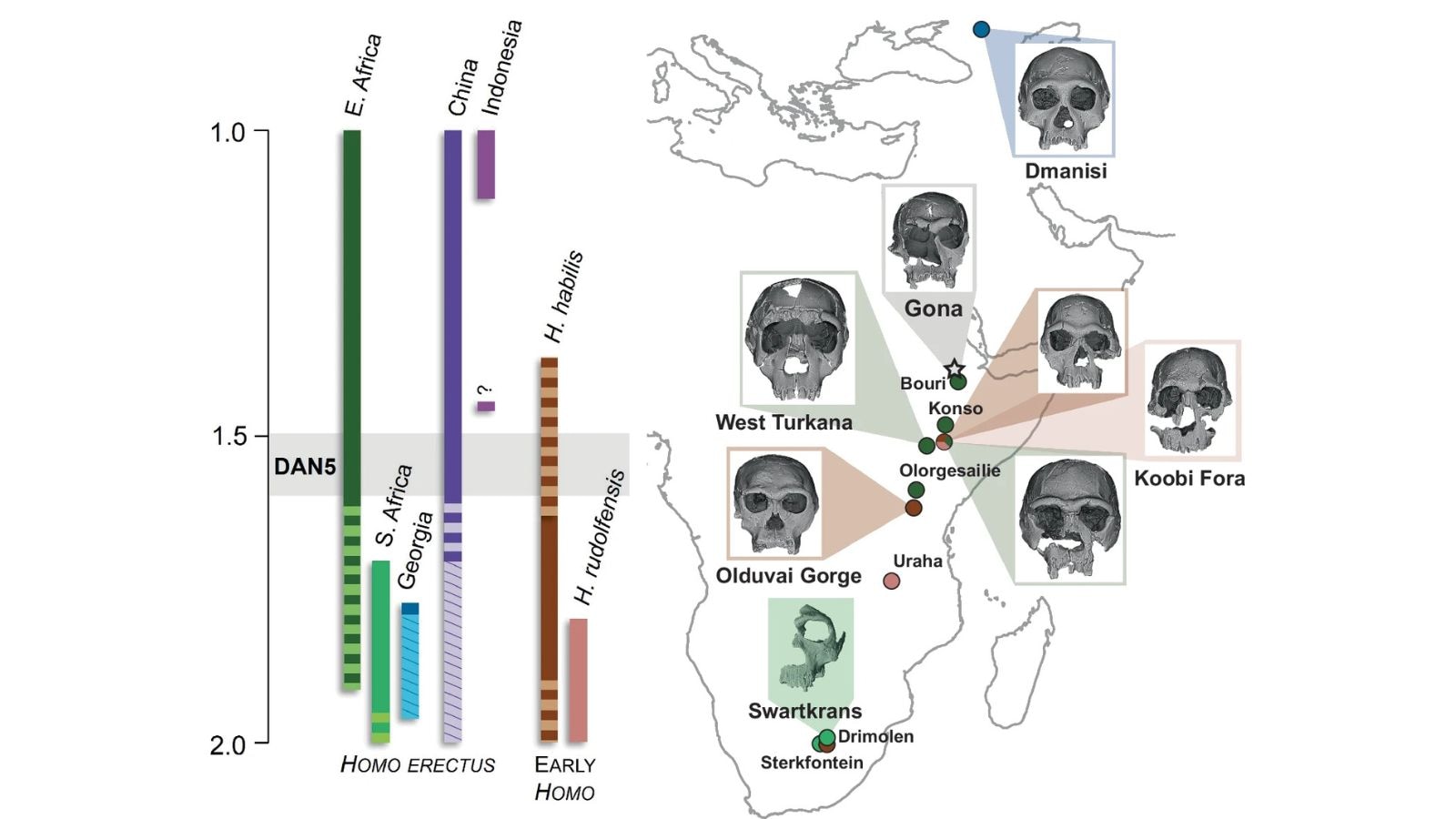
Scientists have reconstructed a very old human-like skull from Ethiopia.
This skull, called DAN5, is about 1.5 to 1.6 million years old and belongs to a species called Homo erectus.
Surprisingly, the face of this skull looks more like older human ancestors, not like other Homo erectus fossils from the same time.
This discovery shows that early humans had a lot of different looks and that some groups kept older features longer than others.
The skull was found in a place called Gona, and scientists used special scans to put it back together like a puzzle.
This helps us learn more about how humans evolved and spread around the world.

A 3D reconstruction of an early Homo erectus skull, DAN5, reveals unexpectedly primitive facial features.
The fossil, found in Ethiopia, dates to 1.5 to 1.6 million years ago and combines a small braincase with an archaic facial structure.
Researchers suggest that the Gona population may have retained ancestral traits, explaining diversity in the fossil record.
DAN5 is the most complete fossil human skull from this era found in the Horn of Africa.
The findings challenge the idea that key evolutionary steps in Homo erectus occurred outside Africa, highlighting anatomical diversity among early humans.
- Who
- Research team led by Dr. Karen Baab
- What
- 3D reconstruction of an early Homo erectus skull
- When
- Fossil dates to 1.5 to 1.6 million years ago; study published December 16
- Where
- Gona, Ethiopia
- Why
- To understand the evolutionary history of Homo erectus
- Fossil Name
- DAN5
- Location
- Gona, Ethiopia
- Age
- 1.5 to 1.6 million years old
- Lead Researcher
- Dr. Karen Baab
- Publication Date
- December 16
- Journal
- Nature Communications
- Key Features
- Small braincase, primitive facial structure, large molars