

Archive · 20 Jan 2026
AI-Powered Wearable Helps Stroke Patients Communicate
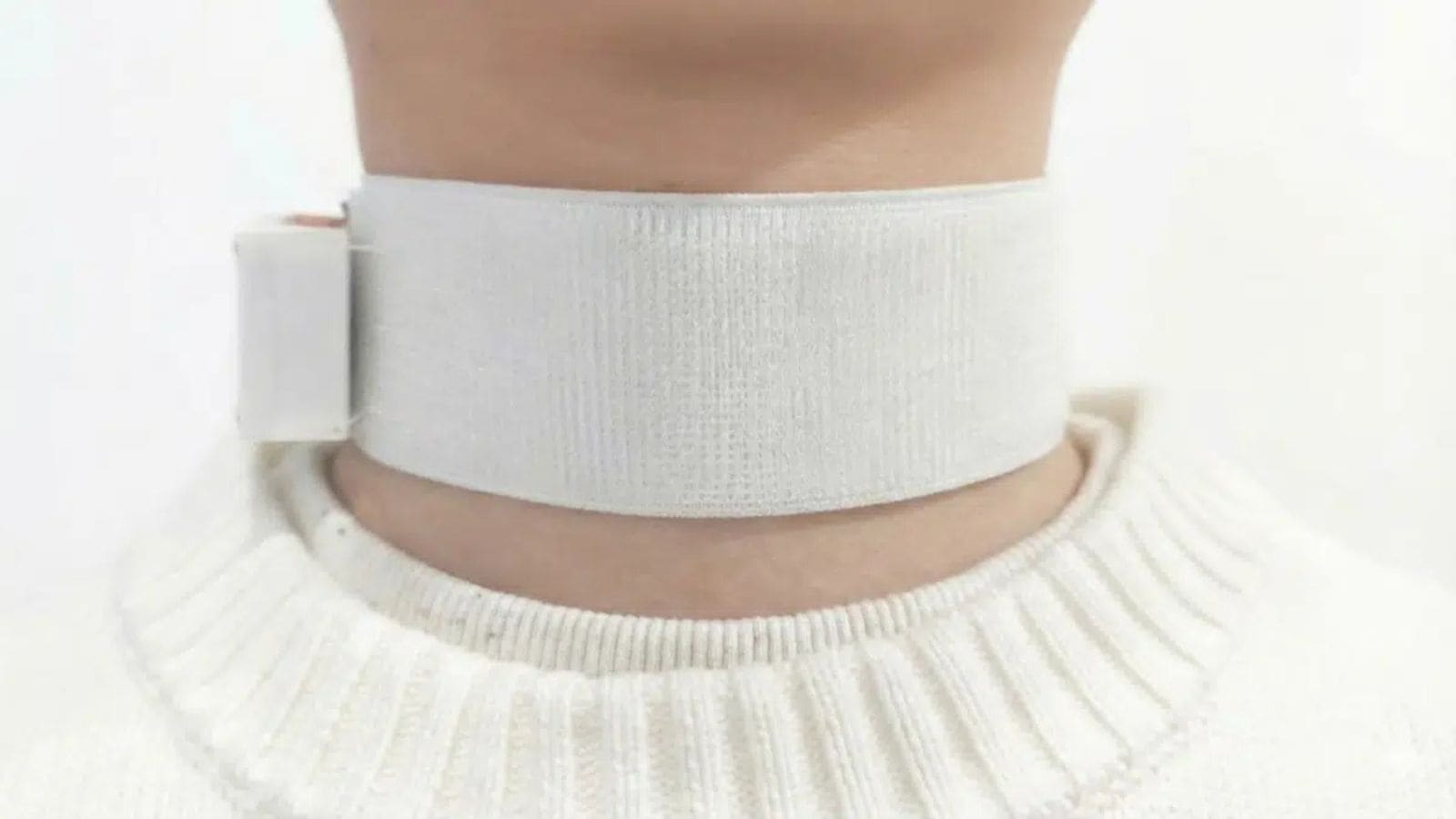
Scientists have created a special necklace called Revoice that helps people who had a stroke and have trouble speaking.
The necklace has tiny sensors that can feel the movements in your throat when you silently mouth words.
It then uses AI to understand what you're trying to say and even guesses how you're feeling.
The device was tested on five people and worked really well, understanding almost all the words and sentences they tried to say.
The researchers hope this can help not just stroke patients, but also people with other conditions like Parkinson's disease.
They're planning more tests to make sure it works well for everyone.

Researchers developed an AI-powered wearable called Revoice to help stroke patients with dysarthria communicate by mouthing words.
The device senses throat vibrations and pulse patterns to decode words and emotional cues with high accuracy.
Tested on five stroke patients, Revoice achieved 95.8% accuracy for words and 97.1% for complete sentences.
The device is non-invasive, wearable all day, and powered by a battery that lasts a full day.
Researchers plan further clinical studies, including a study in Cambridge for native English-speaking dysarthria patients.
- Who
- Researchers from the University of Cambridge and Beihang University
- What
- Developed an AI-powered wearable device called Revoice to help stroke patients with dysarthria communicate by mouthing words
- When
- The research was published in Nature Communications, with ongoing clinical studies planned
- Where
- Developed in collaboration between the UK and China, with testing conducted on stroke patients
- Why
- To provide a non-invasive communication aid for stroke patients with dysarthria, improving their ability to express themselves
- Device Name
- Revoice
- Developers
- University of Cambridge and Beihang University
- Condition Targeted
- Dysarthria (motor-speech disorder)
- Test Accuracy
- 95.8% for words, 97.1% for sentences
- Test Participants
- 5 stroke patients
- Battery Life
- 1 full day
- Research Publication
- Nature Communications