

Archive · 7 Nov 2025
NASA Launches Twin Probes on New Trajectory to Map Mars' Atmosphere
Imagine Mars as a planet that used to have a sky like Earth's, but it lost most of it a long, long time ago.
This means the sun's strong rays can hit the surface easily.
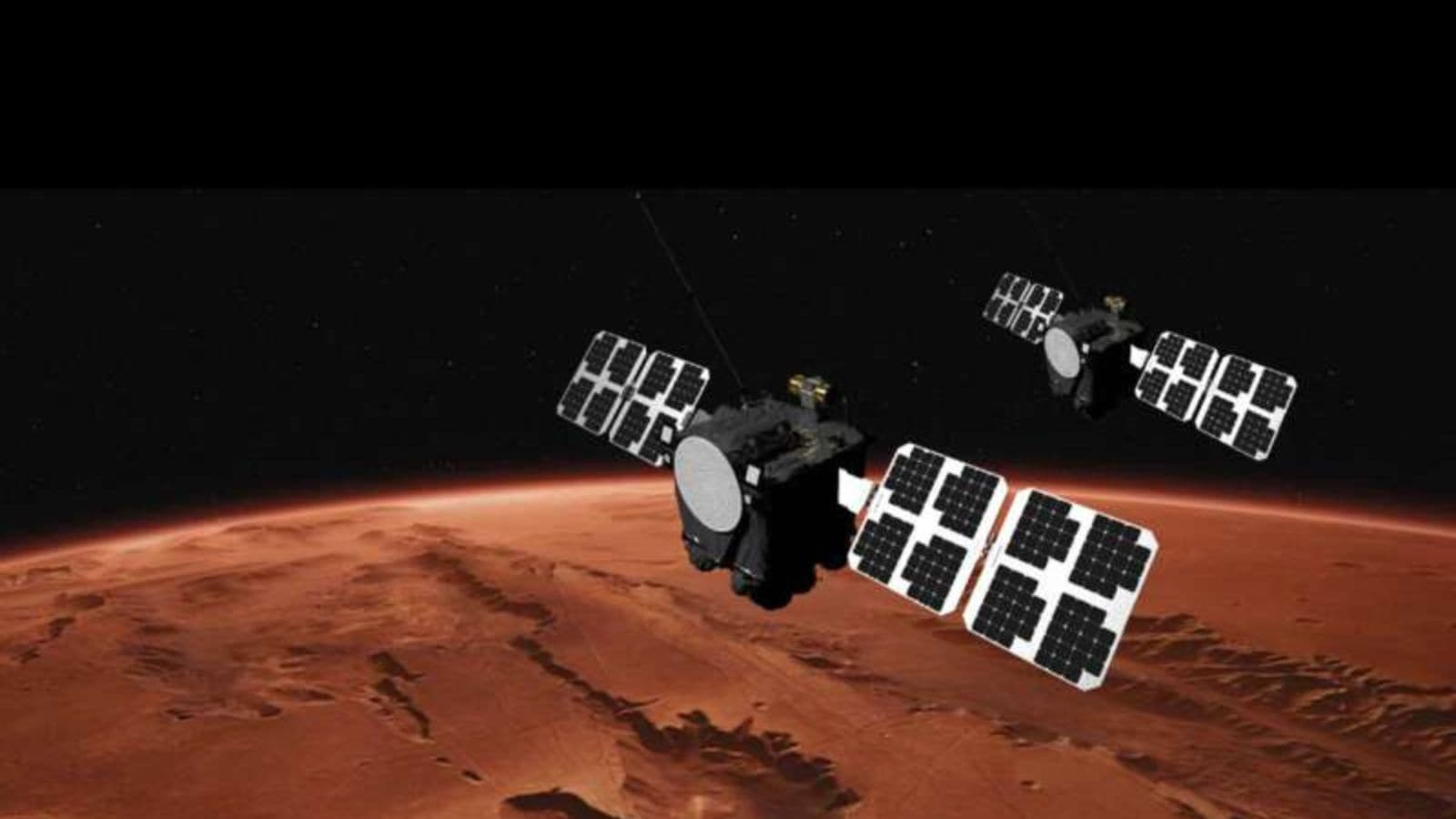
NASA is sending two special explorer robots, named Blue and Gold, to Mars.
They will fly around the planet together but in slightly different paths.
These robots will act like doctors for Mars' sky, taking pictures and measuring things in its thin upper atmosphere and its invisible magnetic shield.
They want to understand how Mars lost its air and how the sun's powerful storms can affect the planet.
This information will help scientists figure out how to protect future astronauts who might visit Mars, just like we need to protect ourselves from the sun here on Earth.

NASA's ESCAPADE mission will launch two identical spacecraft, Blue and Gold, to Mars.
The twin probes will map Mars' upper atmosphere, ionosphere, and magnetic fields in three dimensions.
ESCAPADE will use a new trajectory, involving a Lagrange point and a slingshot maneuver around Earth, taking about 12 months to reach Mars.
Understanding Mars' magnetic fields and ionosphere is crucial for protecting future astronauts from solar radiation and ensuring communication.
The mission aims to understand why Mars lost its atmosphere and how its localized magnetic fields interact with solar wind.
- Who
- NASA (University of California, Berkeley)
- What
- Launching twin spacecraft, ESCAPADE (Blue and Gold), to map Mars' upper atmosphere, ionosphere, and magnetic fields using a new trajectory.
- When
- Launch no earlier than Sunday (November 9); arrival in early 2027.
- Where
- Launching from Cape Canaveral, Florida, to Mars.
- Why
- To understand Mars' lost atmosphere, map localized magnetic fields for future human landings, and forecast solar storms that could harm astronauts.
Traditional Trajectory
ESCAPADE Trajectory
Travel Time
Traditional Trajectory
The Hohmann Transfer typically takes seven to eleven months.
ESCAPADE Trajectory
ESCAPADE's new trajectory takes approximately 12 months to reach Mars.
Launch Window
Traditional Trajectory
The Hohmann Transfer requires relatively limited launch windows, usually only a few weeks every 26 months.
ESCAPADE Trajectory
The new trajectory's launch window requirements are not specified but it utilizes a Lagrange point and Earth slingshot maneuver.
Fuel Efficiency
Traditional Trajectory
The Hohmann Transfer is noted for being fuel-efficient.
ESCAPADE Trajectory
The new trajectory's fuel efficiency compared to Hohmann Transfer is not explicitly stated, but it uses gravitational assistance.
- Mission Name
- Escape and Plasma Acceleration Dynamics Explorers (ESCAPADE)
- Number of Spacecraft
- 2 (Blue and Gold)
- Lead Institution
- University of California, Berkeley
- Launch Location
- Cape Canaveral, Florida
- Scheduled Launch
- No earlier than Sunday (November 9)
- Target Arrival
- Early 2027
- Primary Objective
- Map Mars' upper atmosphere, ionosphere, and magnetic fields in 3D