

Archive · 12 Dec 2025
3I/ATLAS Comet Shows Unusual Chemical Composition
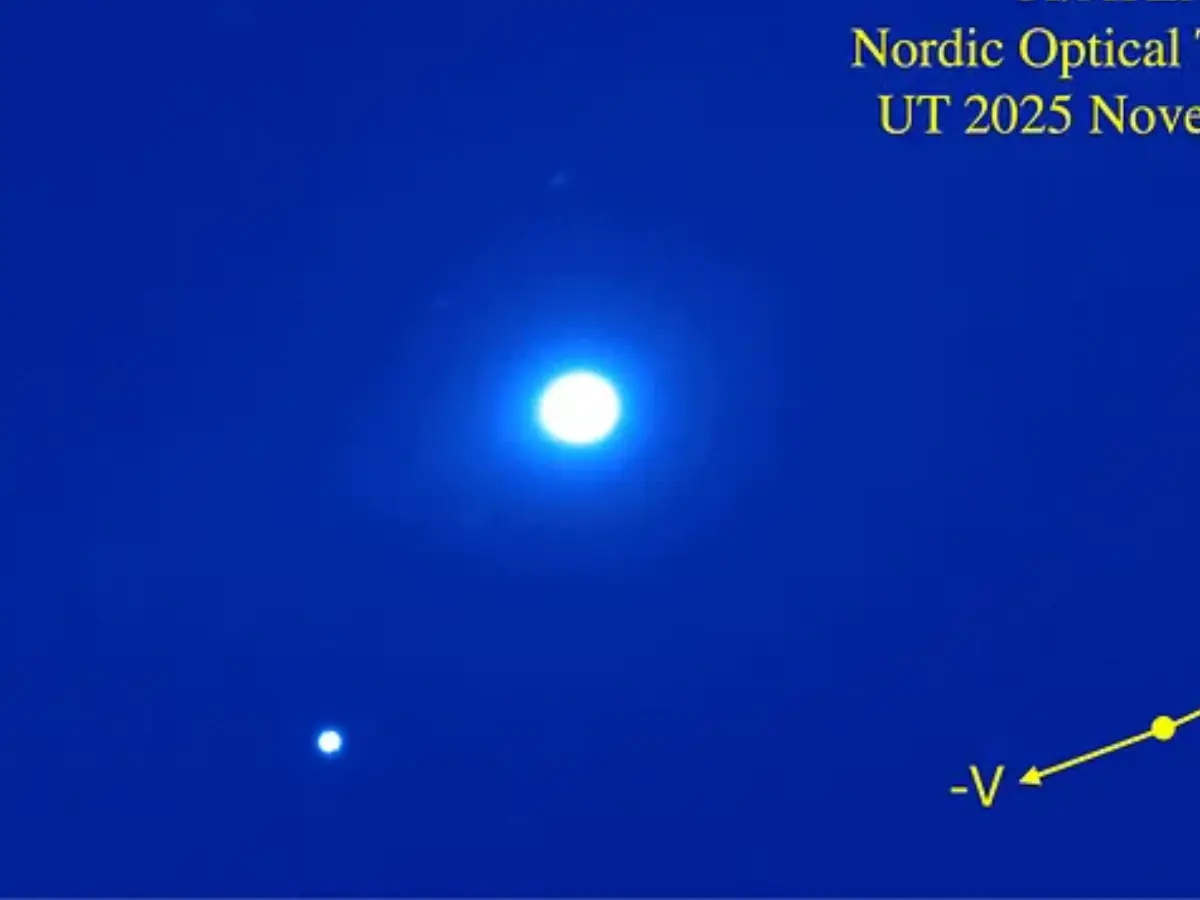
Scientists found a comet named 3I/ATLAS that has a very unusual chemical makeup.
They used a big telescope in Chile to see what the comet is made of.
The comet releases two special chemicals: methanol and hydrogen cyanide.
What's strange is that the comet has a lot more methanol than hydrogen cyanide, which is different from other comets.
The methanol also seems to be coming from more places on the comet, not just the center.
As the comet gets closer to the Sun, the amount of methanol increases quickly.
This makes 3I/ATLAS very special and different from other comets we have seen before.

Scientists discovered 3I/ATLAS comet has an unusual chemical composition with a high methanol to hydrogen cyanide ratio.
Observations were made using the Atacama Compact Array in Chile from late August through October 2025.
Methanol was detected in a wider area of the comet, not just the nucleus, and increased as the comet approached the Sun.
The methanol to hydrogen cyanide ratio in 3I/ATLAS is the highest ever seen in a comet, similar to another anomalous comet C/2016 R2 (PanSTARRS).
The study suggests methanol might be produced in the comet's coma, which is unusual for comets.
- Who
- Scientists using the Atacama Compact Array of ALMA
- What
- Discovered unusual chemical composition in 3I/ATLAS comet
- When
- Late August through October 2025
- Where
- Atacama Compact Array, Chile
- Why
- To study the chemical makeup of the interstellar comet 3I/ATLAS
- Comet Name
- 3I/ATLAS
- Observation Period
- Late August through October 2025
- Observation Location
- Atacama Compact Array, Chile
- Key Chemicals Detected
- Methanol (CH3OH) and Hydrogen Cyanide (HCN)
- Distance from Sun
- 2.6 to 1.7 AU
- Notable Comparison
- C/2016 R2 (PanSTARRS)