

Archive · 27 Jul 2026
NASA's Juno Maps Io's Volcanic Heat
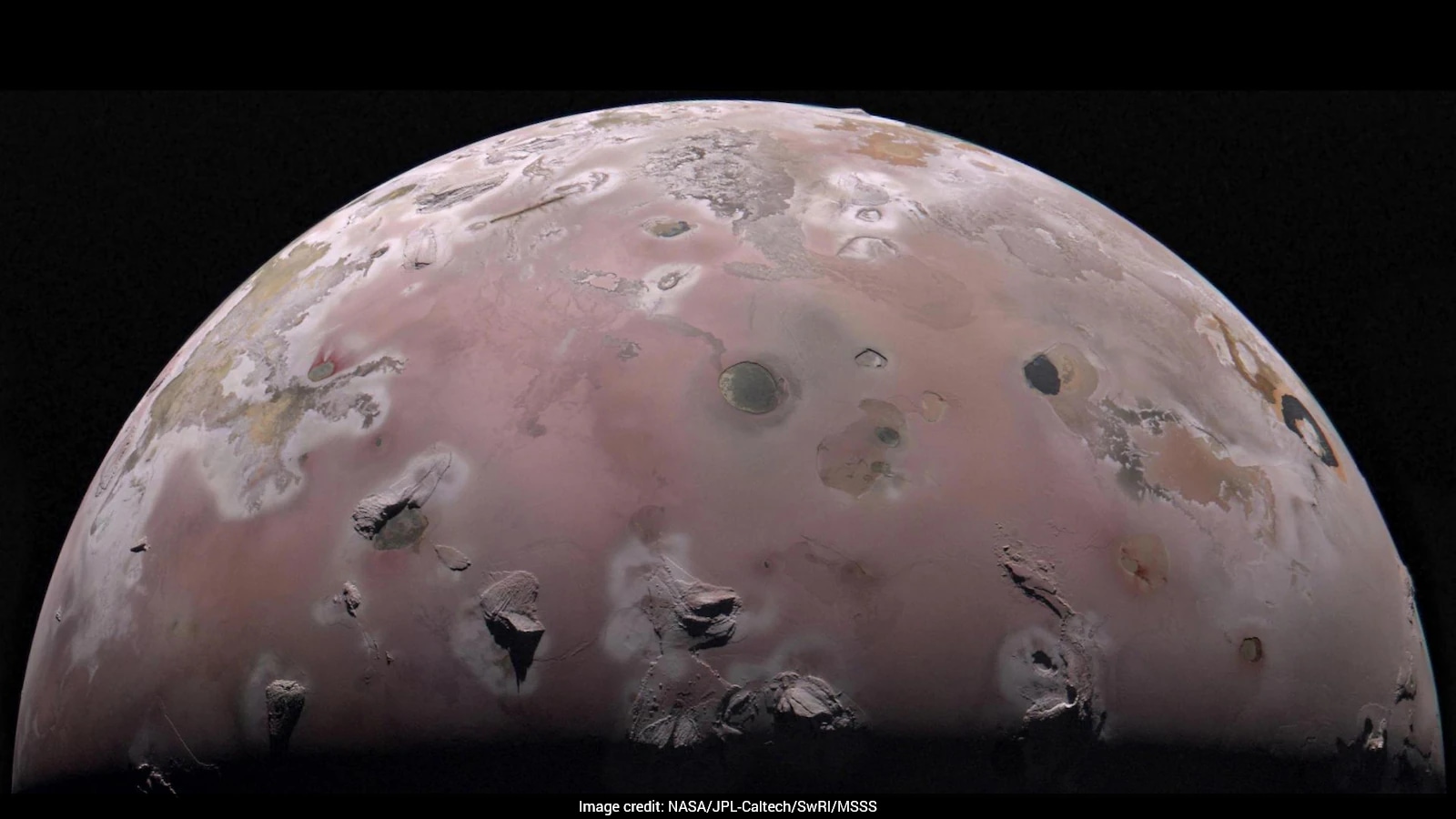
NASA's Juno spacecraft has been studying Jupiter's moon Io, which is the most volcanically active body in our solar system.
Io is caught in a gravitational tug-of-war between Jupiter and its neighboring moons, which causes extreme tidal flexing and generates a lot of heat inside.
This heat turns Io's interior into a churning cauldron of magma that feeds hundreds of active volcanoes.
Juno's special instrument, called JIRAM, captured thermal images of Io, showing the heat emitted from lava lakes, fissure eruptions, and massive volcanic calderas.
The data allowed scientists to see several meters below the surface, revealing a significant temperature increase.
Io's surface is smooth when viewed at long microwave wavelengths, and the upper layer has a low density, similar to volcanic ash or pumice.
The observations show that heat is rising steadily through Io's crust or escaping through scattered patches of thin crust above lava or hot vents.
This study helps us understand how tidal heating works throughout the cosmos and how it can create volcanic activity and fuel subsurface oceans on moons far from their parent star.

NASA's Juno spacecraft has mapped the heat of Jupiter's volcanic moon Io.
Io is the most volcanically active body in the solar system, with hundreds of active volcanoes.
Io's extreme tidal flexing generates immense internal friction and heat, turning its interior into a churning cauldron of magma.
Juno's JIRAM instrument captured thermal images of Io, revealing a significant temperature increase below the surface.
The observations show that Io's surface is smooth and has a low density, similar to volcanic ash or pumice.
- Who
- NASA's Juno spacecraft and scientists
- What
- Mapped the heat of Jupiter's volcanic moon Io
- When
- Recent flybys, findings published Wednesday
- Where
- Jupiter's moon Io
- Why
- To understand Io's internal heat engine and volcanic activity, and to advance space exploration technologies.
Scientific Discovery
Technological Advancement
Purpose of the Study
Scientific Discovery
To understand Io's internal heat engine and volcanic activity.
Technological Advancement
To advance the capabilities of space exploration and remote sensing technologies.
- Spacecraft
- Juno
- Moon
- Io
- Instrument
- Jovian Infrared Auroral Mapper (JIRAM)
- Journal
- Journal of Geophysical Research: Planets
- Temperature Increase
- Greater than 20 degrees C
- Surface Coverage
- About 10% of the surface