

Archive · 19 May 2025
Twinkling Star Reveals Secrets of Plasma in Our Galaxy
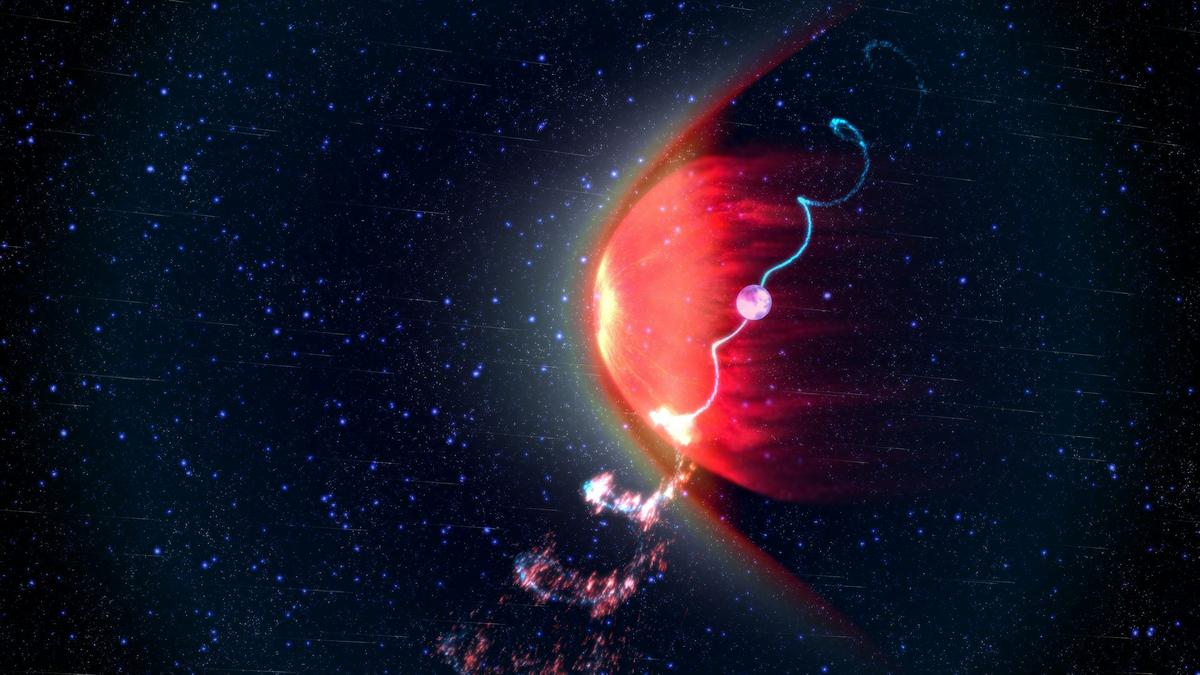
Scientists studied a twinkling star using a powerful radio telescope.
They found lots of plasma structures in space, like giant space cyclones.
They also looked inside a shock wave around a spinning star called a pulsar.
The star is 512 light-years away.
This research showed that the area around our solar system isn't empty, but filled with these structures.
The scientists even found that some plasma is moving in unexpected ways, which could change how scientists understand shock waves.
The findings were made possible because of a nearby pulsar and a sensitive telescope, and future telescopes could reveal even more.

Scientists used a radio telescope to study a twinkling star and discover plasma structures.
The study observed a pulsar 512 light-years away and its surrounding shock wave.
Researchers found 25 scintillation arcs, revealing numerous plasma structures in the Local Bubble.
The study mapped plasma layers inside a pulsar's shock wave for the first time.
Unexpected plasma movement within the shock wave challenges existing models.
- Who
- Scientists using the MeerKAT radio telescope in South Africa.
- What
- Scientists observed a twinkling star and found unexpected plasma structures, including those within a pulsar's shock wave.
- When
- Published May 13, 2025
- Where
- Near a pulsar 512 light-years from Earth, within our galaxy's Local Bubble.
- Why
- To understand the structure and behavior of plasma in interstellar space and around a pulsar's shock wave.
Current Models
New Findings
Plasma Flow
Current Models
Current models for shock waves do not account for plasma moving against the expected flow of shocked material.
New Findings
The study showed inner plasma structure moving towards the shock front, which is unexpected and will lead to new models.
- Pulsar Distance
- 512 light-years
- Telescope Used
- MeerKAT radio telescope
- Number of Scintillation Arcs Found
- 25
- Location
- Local Bubble
- Local Bubble Temp
- 10,000 degrees Celsius
- Bubble Formation
- 14 million years ago