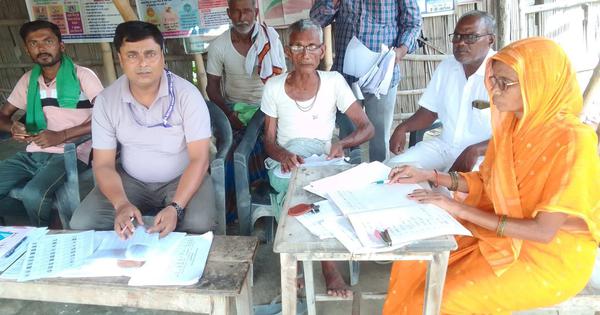
Archive · 25 Jul 2025
EC Revises Bihar Voter Rolls, Adjusts Document Requirements

Imagine the government is checking who is allowed to vote in a place called Bihar.
They started by asking everyone to prove they're citizens with documents.
But they changed their minds and said people could provide the documents later.
They say they're doing this to make sure the voting list is accurate, removing people who shouldn't be there and adding those who should.
Now, people have a chance to add their names, or fix any problems with the list, but they have until September 1, 2025 to provide documentation.
Some people are worried the changes could make it harder for some people to vote.

The Election Commission (EC) initiated a special intensive revision (SIR) of Bihar's voter list.
The EC faced criticism and a court challenge regarding the rationale and timing of the revision.
The EC initially required voters to produce documents proving citizenship, but later adjusted the process.
The EC cited multiple reasons for the revision, including concerns about the accuracy of electoral rolls.
The claims and objections period for voter inclusion or exclusion is scheduled from August 1 to September 1, 2025.
- Who
- The Election Commission of India
- What
- A special intensive revision of Bihar's voter list.
- When
- The period for filing claims and objections is from August 1 to September 1, 2025.
- Where
- Bihar
- Why
- To maintain the integrity of the voter list and address concerns about accuracy.
Critics of Revision
Election Commission
Disenfranchisement concerns vs. integrity of voter list
Critics of Revision
The exercise risks disenfranchising millions of voters.
Election Commission
The Commission cited the need for a fresh electoral roll to eliminate names of “dead/shifted/absentee voters” and include “young citizens”.
- Revision Type
- Special Intensive Revision (SIR)
- Location
- Bihar
- Claims and Objections Period
- August 1 - September 1, 2025
- Documents Required
- Varies; initially required but later postponed
- Voters without Home Presence (Phase 1)
- 6.62% of the electorate