

Archive · 22 May 2025
US and Japan Race to Solve Universe's Existence Mystery
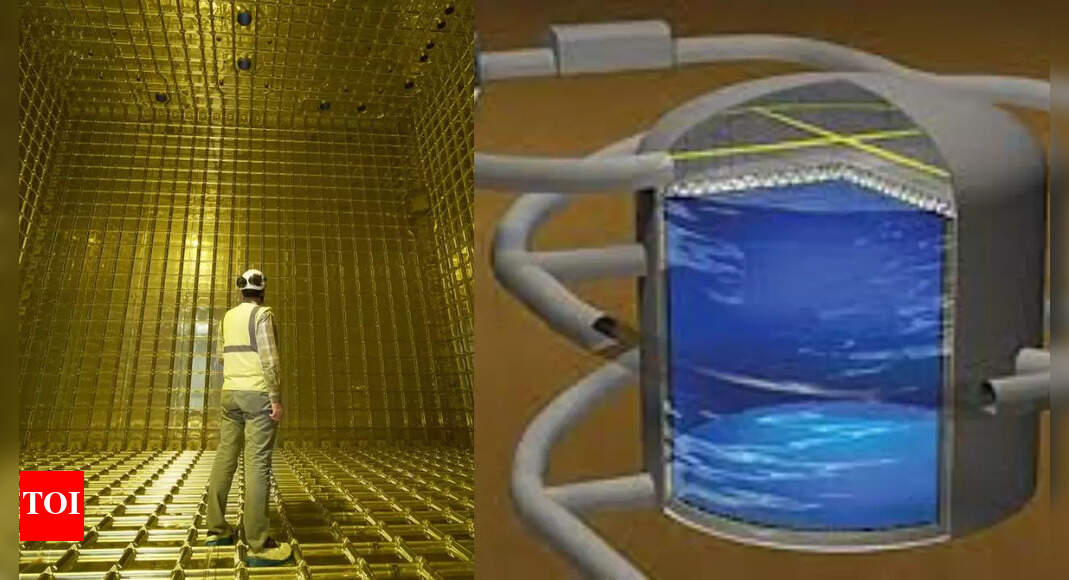
Imagine the universe started with equal amounts of stuff and anti-stuff, which should have canceled each other out.
But they didn't!
Scientists in the US and Japan are trying to figure out why there's still stuff like us.
They're building huge detectors deep underground to study tiny particles called neutrinos.
These particles might hold the key to understanding why our universe exists, as they might explain how matter survived.
Both teams are racing, with the Japanese experiment expected to start sooner, but both experiments are very important.

Scientists in the US and Japan are working to understand the origin of the universe.
They are studying neutrinos, elusive subatomic particles, for clues.
The US is building the Deep Underground Neutrino Experiment (DUNE) in South Dakota.
Japan is constructing Hyper-Kamiokande, a next-generation neutrino detector.
Both projects aim to uncover why matter survived over antimatter.
- Who
- Scientists from the US and Japan, along with international collaborations.
- What
- Scientists are studying neutrinos and antineutrinos to understand the imbalance between matter and antimatter after the Big Bang.
- When
- Experiments are in progress, with results expected in several years.
- Where
- South Dakota, USA and Japan
- Why
- To understand why matter exists and the origin of the universe.
- Location of Experiments
- South Dakota, USA and Japan
- DUNE Collaboration
- Over 1,400 scientists from 30-35 countries
- Focus of Study
- Detecting neutrinos and antineutrinos
- Distance of Neutrino Beam
- 800 miles
- Hyper-Kamiokande Timeline
- Under three years