

Archive · 3 Nov 2025
AI Researchers Debate AI's Role and Limitations at First-of-Its-Kind Conference
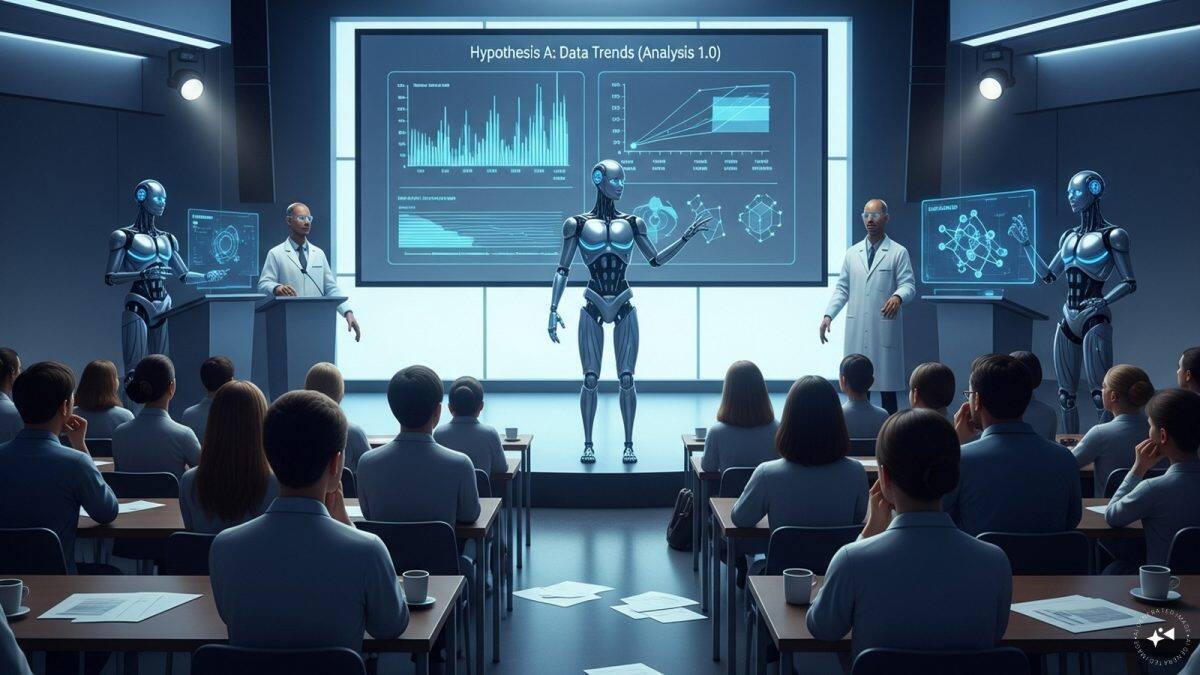
Imagine a science conference where robots wrote all the research papers!
That's kind of what happened at a new event called Agents4Science 2025.
Scientists let AI, like ChatGPT and Gemini, do the work of leading research and writing up findings.
Some AI helped brainstorm and analyze data, which is pretty cool!
But, the human scientists still had to fix things.
The AI sometimes made up information, like fake references, and didn't always understand the big picture.
One expert felt the AI's research was correct but not very exciting or important.
Another worried people might trust AI too much because it sounds so sure of itself.
Even though AI is getting better, humans are still needed to guide it and make sure the science is actually good and accurate.
The experts think AI could be a great helper, like a super-smart intern, but humans need to stay in charge.

A conference called Agents4Science 2025 featured AI systems as lead authors on all accepted research papers.
AI demonstrated capabilities in tasks like simulating marketplaces and analyzing policy data, but struggled with context and accuracy.
Human experts raised concerns about AI's scientific judgment, noting its research can be uninspired and lack depth.
Persistent issues include AI's tendency to hallucinate references and its confident tone which could lead to uncritical acceptance of results.
Experts believe AI can be a valuable research collaborator or intern, but human oversight is crucial for accuracy, accountability, and defining meaningful research.
- Who
- AI researchers and human experts
- What
- Debated the capabilities and limitations of AI in scientific research, with AI systems listed as lead authors on accepted papers.
- When
- At the Agents4Science 2025 online conference
- Where
- Globally (online conference)
- Why
- To showcase AI-led scientific research and discuss its growing role, strengths, and persistent flaws as a scientific collaborator.
AI as a Scientific Collaborator
AI's Current Limitations
AI's Capability in Research
AI as a Scientific Collaborator
AI is evolving into a 'co-scientist' capable of generating ideas, designing experiments, and analyzing data, accelerating research.
AI's Current Limitations
AI struggles with context, produces redundant text, fabricates references (hallucinates), and its research can be technically correct but uninspired or nonsensical.
AI's Role and Authorship
AI as a Scientific Collaborator
The conference was created to showcase AI-led research and explore its potential role as a formal contributor, challenging current authorship restrictions.
AI's Current Limitations
Human experts emphasize that accountability for accuracy and originality must remain with humans, and AI should be treated as a collaborator, not an author, due to its current flaws.
Impact on Scientific Progress
AI as a Scientific Collaborator
AI can significantly speed up the research process and handle complex data analysis efficiently.
AI's Current Limitations
AI's confident tone might lead to uncritical trust in results, and its agreeable communication style could suppress vital scientific disagreements and critical thinking.
- Conference Name
- Agents4Science 2025
- Number of Submissions
- Over 300
- Number of Accepted Papers
- 47
- AI Authorship Status
- AI systems listed as sole first authors
- Key Concerns
- Reasoning, accuracy, judgment, hallucinated references