1 day ago
Surrogate Advertising Debate Highlights Celebrity and Government Policy Dilemma
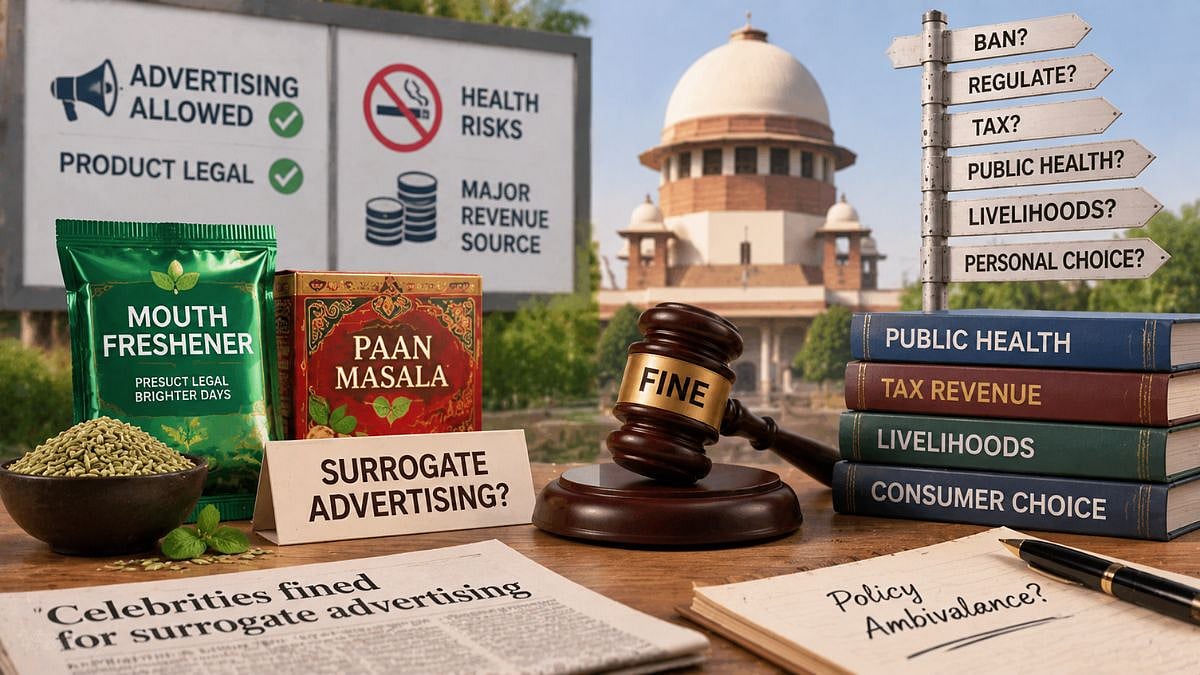
Some celebrities advertised a mouth freshener that critics say represents paan masala, a tobacco-related product.
The celebrities were fined, even though the product was allowed to be sold and the advertisement was approved.
The article says this seems unfair because the company and advertising agency were not blamed.
Tobacco and alcohol can harm people, but they also provide governments with large amounts of tax money and support many jobs.
Banning them could affect farmers, workers and other businesses.
Raising taxes may not stop people who are addicted from buying them.
Governments also want to reduce illnesses linked to unhealthy products.
This has led to discussions about warning labels and restrictions on junk food.
The main question is how to protect public health without treating celebrities differently or taking away too much consumer choice.

A recent fine on celebrities endorsing a mouth freshener renewed debate over surrogate tobacco advertising.
The article argues that the product and advertisement were permitted, while the celebrity alone faced punishment.
Tobacco and alcohol generate substantial government revenue, making outright bans difficult despite health risks.
The government faces a dilemma between limiting harmful consumption and protecting jobs, livelihoods and tax income.
The debate has expanded to junk food, warning labels and how far governments should interfere with consumer choices.
- Who
- Celebrities, product and advertising companies, consumers, workers and governments are involved.
- What
- A fine imposed on celebrities for endorsing a surrogate tobacco product has triggered debate over advertising rules and public-health policy.
- Where
- The discussion focuses on India.
- When
- The controversy is recent; the article does not provide a specific date.
- Why
- The dispute reflects tension between public-health concerns, government revenue, employment and consumer choice.
Stronger Public-Health Regulation
Policy Consistency and Consumer Choice
Celebrity accountability
Stronger Public-Health Regulation
Celebrities who promote products linked to tobacco should face consequences because endorsements can encourage consumption of harmful goods.
Policy Consistency and Consumer Choice
If the product is legal and the advertisement is approved, punishing only the celebrity appears inconsistent; the company and advertising agency should also be considered.
Bans versus taxation
Stronger Public-Health Regulation
Products that damage health should either be banned or have their advertising prohibited, while taxes and warnings can discourage consumption.
Policy Consistency and Consumer Choice
Governments rely heavily on tobacco and liquor revenue and related employment, while higher taxes may have limited effect on addiction and affluent consumers.
Junk-food controls
Stronger Public-Health Regulation
Warning labels and restrictions can help protect children and reduce illnesses such as hypertension, diabetes and obesity.
Policy Consistency and Consumer Choice
Extending restrictions from tobacco and alcohol to ordinary foods could interfere excessively with personal choice and create a 'nanny state.'
Key facts
- Product at issue
- A mouth freshener described as a surrogate for paan masala.
- Consumer Price Index share
- Paan masala and related products have a 1.2% weight in the consumer price index.
- Tobacco tax revenue
- The article estimates tobacco-related government earnings at approximately Rs 80,000-100,000 crore.
- Liquor tax revenue
- Liquor revenue is estimated at about 10-15% of states’ own tax revenue, or roughly Rs 2.5-3 lakh crore.
- Tobacco employment
- About 6 million farmers and a similar number of farm labourers are linked to tobacco cultivation.
- Liquor employment
- Around 2.5 million people are directly employed in liquor, with another 5-5.5 million potentially involved across its wider value chain.
- Broader debate
- The article discusses possible controls and warning labels for junk food, including products high in sugar, salt and oil.
Sources
Related news

SRK, Ajay Devgn Face Notices Over Surrogate Advertising

Maharashtra FDA Says Actors Responsible, Awaits Responses Over Surrogate Advertisement

Tukaram Mundhe Crackdown Makes Celebrities Wary of Junk Food Ads

Maharashtra FDA Calls Vimal Ad Actors Law Violators

Vimal Elaichi Makers Challenge Maharashtra FDA Notices To Three Actors
Uttar Pradesh Seeks Faster Loans for Rooftop Solar Installations

Book Explores Hidden Forces Behind How Indians Consume

PSU Car Loan Rates Start at 7.35% in September 2026

Government Denies Fake Viral Notification Claiming Public Sector Bank Mergers