

1 week ago
Five Migrants Redirected to Equatorial Guinea After Liberia Resistance

The United States tried to send 20 migrants to Liberia.
Five of them reportedly refused to get off the airplane when it arrived.
They were told they would return to the United States, but the plane instead flew to Equatorial Guinea.
The five migrants were then made to leave the plane there.
They are now being held with more than 30 other migrants.
Human rights groups say the detention site has poor medical care and causes serious psychological distress.
U.S. officials say the migrants were sent to a safe third country after judges found they had no right to remain in the United States.
Rights advocates say these agreements move people around without giving them adequate legal protection.

Five migrants reportedly refused to leave a U.S. deportation flight after it arrived in Liberia.
The group included three Cuban men, one Brazilian man and one Cameroonian woman.
Authorities reportedly sent them onward to Malabo, Equatorial Guinea, where they were forced to disembark.
Liberia received 15 of the 20 deportees it had expected, according to a Liberian official.
Sources say about 40 deportees are now detained at a decommissioned hotel in Malabo amid rights concerns.
- Who
- Five migrants, including three Cubans, one Brazilian and one Cameroonian, were sent to Equatorial Guinea after resisting deportation to Liberia.
- What
- They reportedly refused to disembark in Liberia and were instead transported to Malabo, where they were forced to leave the plane.
- Where
- The flight traveled from Louisiana through Dakar, Senegal, to Monrovia, Liberia, and then Malabo, Equatorial Guinea.
- When
- The incident occurred this week; the flight arrived in Liberia on Thursday and reached Malabo later that day.
- Why
- The United States is using third-country deportation agreements to remove migrants who cannot legally be returned to their home countries.
U.S. officials
Rights advocates and detainees
Legality of removals
U.S. officials
The Department of Homeland Security said migrants found by a judge to have no right to remain in the United States would be removed, and described the destination as a safe third country.
Rights advocates and detainees
The report says many third-country deportees obtained legal protection against repatriation because immigration judges found they faced possible torture or other abuses at home.
Use of African agreements
U.S. officials
The State Department said it remained committed to ending illegal and mass immigration and strengthening U.S. border security.
Rights advocates and detainees
Human rights groups and advocates denounced the agreements, saying they can result in people being moved between countries and ultimately repatriated.
Treatment in Equatorial Guinea
U.S. officials
U.S. authorities characterized the migrants’ destination as safe.
Rights advocates and detainees
Rights groups reported grim conditions at the Malabo detention site, including inadequate medical care, psychological distress and lack of legal assistance.
Key facts
- Expected arrivals in Liberia
- Liberia announced that the first group would include 20 deportees.
- People who disembarked
- A Liberian official said 15 deportees left the plane in Monrovia.
- People redirected
- Five migrants reportedly refused to disembark and were taken to Equatorial Guinea.
- Nationalities of redirected migrants
- Three Cuban men, one Brazilian man and one Cameroonian woman.
- Current detention population
- Sources said approximately 40 deportees are being held in Malabo.
- Detention location
- A decommissioned hotel in Malabo, Equatorial Guinea.
- Reported conditions
- Rights groups cited inadequate medical care, severe psychological distress and denial of legal assistance.
Quotes
Department of Homeland Security spokesperson
Spokesperson for the U.S. Department of Homeland Security
“If a judge finds an illegal alien has no right to be in this country, we are going to remove them. Period.”
 theprint.in
Meredyth Yoon
Litigation director for Asian Americans Advancing Justice-Atlanta
“The Trump Administration is using these deportation agreements to shuffle people around to different countries like objects.”
theprint.in
Sources
Related news
Liberia Agrees to Accept Up to 1,200 US Deportees
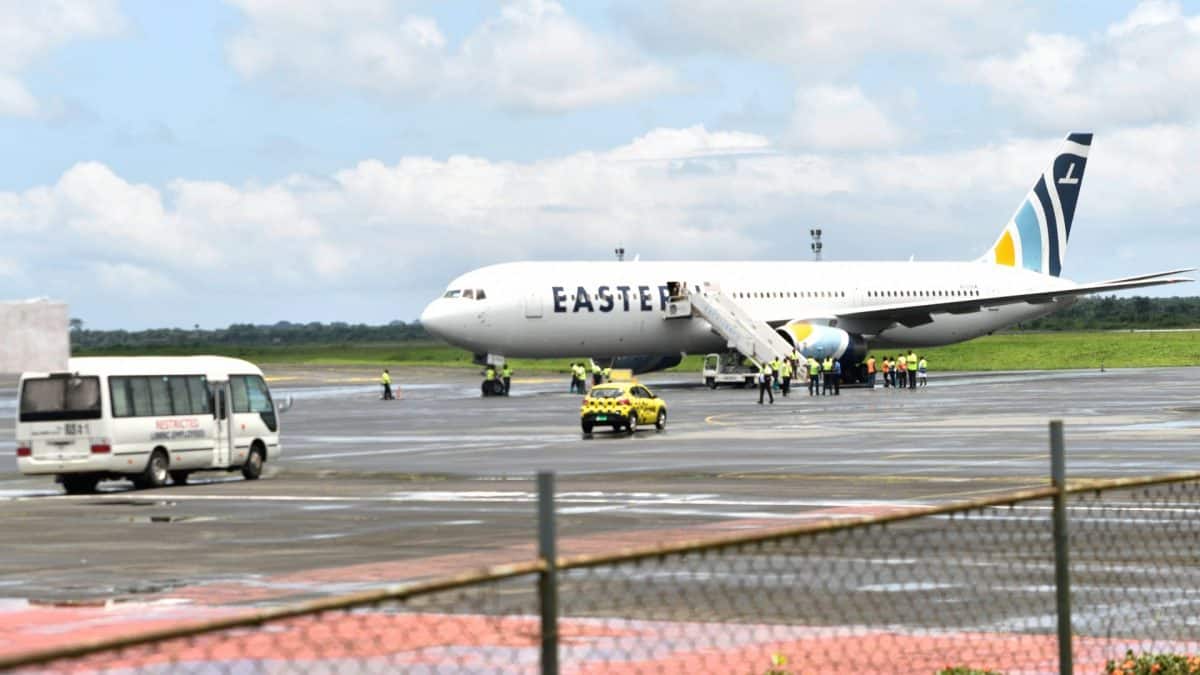
US Sends First 20 Deportees to Liberia Under Controversial Agreement
Guatemala Says 2,300 Mexicans Transited After U.S. Deportations
Eswatini Receives Two More Deportees From United States

Iranian Migrant Deported to Unfamiliar Country Fears for Safety
UN experts urge Thailand against extradition of journalist Bai Zhaodong

Eric Trump Showcases New Patriot Passport Bearing Trump’s Image
US Warns Middle East Travelers Amid Escalating Iran-Linked Tensions

Family Seeks US Intervention Over VanDyke Detention in Delhi

India and World Bank Discuss Deeper Capital Cooperation

Trump Administration Proposes Parental Status Proof for Children’s Passports
