

Archive · 9 Nov 2025
Gibbon Genome Decoded, Revealing Insights into Human Evolution and Adaptation
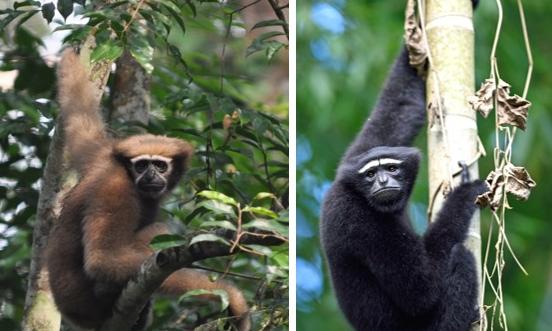
Scientists have read the complete instruction manual, called a genome, for gibbons, a type of ape.
They found that gibbons' instruction manual is much more jumbled up than ours.
This jumbling, caused by a special element in their genes, helps them change and adapt quickly to different forest homes.
These changes might be similar to how we changed over time and can even help us understand some human health problems.
Scientists also figured out why gibbons have super long arms – a tiny change in their instruction manual affects how their limbs grow.
This helps them swing through trees really fast!
They also learned that an ancient, extinct gibbon is actually a type of modern gibbon.
By studying gibbons, we learn more about how all apes, including us, came to be.

Researchers have decoded the gibbon genome, revealing a highly dynamic and rearranged genetic structure.
Frequent chromosomal changes in gibbons may have accelerated their evolution and adaptation to diverse forest environments.
A specific deletion in the SHH gene has been identified as the cause of gibbons' unusually long limbs.
Gene families related to vocalisation, limb development, and brain function show significant differences compared to humans.
The study helps resolve gibbon phylogeny and offers insights into primate divergence and human genetic disorders.
- Who
- An international research team including scientists from CSIR-CCMB
- What
- Decoded the gibbon genome, revealing significant chromosomal rearrangements and gene differences compared to humans, shedding light on evolution and adaptation.
- When
- The study was published in 'Cell'.
- Where
- Gibbons are found in the forests of northeast India, Bangladesh, southeast Asia, and Indonesia. Research involved CCMB in Hyderabad.
- Why
- To understand primate evolution, gibbon adaptation, and potential implications for human genetic disorders.
Implications for Human Evolution
Gibbon Specific Adaptations
Chromosomal Rearrangements
Implications for Human Evolution
Frequent chromosomal changes in gibbons provide a model for understanding primate divergence and human genetic disorders related to chromosomal rearrangements.
Gibbon Specific Adaptations
These genomic changes, potentially accelerated by a unique genetic element, may have helped gibbons adapt to diverse forest environments and explain their rapid evolution.
Limb Elongation
Implications for Human Evolution
The identification of a specific deletion in the SHH gene provides a definitive explanation for the unusually long limbs of gibbons compared to other primates.
Gibbon Specific Adaptations
These long limbs are a key adaptation for gibbons' brachiating, tree-dwelling lifestyle, allowing them to swing between branches efficiently.
- Species Studied
- Gibbon
- Key Finding 1
- Highly rearranged and dynamic genome structure compared to humans and other great apes.
- Key Finding 2
- Identified a 205-base-pair deletion in the SHH gene linked to elongated limbs.
- Key Finding 3
- Gene families related to vocalisation, limb development, and brain function show significant differences.
- Publication
- Cell
- Research Institution (India)
- CSIR-Centre for Cellular and Molecular Biology (CCMB)
- Extinct Gibbon Reclassification
- Junzi imperialis reclassified as belonging to the genus Nomascus.