

Archive · 11 Nov 2025
Ladakh Protests Highlight Concerns Over Development and Cultural Identity
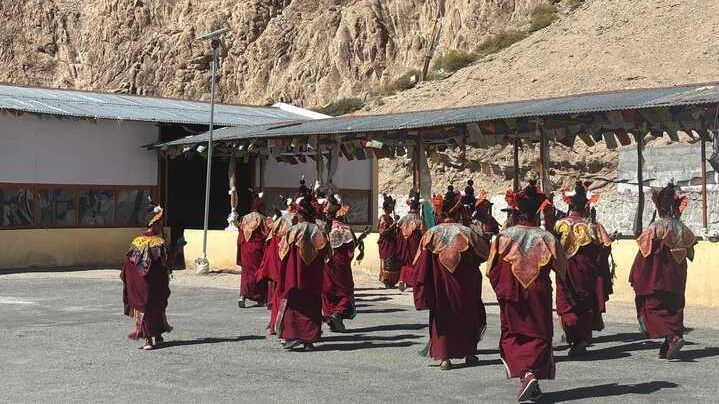
Imagine a place called Ladakh, which has unique traditions and a special way of life.
The government wants to build big projects there, like solar farms and mines.
Some people in Ladakh worry that these projects will bring many people from other places to live there.
They are afraid this will change their community and make their own culture and traditions less important.
They also worry about losing their special protections under a part of the Constitution called the Sixth Schedule.
This is why some people protested, and sadly, some people were hurt or even died.
The article also talks about how other languages and cultures in India are facing similar challenges as the government promotes a more uniform approach.
The author believes that allowing different regions to keep their unique identities is key to India's strength, like a colorful mosaic rather than a single block.

Development projects in Ladakh's Changthang region raise concerns about demographic changes and the dilution of local identity and demands for Sixth Schedule protection.
A fact-finding mission highlighted fears of corporate intrusion and socio-cultural imbalance due to development plans and the creation of new districts in Ladakh.
Recent protests in Ladakh resulted in fatalities and injuries among protesters and security personnel, underscoring the intensity of local grievances.
The article argues that the BJP's pursuit of uniformity threatens the diverse cultural fabric of India, citing endangered regional languages and customs.
Federalism is presented as crucial for accommodating national unity with regional diversity, safeguarding unique identities against coercive conformity.
- Who
- Local people of Ladakh, fact-finding mission (Socialist Party (India), National Alliance of People’s Movements, Hum Bharat Ke Log), protesters, security personnel, BJP government.
- What
- Protests and concerns over proposed development projects and government policies perceived as threatening regional identity, culture, and the federal structure of India.
- When
- Recently (referring to the violence where protesters were killed and injured), and ongoing concerns.
- Where
- Ladakh, India.
- Why
- Fear that development projects will alter demographics, dilute local identities, and undermine demands for constitutional protection (Sixth Schedule), as well as concerns about a national push for uniformity in culture and language potentially harming regional diversity.
Concerns Over Central Government's Development Plans
Government's Rationale and Broader Context
Impact of Development Projects on Demographics and Identity
Concerns Over Central Government's Development Plans
The Centre's plans for renewable energy, solar parks, and mining in Changthang could bring thousands of outside workers, leading to a demographic shift and dilution of local identity and demands for Sixth Schedule protection. The announcement of new districts is also seen as alarming, potentially facilitating corporate intrusion and unsettling the socio-cultural balance.
Government's Rationale and Broader Context
While not explicitly stated, the government's rationale for development projects is generally presented as administrative efficiency and economic progress. The article implies these plans are part of a broader national agenda which some perceive as uniformity.
Protection of Regional Identity and Culture
Concerns Over Central Government's Development Plans
Local people fear that development plans and the imposition of Hindi as an official language threaten their native identities, traditions, livelihoods, and linguistic heritage. The demand for Sixth Schedule protection is seen as a legitimate way to safeguard their distinct tribal population and cultural distinctiveness.
Government's Rationale and Broader Context
The article critiques the BJP's push for 'One nation, One people, One culture' and linguistic policies that threaten diversity, citing examples of endangered regional languages like Rajasthani and the overshadowing of Gujarati and Punjabi. It argues that forceful imposition of cultural identity is a cause for concern.
Federalism and Constitutional Protection
Concerns Over Central Government's Development Plans
The demand to restore statehood and bring Ladakh under the Sixth Schedule is presented as adhering to the federal principle of the Indian Constitution and is considered legitimate and just for protecting identity, culture, and dignity. The article argues that India's strength lies in coexistence, not coercive conformity.
Government's Rationale and Broader Context
The article acknowledges that the federal structure enshrined in the constitution allows for accommodating cultural and regional interests, but the discretion lies with legislators. It suggests that embracing the federal structure by lawmakers would safeguard regional identities.
- Region of Concern
- Ladakh, specifically Changthang area
- Primary Concerns
- Demographic changes, loss of cultural identity, linguistic endangerment, environmental impact of development projects.
- Key Demands
- Sixth Schedule protection, restoration of statehood.
- Recent Incidents
- Four protesters killed, 15 protesters injured, around 30 security personnel injured during recent violence.
- Related Issues
- Concerns about linguistic extinction (Rajasthani, Gujarati, Punjabi) and forceful imposition of cultural uniformity.
- Author's Affiliation
- Karti P Chidambaram, Member of Parliament for Sivaganga, Member of the All India Congress Committee