

Archive · 27 Dec 2025
Kashmir's Mushq Budji Rice Saved from Extinction
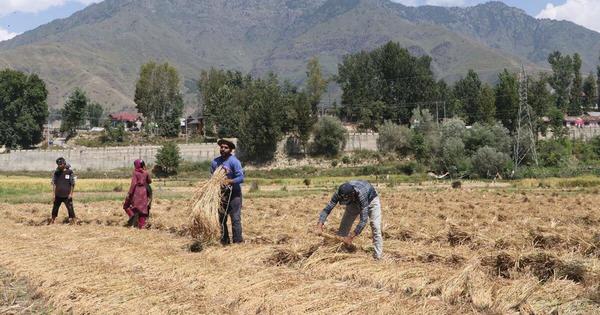
Mushq Budji is a special kind of rice that grows in the Kashmir Himalayas.
It has a nice smell and is used in traditional feasts.
But a disease called blast disease almost made it disappear.
Scientists worked for 10 years to make a new kind of Mushq Budji that can resist the disease.
They used special methods to keep the rice's good qualities while making it stronger.
Farmers are now growing this new rice, and it is doing well.
The rice is also being shown to people in other countries to sell it there.
But there are still some problems, like not enough people knowing about it and some issues with processing the rice.

Mushq Budji is a traditional aromatic rice variety from Kashmir, highly susceptible to blast disease.
Researchers at SKUAST-Kashmir developed disease-resistant varieties (SKUA-485 and SKUA-528) using marker-assisted selection.
The improved varieties maintain traditional traits like cold tolerance and aroma while being resistant to blast disease.
Farmers are increasingly adopting the improved Mushq Budji, with cultivation area expanding from 250 ha in 2022-23 to an estimated 1,000 ha by 2025.
Challenges include weak marketing, limited demand, and issues with rice milling, but efforts are being made to explore export opportunities.
- Who
- Farmers and researchers in Kashmir
- What
- Revival of Mushq Budji rice through disease-resistant varieties
- When
- 2007 (revival program), 2023 (Geographical Indication tag)
- Where
- Kashmir Himalayas
- Why
- To save the traditional rice variety from extinction due to blast disease
- Rice Variety
- Mushq Budji
- Growing Altitude
- 1,600-1,800 meters
- Geographical Indication Tag
- 2023
- Disease
- Blast disease
- Improved Varieties
- SKUA-485, SKUA-528
- Aroma Compounds
- 35 identified
- Key Aroma Compound
- 2-acetyl-1-pyrroline (2-AP)
- Cultivation Increase
- 250 ha (2022-23) to 1,000 ha (2025)