

Archive · 2 Dec 2025
Terrorist Attacks and Political Developments in India
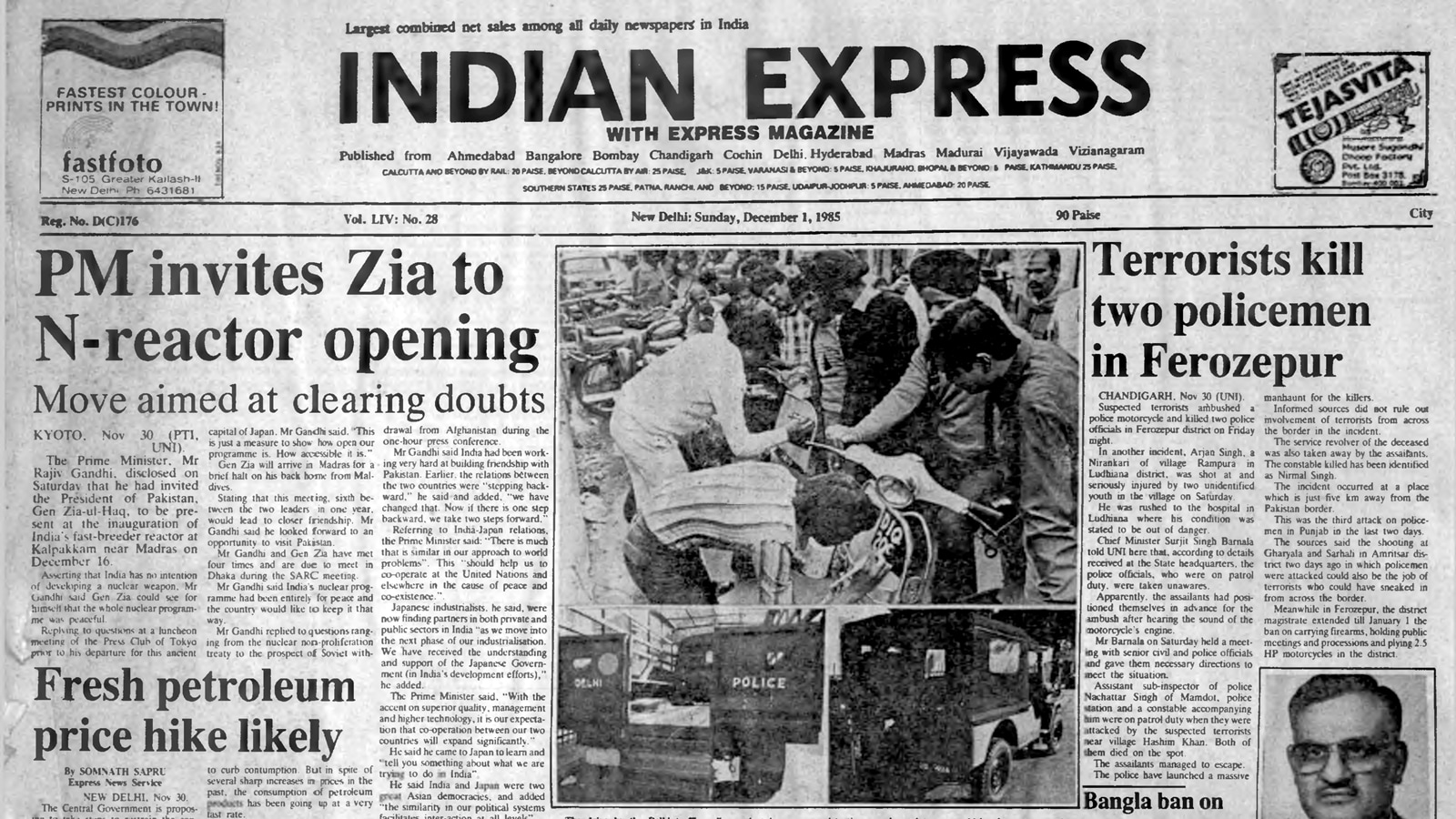
On December 1, 1985, terrorists in India ambushed and killed two police officers in Ferozepur district.
In another incident, a man named Arjan Singh was shot and injured in Ludhiana.
Meanwhile, the Prime Minister, Rajiv Gandhi, invited the President of Pakistan, Gen Zia-ul-Haq, to see India's peaceful nuclear programme.
In Bombay, a big fight happened between police and people selling things on the pavement, with many people getting hurt.
Also, India changed its mind and said it would talk about trade with other countries.

Terrorists ambushed and killed two police personnel in Ferozepur district, Punjab.
Arjan Singh, a Nirankari, was shot and seriously injured in Ludhiana.
Prime Minister Rajiv Gandhi invited Pakistan President Gen Zia-ul-Haq to the inauguration of India's fast-breeder reactor at Kalpakkam.
Clashes in Bombay between police and pavement stall owners left at least 50 injured, with police firing 16 rounds.
India indicated it was no longer opposed to negotiations under the General Agreement on Tariffs and Trade (GATT).
- Who
- Terrorists, police personnel, Arjan Singh, Rajiv Gandhi, Gen Zia-ul-Haq, pavement stall owners, Bombay Municipal Corporation
- What
- Terrorist attacks, political invitation, clashes between police and stall owners, India's stance on trade talks
- When
- December 1, 1985
- Where
- Ferozepur district, Ludhiana, Bombay, Kalpakkam near Madras
- Why
- Terrorist motives unclear; police action to demolish unauthorised structures; Rajiv Gandhi's invitation to showcase peaceful nuclear programme; India's shift in trade policy
- Date
- December 1, 1985
- Location of Terrorist Attack
- Ferozepur district, Punjab
- Victims of Terrorist Attack
- Two police personnel
- Injured in Bombay Clash
- At least 50 persons, including police and demolition squad head G R Khairnar
- Rajiv Gandhi's Invitation
- Invited Pakistan President Gen Zia-ul-Haq to Kalpakkam reactor inauguration
- India's Stance on Trade Talks
- No longer opposed to GATT negotiations
