

Archive · 27 Nov 2025
James Webb Telescope Reveals New View of Dying Star
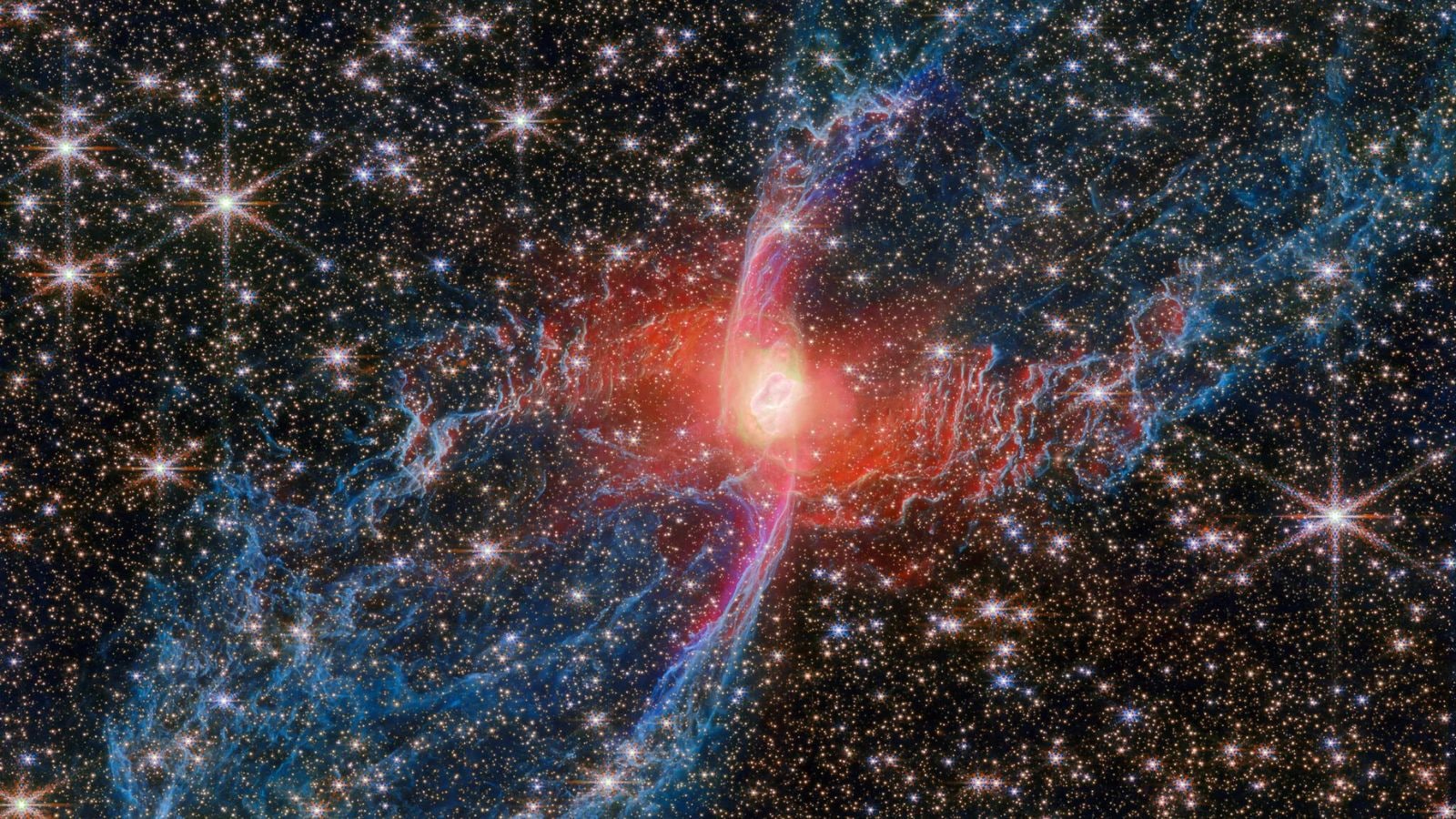
The James Webb Space Telescope has taken a new picture of a dying star called the Red Spider Nebula.
This nebula is a big cloud of dust and gas in space.
The picture shows two big bubbles, or lobes, that look like a spider's legs.
These lobes are about 3 light-years wide and are made of gas that the star has been throwing off for thousands of years.
The star at the center is like our Sun and will eventually turn into a white dwarf.
The nebula's shape is like an hourglass, and scientists think there might be another star nearby that helps make this shape.
This nebula gives us a idea of what might happen to our Sun in the future.

The James Webb Space Telescope captured a new image of the Red Spider Nebula (NGC 6537), showing its full lobes for the first time.
The nebula's lobes, highlighted in blue, stretch roughly three light-years and resemble a spider's legs.
The Red Spider Nebula is a planetary nebula formed during the final stage of a star's life, similar to our Sun.
The lobes are outlined by light from molecular hydrogen (H₂), inflated by gas escaping from the nebula's center over thousands of years.
Scientists believe an unseen companion star may influence the nebula's distinctive hourglass shape.
- Who
- NASA and the European Space Agency (ESA)
- What
- New image of the Red Spider Nebula (NGC 6537)
- When
- Recently released (exact date not specified)
- Where
- Located about 3,000 light-years from Earth
- Why
- To study the final stage of a star's life and the formation of planetary nebulae
- Nebula Name
- Red Spider Nebula (NGC 6537)
- Distance from Earth
- 3,000 light-years
- Lobe Size
- Roughly 3 light-years each
- Telescope Used
- James Webb Space Telescope (JWST)
- Instrument Used
- NIRCam (Near-Infrared Camera)
- Star Type
- Similar to our Sun
- Future Star Stage
- White dwarf