

Archive · 12 Oct 2026
Webb Helps Identify Most Distant Fast Radio Burst Yet
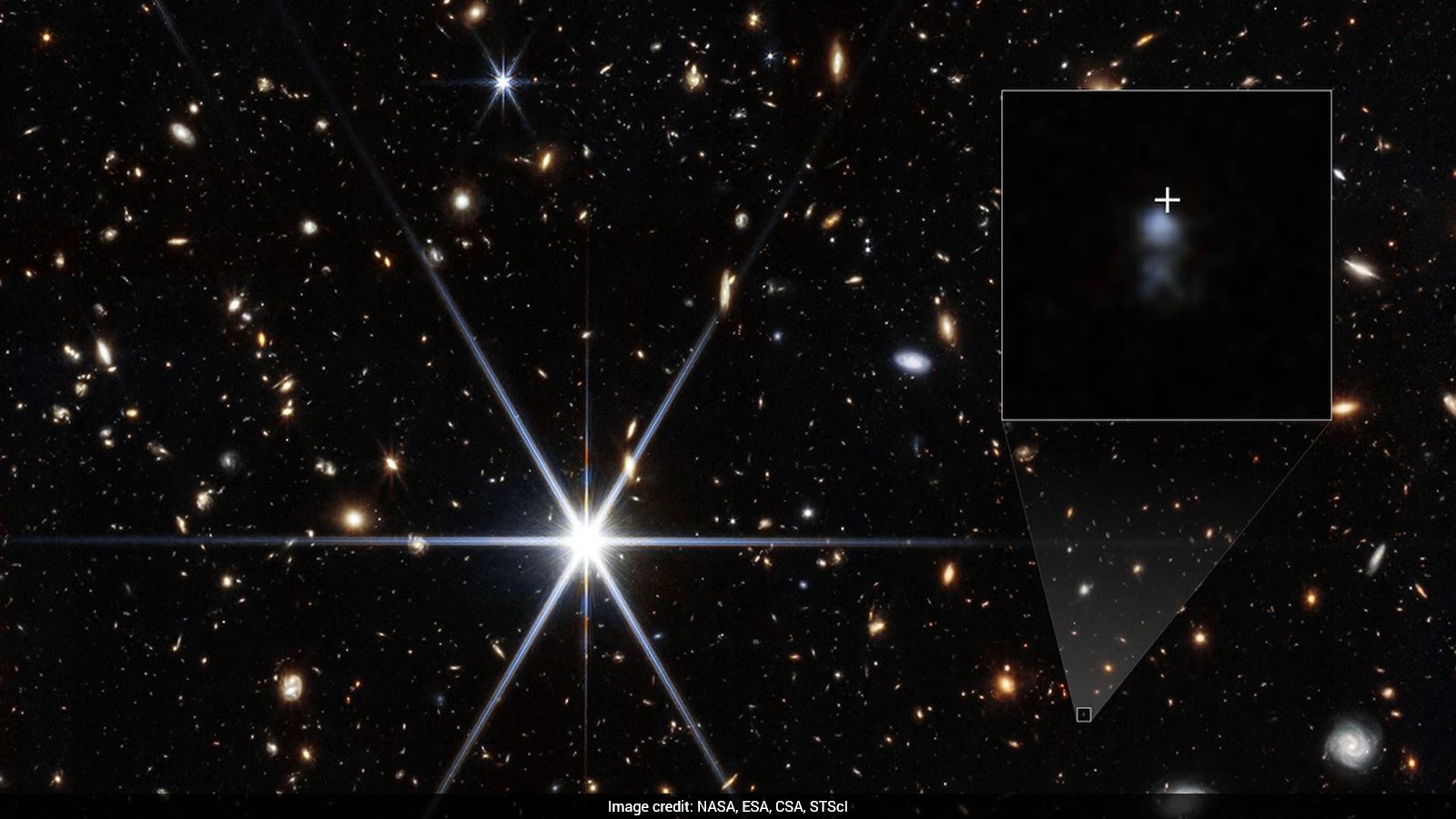
A fast radio burst is a very brief flash of radio energy from space.
Scientists detected one called FRB 20240304B in 2024.
It had been travelling for more than 10 billion years before its signal reached Earth.
The James Webb Space Telescope helped researchers find the small, young galaxy it came from.
The galaxy is making stars quickly and has few heavy elements.
Scientists do not yet know exactly what creates these bursts.
Some ideas involve colliding neutron stars or highly magnetic neutron stars.
The burst may also help scientists study matter that is hard to see between galaxies.

FRB 20240304B travelled for more than 10 billion years before reaching Earth.
The MeerTRAP team detected the burst with the MeerKAT telescope on March 4, 2024.
James Webb Space Telescope observations identified its host as a young, compact, actively star-forming dwarf galaxy.
The burst came from when the universe was about 3 billion years old, setting a new distance record and doubling the previous one.
Scientists say fast radio bursts could help map otherwise invisible matter and structures across the universe.
- Who
- The MeerTRAP team and astronomers, including lead author Manisha Caleb, studied the burst.
- What
- They detected and traced FRB 20240304B, reported as the most distant fast radio burst recorded.
- When
- Detected on March 4, 2024; it originated when the universe was about 3 billion years old.
- Where
- It came from a young, compact dwarf galaxy; the signal was detected with MeerKAT and its host studied with the James Webb Space Telescope.
- Why
- Researchers studied the burst to identify its distant host galaxy, investigate the environments where such bursts occur, and explore their use in tracing cosmic matter.
Possible origins
What is known
What produces fast radio bursts
Possible origins
Leading theories include mergers of two neutron stars or activity such as starquakes on a young, highly magnetic neutron star called a magnetar.
What is known
Researchers have not conclusively established what generates fast radio bursts.
What the host galaxy reveals
Possible origins
The team initially expected a large, well-formed galaxy with many stars.
What is known
Webb observations instead identified a small dwarf galaxy that is actively forming stars and contains few heavy elements.
- Burst designation
- FRB 20240304B
- Detection date
- March 4, 2024
- Detection instrument
- MeerKAT telescope, used by the MeerTRAP team
- Host-galaxy instrument
- James Webb Space Telescope
- Travel time to Earth
- More than 10 billion years
- Universe's age at origin
- About 3 billion years
- Host galaxy
- Young, compact, actively star-forming, and low in heavy elements