Archive · 13 Sep 2026
India Secures Unanimous BRICS Declaration After Overnight Diplomacy
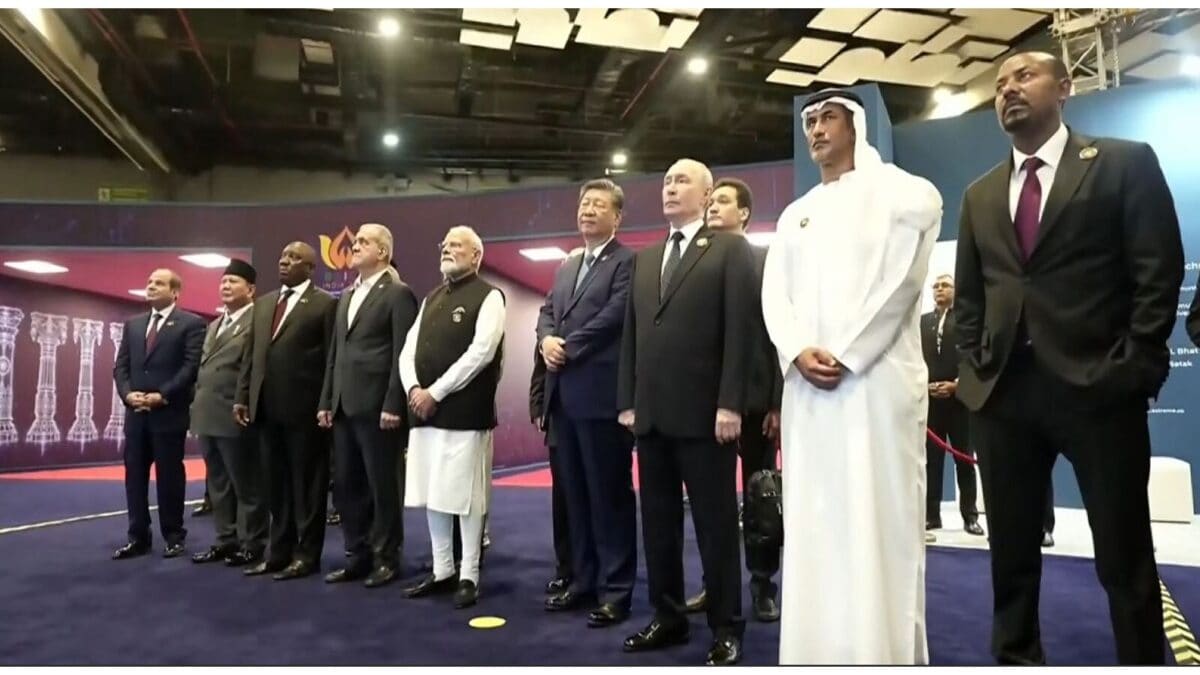
BRICS countries agreed on one shared statement called the Delhi Declaration.
India helped members reach an agreement after difficult talks.
Iran and the United Arab Emirates had different views about the conflict in West Asia.
Saudi Arabia also had regional concerns, while Russia and China had their own priorities.
Instead of blaming one country, the statement asks everyone to show restraint and protect civilians.
It says disagreements should be handled through talks and diplomacy.
BRICS members also criticized tariffs, trade barriers and sanctions that can hurt world trade.
They condemned a terrorist attack in Jammu and Kashmir that killed 26 people.
The countries also supported a Palestinian state and a peaceful two-state solution.

BRICS members unanimously adopted the Delhi Declaration after negotiations continued until about 4 a.m. Saturday.
India balanced differing positions among Iran, the UAE, Saudi Arabia, Russia and China.
The declaration urges restraint, civilian protection, respect for sovereignty and diplomacy in West Asia.
Leaders criticized unilateral tariffs, trade barriers and coercive measures for threatening global trade and supply chains.
BRICS condemned the April 22, 2025 terrorist attack in Jammu and Kashmir and reaffirmed support for Palestinian statehood and a two-state solution.
- Who
- BRICS member countries, with India coordinating negotiations; Prime Minister Narendra Modi supported a unified declaration.
- What
- The bloc unanimously adopted the Delhi Declaration covering West Asia, trade, terrorism, global governance and Palestine.
- When
- The declaration was adopted at the BRICS summit on Saturday; final negotiations reportedly continued until about 4 a.m.
- Where
- At the BRICS summit in New Delhi, India; Iran and the UAE also held a bilateral meeting on the sidelines.
- Why
- India sought consensus despite members’ conflicting positions and wanted the summit to project solidarity against unilateral actions while addressing international conflicts and security concerns.
Countries Seeking Specific Positions
Countries Seeking Common Wording
West Asia conflict
Countries Seeking Specific Positions
Iran wanted explicit reference to an attack on Iranian territory and what it described as a violation of the United Nations Charter; the UAE wanted recognition of Iranian attacks on its territory.
Countries Seeking Common Wording
India shifted the declaration toward shared principles, including restraint, sovereignty, civilian protection and diplomacy, allowing members to retain their national positions without assigning blame.
Russia-Ukraine language
Countries Seeking Specific Positions
Russia was reportedly wary of conflict language that could be interpreted as criticizing Moscow or referring to the Ukraine war.
Countries Seeking Common Wording
India used broad references to sovereignty, territorial integrity and peaceful dispute resolution rather than directly naming the Russia-Ukraine war.
Trade restrictions
Countries Seeking Specific Positions
The United States and other countries were associated in the articles with higher tariffs, sanctions and protectionist measures that BRICS leaders criticized.
Countries Seeking Common Wording
The declaration condemned unilateral and coercive trade measures without naming a specific country, reducing the risk of sharpening India’s relationship with Washington.
- Declaration
- Delhi Declaration, also referred to as the New Delhi Declaration
- Adoption
- Approved unanimously by BRICS members
- Negotiations
- India’s diplomats worked until approximately 4 a.m. Saturday to finalize the text
- West Asia
- The statement called for maximum restraint, civilian protection, respect for sovereignty and dialogue
- Trade
- Leaders criticized unilateral tariffs, non-tariff measures, protectionism and coercive measures
- Jammu and Kashmir attack
- The April 22, 2025 terrorist attack killed 26 people and injured others
- Palestinian issue
- BRICS reaffirmed support for Palestine’s full United Nations membership and a two-state solution