

7 months ago
NASA Discovers Ammonia Compounds on Europa
Scientists have found something exciting on Jupiter's moon Europa.
They looked at old data from a spacecraft called Galileo and found signs of special chemicals called ammonia on Europa's surface.
These chemicals might have come from water deep under the moon's icy surface.
The spacecraft took pictures and used special tools to find these chemicals.
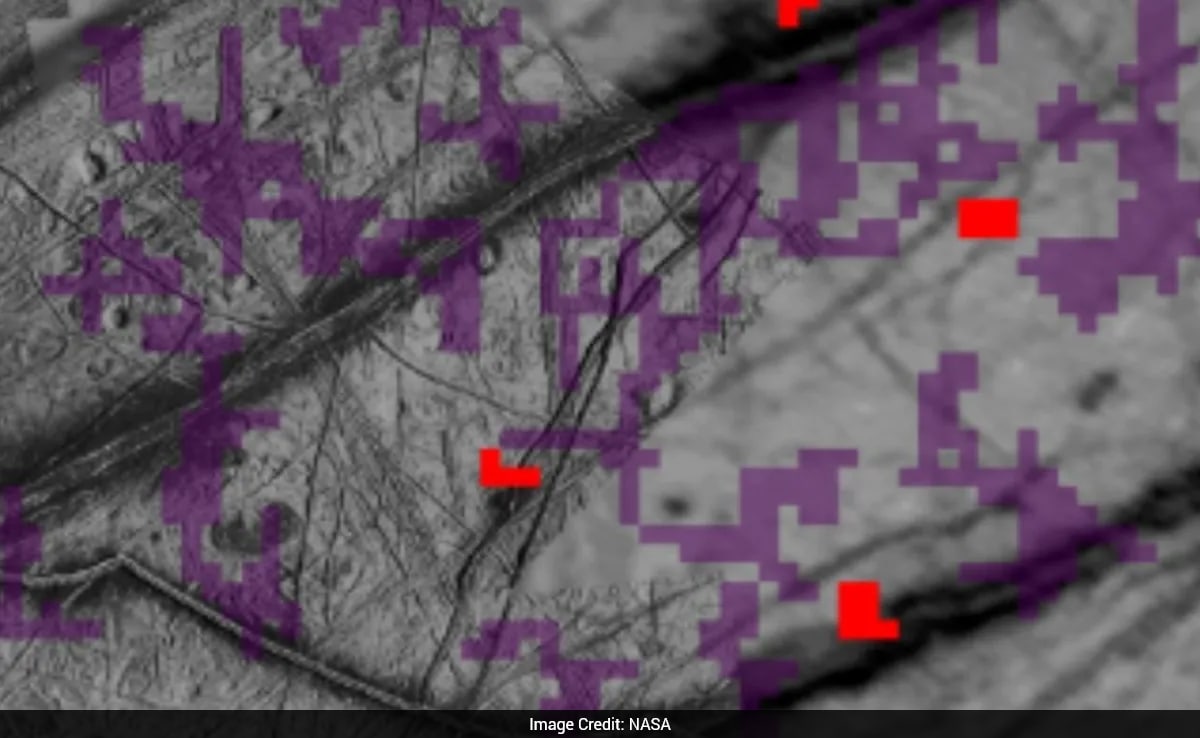
The pictures show cracks on the moon's surface, and the chemicals are near these cracks.
This helps scientists learn more about what's happening under the ice.

NASA scientists discovered ammonia-bearing compounds on Europa's surface using old data from the Galileo spacecraft.
The discovery was made through a composite image and data from the Near-Infrared Mapping Spectrometer (NIMS).
Red pixels in the image indicate locations where ammonia-containing compounds were detected.
Cracks on Europa's icy surface suggest that ammonia-rich compounds may have been brought up by cryovolcanic activity.
The Galileo mission, launched in 1989 and operated by the Jet Propulsion Laboratory, studied the Jupiter system for several years.
- Who
- NASA scientists
- What
- Discovered ammonia-bearing compounds on Europa's surface
- Where
- Jupiter's moon Europa
- When
- Data collected in 1997, analyzed recently
- Why
- To understand what may be happening beneath the moon's thick ice
Key facts
- Location
- Jupiter's moon Europa
- Source of Data
- NASA's Galileo spacecraft
- Detection Method
- Near-Infrared Mapping Spectrometer (NIMS)
- Mission Launch Year
- 1989
- Mission End Year
- 2003
- Operating Laboratory
- Jet Propulsion Laboratory, managed by Caltech
- Area Analyzed
- 250 miles (400 kilometers) wide
- Orbit During Detection
- 11th orbit of Jupiter in 1997