Archive · 25 Dec 2025
Hubble Discovers Massive, Chaotic Planet-Forming Disk
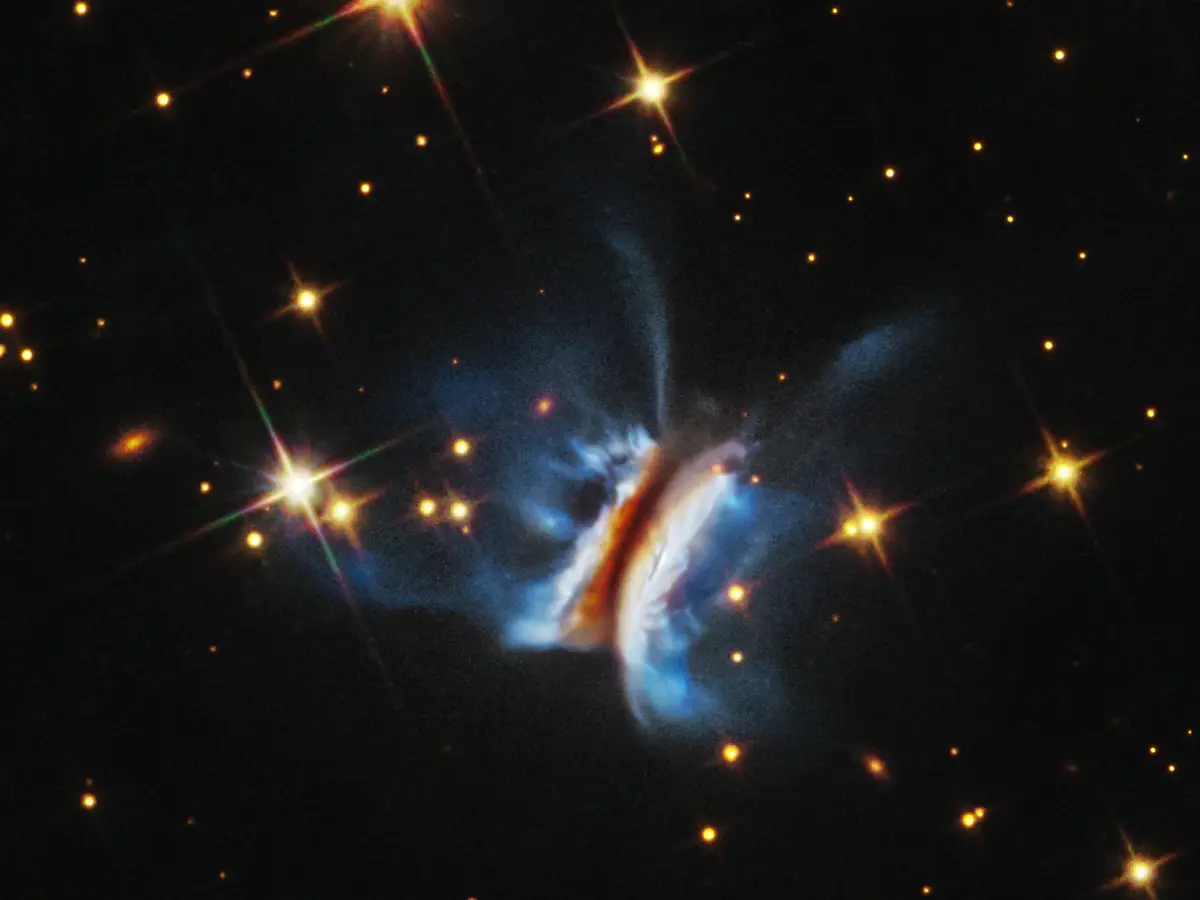
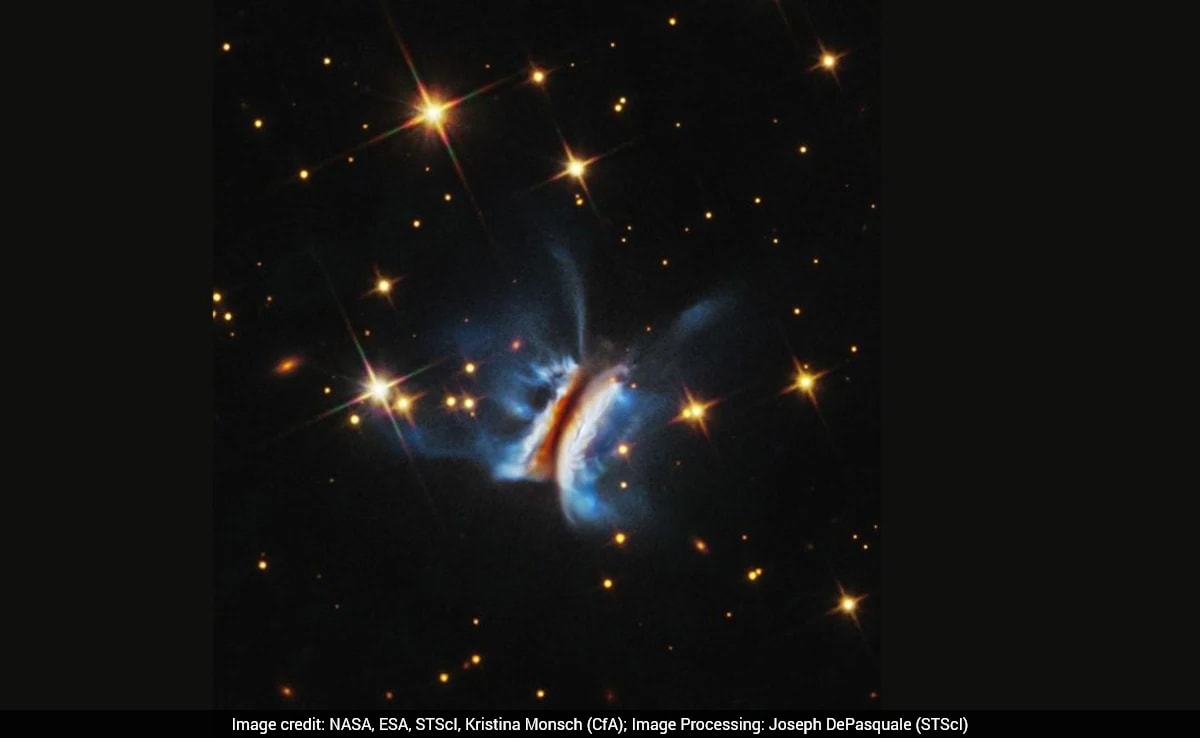
NASA's Hubble Telescope found a huge, messy disk of material around a young star.
This disk is 600 billion kilometres wide, which is 40 times bigger than our solar system.
It's called Dracula’s Chivito and is very chaotic, with material stretching far above and below the disk.
Scientists think it might have one or two stars at its centre.
This disk is special because it's lopsided, with different features on each side.
It's like a bigger, messier version of what our solar system looked like when it was young.
Over time, this disk might form a big planetary system, just like ours did.

NASA's Hubble Telescope discovered the largest known planet-forming disk, IRAS 23077+6707, nicknamed Dracula’s Chivito, which is 600 billion kilometres wide.
The disk is 40 times the diameter of our solar system and is unusually chaotic and turbulent.
The central star is young and could be a hot, massive star or a pair of stars.
The disk is asymmetrical, with different features on either side, suggesting it interacts differently with its surroundings.
Scientists believe this disk could represent a scaled-up version of our early solar system and may host a vast planetary system in the future.
- Who
- NASA's Hubble Telescope and scientists led by Kristina Monsch
- What
- Discovery of the largest known planet-forming disk, IRAS 23077+6707, nicknamed Dracula’s Chivito
- When
- Not specified
- Where
- 1,000 light-years from Earth
- Why
- To study planet formation and the environments where it happens
- Distance from Earth
- 1,000 light-years
- Diameter
- 600 billion kilometres
- Disk Mass
- 10 to 30 times that of Jupiter
- Central Star
- Young, possibly a hot, massive star or a pair of stars
- Discovery Tool
- NASA's Hubble Telescope
- Nickname
- Dracula’s Chivito
- Lead Researcher
- Kristina Monsch, Center for Astrophysics