

Archive · 27 May 2025
Einstein Probe Uncovers Unprecedented X-ray Flare from FEXT EP241021a
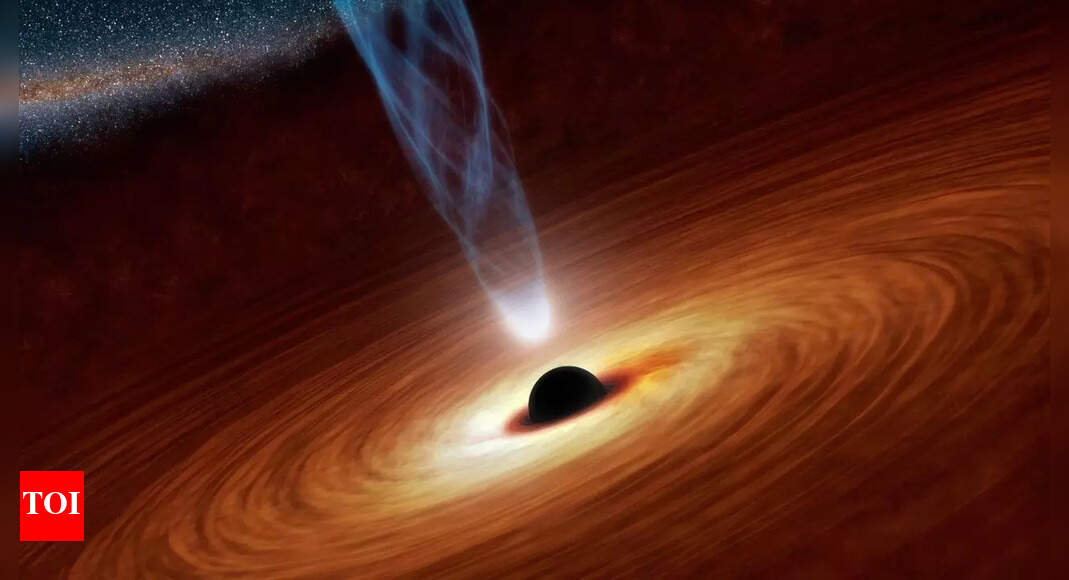
Scientists have discovered a strange burst of X-rays, called EP241021a, using a space telescope.
This burst, which lasted for a very short amount of time initially, was incredibly bright.
What makes it unusual is how long the X-ray emission lasted.
It's like a quick flash followed by a long, fading glow.
Astronomers think it might come from a super-magnetic star or when a black hole eats a star.
They're watching this event closely to learn more about these powerful cosmic events.

Einstein Probe detected a new fast-evolving X-ray transient (FEXT), EP241021a.
EP241021a's initial X-ray flare lasted approximately 92 seconds.
The flare reached a luminosity of about one quindecillion erg/s.
Optical emissions were detected about 1.8 days after the initial X-ray detection.
Scientists propose two possible origins: a magnetar engine or a jetted tidal disruption event (TDE).
- Who
- An international team of astronomers.
- What
- Detection of an unusually long-lasting X-ray emission from EP241021a.
- When
- Detected on October 21, 2024; Follow-up observations over 79 days.
- Where
- Undisclosed location in space.
- Why
- To study and understand the origin of fast-evolving X-ray transients.
Magnetar Engine
Jetted Tidal Disruption Event
Origin of EP241021a
Magnetar Engine
A magnetar engine, involving a highly magnetized neutron star.
Jetted Tidal Disruption Event
A jetted tidal disruption event (TDE), where a star is consumed by a black hole.
- Transient Name
- EP241021a
- Initial Flare Duration
- 92 seconds
- Peak Luminosity
- One quindecillion erg/s
- Detection Date
- October 21, 2024
- Delay before Optical Emission
- 1.8 days
