

Archive · 14 Nov 2025
Rogue Giant Planet Crashed Through Solar System, Reshaping Orbits
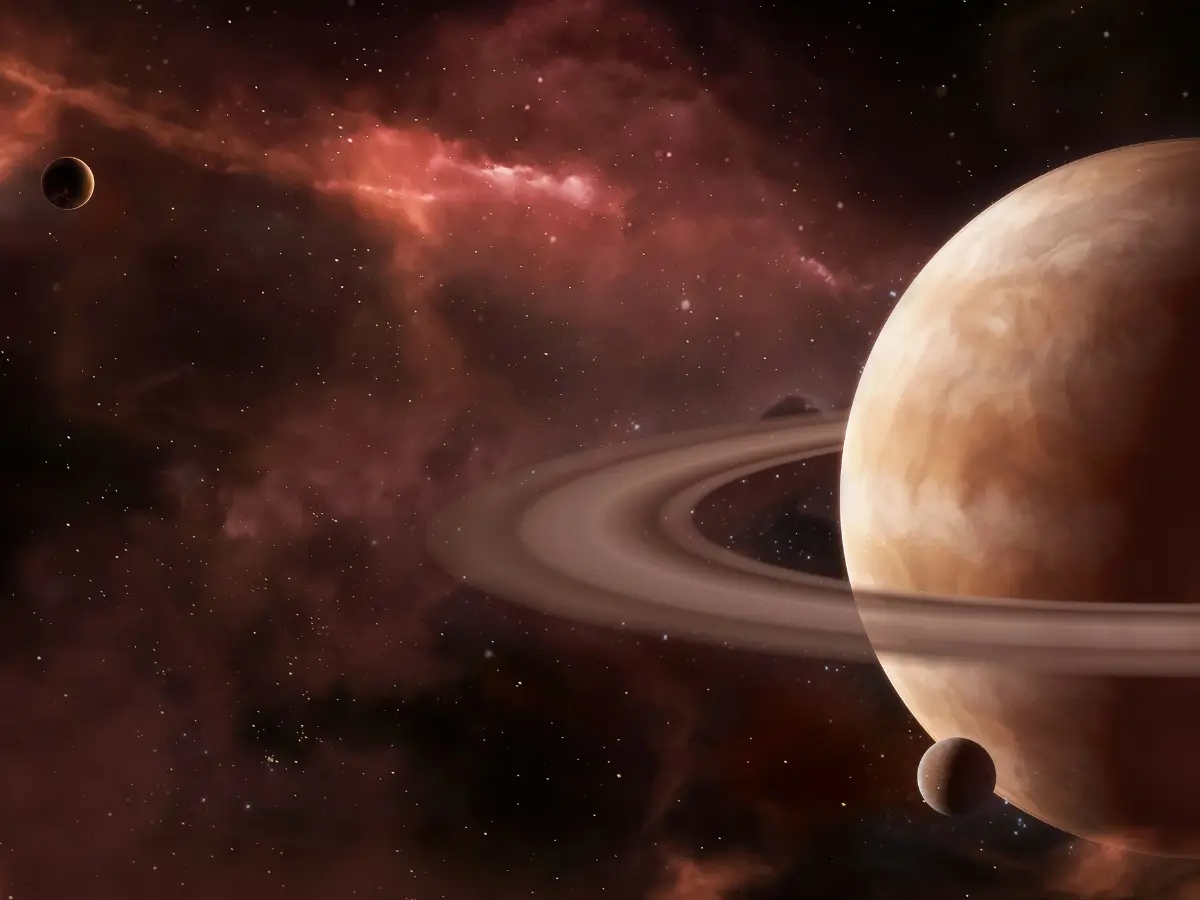
Imagine our solar system is like a giant playground with planets orbiting the Sun.
For a long time, scientists wondered why the big gas planets like Jupiter and Saturn had orbits that were a bit wobbly and tilted compared to the smaller, rocky planets.
They thought something must have pushed them off their original paths.
Now, scientists think a giant, rogue planet or brown dwarf, about eight times bigger than Jupiter, zoomed through our solar system a long, long time ago.
It wasn't part of our solar system originally.
When it flew by really close to the Sun, its strong gravity messed with the paths of Jupiter and the other big planets.
This close encounter made them shift their orbits and tilt them, which is why they move a little differently today.
Scientists used computers to run lots of simulations to figure this out.

A new study suggests a rogue object, eight times Jupiter's mass, significantly altered the orbits of giant planets in our solar system.
This substellar object, a rogue planet or brown dwarf, passed through the solar system billions of years ago.
The object's flyby caused a gravitational disturbance, changing the eccentricities and tilting the orbital planes of Jupiter, Saturn, Uranus, and Neptune.
Scientists ran over 50,000 computer simulations to test various scenarios for the intruder's mass, speed, and trajectory.
Only a single encounter with an object of this magnitude could explain the observed unusual orbits of the four giant planets.
- Who
- A massive rogue substellar object (planet or brown dwarf)
- What
- Caused gravitational disturbance that reshaped the orbits of Jupiter, Saturn, Uranus, and Neptune
- When
- Billions of years ago
- Where
- Our solar system
- Why
- The object's massive size and proximity during a flyby altered the gravitational balance, changing the planets' orbital paths and inclinations.
- Intruder Mass
- Eight times the mass of Jupiter
- Intruder Type
- Substellar object (rogue planet or brown dwarf)
- Intruder Proximity to Sun
- 1.7 astronomical units
- Intruder Speed
- 1-3 kilometers per second
- Simulation Duration
- 20 million years per simulation
- Probability of Encounter
- 1 in 9,000 chance