

Archive · 5 Jun 2025
Middle East Crisis Could Hinder India-Middle East-Europe Corridor
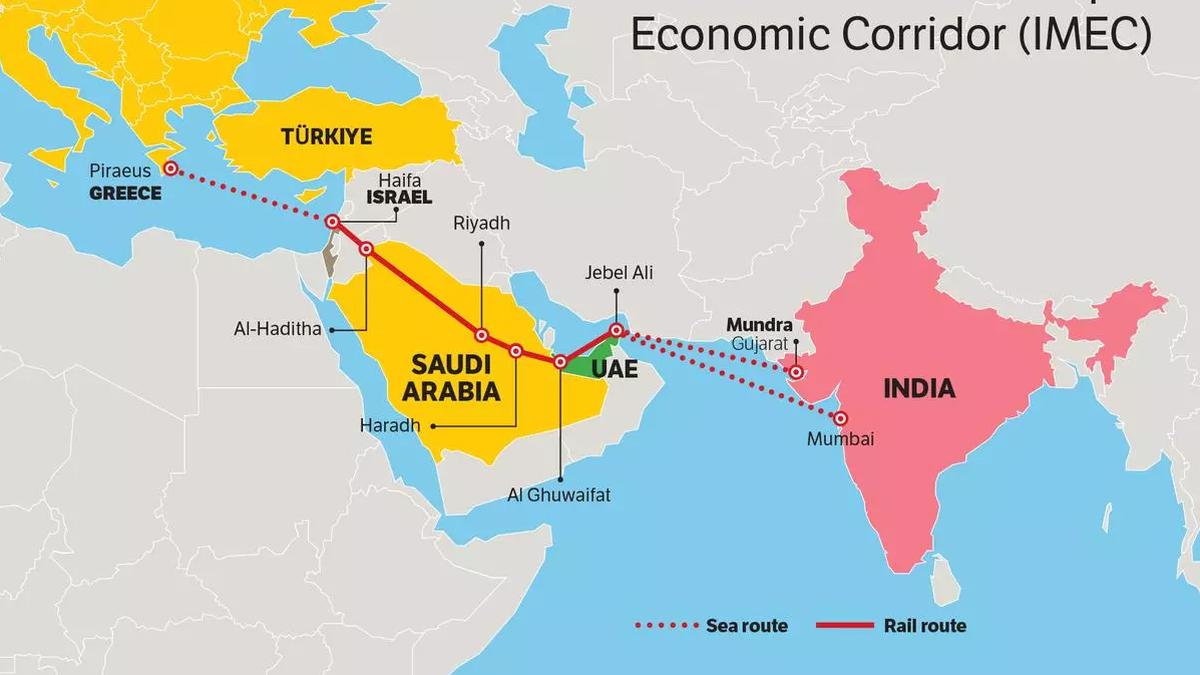
The India-Middle East-Europe Economic Corridor (IMEC) is a planned project to create a faster trade route between India and Europe, going through the Middle East.
Think of it like building a superhighway for goods using ships, trains, and roads.
However, a current problem in the Middle East is making it harder to build this highway.
A big challenge is getting all the countries involved to agree on the same rules for things like taxes and regulations.
Some experts worry it may face competition from other similar projects.
Even though it could speed up how fast things move from Mumbai to Greece, there may still be delays at certain stops.
It's like a race where the track has potential roadblocks.
It could avoid some of the usual, busy shipping spots but may create new, land-based ones.

Middle East crisis poses a potential obstacle to the India-Middle East-Europe Economic Corridor (IMEC).
IMEC aims to connect India to Europe via the Gulf region through ship, ship-rail, and road networks.
A senior official cited geopolitical issues and harmonization challenges, including regulatory standards and taxation.
The IMEC could reduce cargo transit time from Mumbai to Greece by around three days.
Challenges include competition from the China-led Belt and Road Initiative and potential chokepoints.
- Who
- Ministry of External Affairs official and Vice Admiral Anil Chawla (Retd.).
- What
- The India-Middle East-Europe Economic Corridor (IMEC).
- When
- Announced at the G20 summit in 2023. Discussed on June 4, 2025.
- Where
- Connecting India to Europe via the Middle East.
- Why
- To reduce transit time and create a new trade route.
- Project Name
- Economic Corridor
- Route
- India to Europe via the Middle East
- Announced
- G20 summit 2023
- Reduced transit time Mumbai to Greece
- Around 3 days