Archive · 3 Oct 2026
Supreme Court Sets Aside Cattle Transport Conviction Over Missing Papers

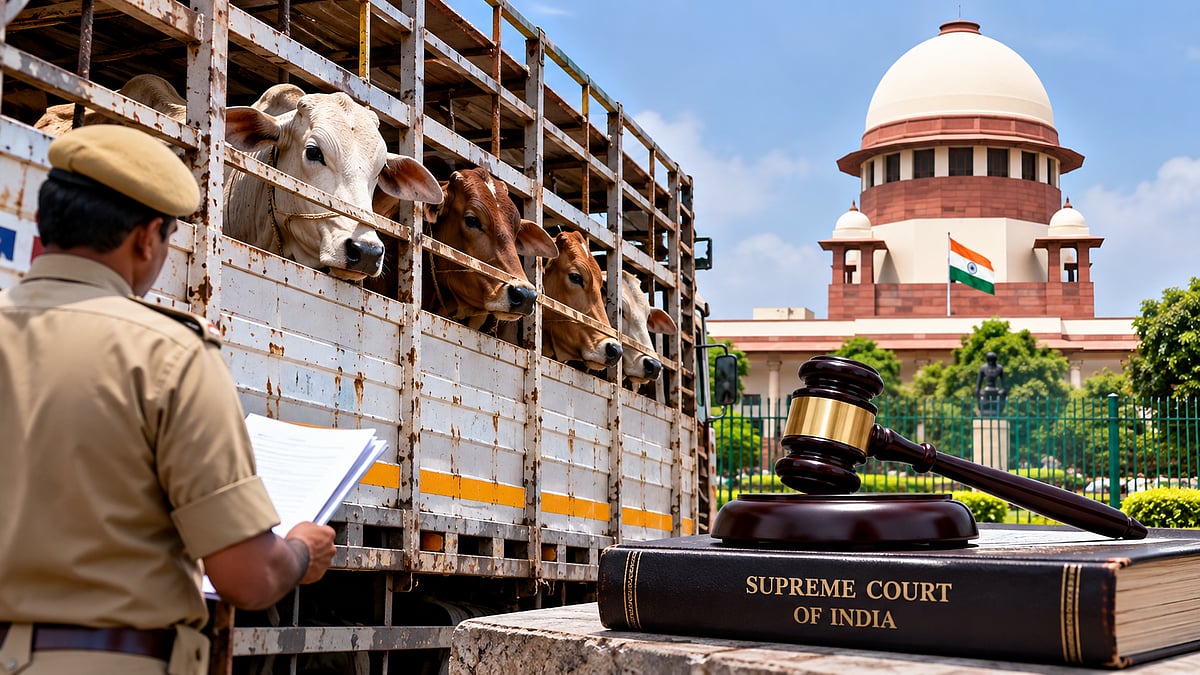
The Supreme Court reviewed a case about 32 bullocks travelling in a truck.
Six people were convicted, but Surabh Bajaj appealed his conviction.
The Court said that having no transport papers does not, by itself, prove that the cattle were going to be slaughtered.
The prosecution first had to show evidence that slaughter was the purpose, or that slaughter was likely.
Only after that could the accused be required to explain the transport under the law.
A veterinary doctor and a Gaushala committee president said the cattle could be used for farming.
The Court set aside Bajaj’s conviction.

The Supreme Court set aside Surabh Bajaj’s conviction under the Chhattisgarh Agricultural Cattle Preservation Act, 2004.
The case involved 32 bullocks transported by truck from Keduwa toward Odisha and six people convicted in connection with the transport.
The Court ruled that missing transport documents alone do not prove the cattle were being taken for slaughter.
It said the prosecution must establish the essential elements of the offence before the reverse burden under Section 11 applies.
A veterinary doctor and a Gaushala committee president testified that the cattle were fit for agricultural work, including ploughing.
- Who
- The Supreme Court, in a Bench comprising Justices J.B. Pardiwala and K. Vinod Chandran, decided Surabh Bajaj’s appeal.
- What
- The Court set aside Bajaj’s conviction and ruled that missing transport documents alone do not establish that cattle were being transported for slaughter.
- When
- The articles do not specify the date of the ruling.
- Where
- The cattle were stopped while travelling from Keduwa toward Odisha; the case concerned the Chhattisgarh Agricultural Cattle Preservation Act, 2004.
- Why
- The Court found no evidence establishing that the cattle were transported for slaughter or were likely to be slaughtered.
Supreme Court’s findings
Prosecution’s allegations
Purpose of transport
Supreme Court’s findings
The Court said there was nothing on record beyond the head constable’s presumption to show the cattle were being transported for slaughter.
Prosecution’s allegations
The prosecution alleged the 32 bullocks were being transported for slaughter.
Missing documents
Supreme Court’s findings
The lack of transport documents alone could not establish an intention to slaughter or prove a violation of Section 6.
Prosecution’s allegations
The cattle were transported without documents; the prosecution’s case also relied on the circumstances of the interception.
Reverse burden
Supreme Court’s findings
The Court said the prosecution must first establish the offence’s essential ingredients before the accused bears the reverse burden under Section 11.
Prosecution’s allegations
The six were convicted under the Act by the lower courts, whose decisions were later challenged by Bajaj.
- Appellant
- Surabh Bajaj, one of six people convicted
- Animals
- 32 bullocks
- Route
- From Keduwa toward Odisha
- Law
- Chhattisgarh Agricultural Cattle Preservation Act, 2004
- Relevant provisions
- Section 6 defines the relevant offence; Section 11 addresses the reverse burden
- Sentence reported
- One year of imprisonment and a ₹1,000 fine for each of the six convicted people; one article specifies rigorous imprisonment
- Agricultural-use testimony
- A veterinary doctor and a Gaushala committee president said the cattle were fit for agricultural work, including ploughing