

Archive · 17 Sep 2025
Astronomers Discover Rare Pulsar, Testing Einstein's Theory
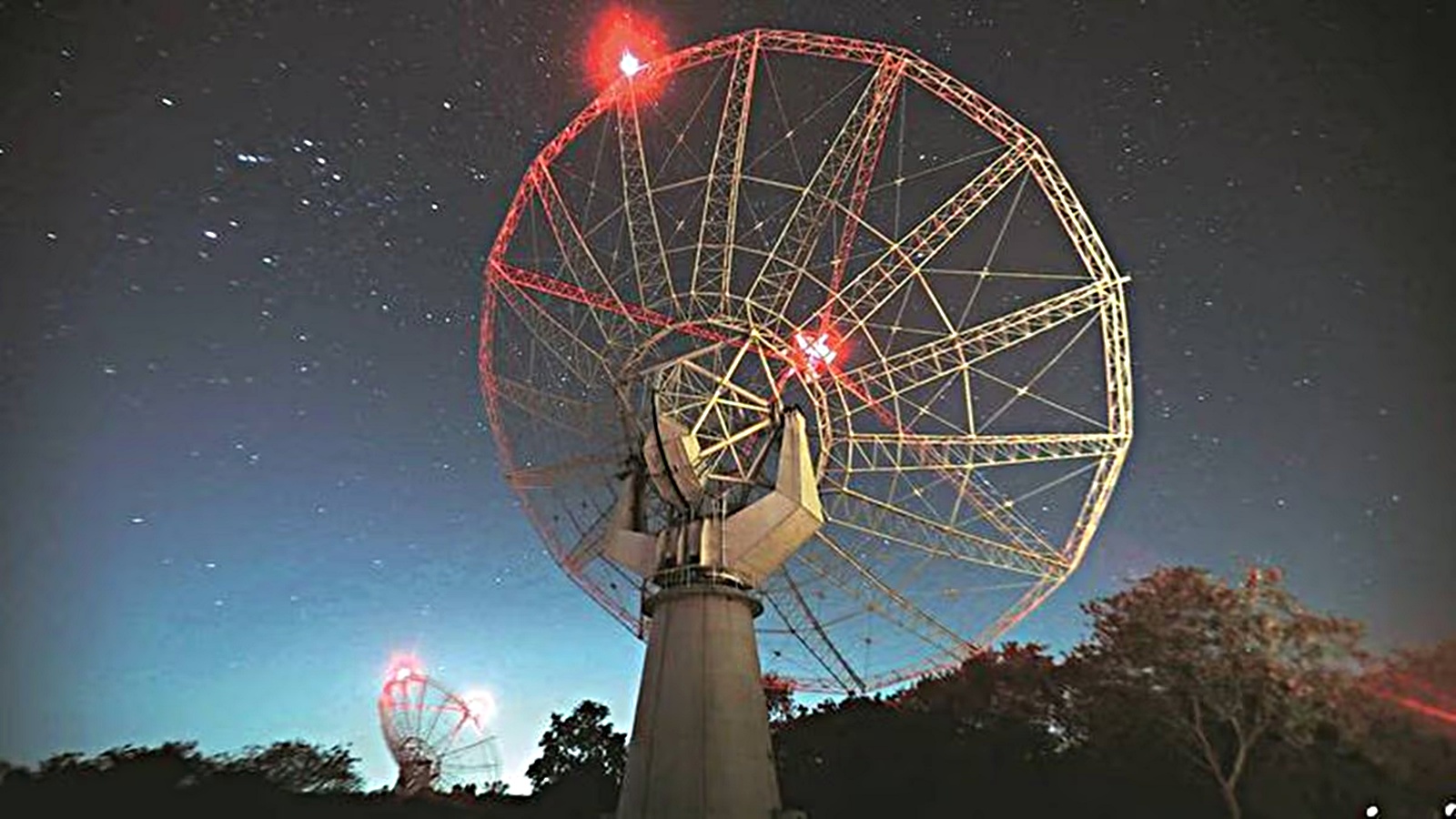
Imagine tiny, spinning city-sized objects called pulsars that send out radio beams like cosmic lighthouses.
Scientists have found a new one in a crowded group of old stars called M80.
This pulsar spins super fast and has a partner it orbits in a stretched-out path, like a lopsided oval instead of a circle.
This unusual shape is interesting because it allows scientists to test Einstein's ideas about gravity, seeing how the pulsar's orbit changes over time.
The pulsar and its partner have a combined mass about 1.67 times the sun's mass, and its behavior suggests unusual events that happened in the past.
Scientists will continue to study this system to learn more.

Astronomers discovered a millisecond pulsar named PSR J1617–2258A.
The pulsar is located in the ancient star cluster M80.
It was discovered using the uGMRT radio telescope.
The pulsar spins 232 times per second.
Its unusual orbit is ideal for testing Einstein's theory of general relativity.
- Who
- A team of astronomers from NCRA-TIFR and international collaborators.
- What
- Discovered a millisecond pulsar (PSR J1617–2258A) in the ancient star cluster M80.
- When
- Published July 22.
- Where
- Discovered using the uGMRT radio telescope near Pune, India, in the star cluster M80.
- Why
- The discovery provides a unique laboratory for testing Einstein's theory of general relativity.
- Pulsar Name
- PSR J1617–2258A
- Location
- Ancient star cluster M80
- Telescope
- uGMRT
- Spin Rate
- 232 times per second
- Orbit Shape
- Oval (eccentric)
- Orbital Period
- Roughly 19 hours