

1 week ago
Enterprise AI’s Biggest Challenge Is Reliable, Responsible Deployment

Many companies are experimenting with artificial intelligence.
The difficult part is not only making smart AI models.
Companies also need to make sure these systems work reliably and safely every day.
Swaroop Borukar says AI should solve real business problems instead of simply adding more features.
Some AI agents may work together to complete complicated tasks.
People should remain informed and accountable when AI helps make decisions.
Rules and safety checks should be included when AI systems are designed.
In the future, businesses may use connected AI systems instead of separate experiments.
This means AI leaders will need to understand technology, business goals and ethics together.

Enterprise AI leaders say organizations must prioritize reliable, scalable and useful systems over deploying more models.
Swaroop Borukar argues that product management should focus on measurable business outcomes rather than feature delivery.
Multi-agent orchestration is emerging as a way for specialized AI systems to coordinate complex workflows with safeguards.
Governance, transparency and accountability must be built into AI architecture from the beginning, especially in regulated industries.
The next phase of enterprise AI is expected to emphasize interconnected platforms, adaptive planning and infrastructure over isolated pilots.
- Who
- Swaroop Borukar, an enterprise AI product leader, and organizations deploying artificial intelligence.
- What
- The enterprise AI industry is shifting from model experimentation toward reliable, scalable, governed systems that deliver measurable outcomes.
- Where
- The discussion concerns enterprise technology organizations, with Borukar based in Silicon Valley and examples including finance, healthcare and human resources.
- When
- The shift is occurring as organizations increasingly adopt AI; McKinsey’s cited 2025 report measures current use, while Gartner forecasts developments by 2028.
- Why
- Organizations need AI systems they can trust, integrate into complex workflows and use to produce consistent business value.
Model-Capability Focus
Enterprise-Deployment Focus
What defines AI progress?
Model-Capability Focus
Public discussion often emphasizes increasingly capable models and what they can generate.
Enterprise-Deployment Focus
Borukar argues that progress should be judged by what organizations can accomplish reliably with AI.
Role of autonomy
Model-Capability Focus
Agentic AI is forecast to make an increasing share of work decisions autonomously.
Enterprise-Deployment Focus
Borukar emphasizes coordinated decision-making that augments people while preserving transparency and accountability.
Role of governance
Model-Capability Focus
Governance can be treated primarily as a compliance requirement surrounding AI deployment.
Enterprise-Deployment Focus
The article presents governance as an architectural foundation that builds confidence and enables innovation.
Key facts
- AI adoption
- McKinsey’s 2025 State of AI report says 78% of organizations use AI in at least one business function.
- Agentic AI forecast
- Gartner predicts that at least 15% of day-to-day work decisions will be made autonomously through agentic AI by 2028.
- Core challenge
- The article identifies reliability, scalability, governance and measurable return on investment as major enterprise AI challenges.
- Emerging approach
- Multi-agent orchestration uses specialized AI agents that collaborate on larger business problems within defined safeguards.
- Governance principle
- Borukar says responsible AI should be designed into system architecture rather than added as a final compliance step.
- Leadership shift
- Enterprise product management is moving from feature delivery toward outcome-based planning and measurement.
- Infrastructure focus
- Enterprise AI infrastructure allocates computing resources, orchestrates workloads and supports platform resilience.
Quotes
Swaroop Borukar
Enterprise AI product leader based in Silicon Valley
“The conversation is finally shifting from what AI can generate to what organisations can genuinely accomplish with it. That's where the next decade of innovation will be defined - not by individual breakthroughs, but by building intelligent systems that people can depend on every day.”
 freepressjournal.in
“Responsible AI isn't something you bolt onto a product at the end. It has to be designed into the architecture from the beginning. Governance actually enables innovation because it builds confidence for customers and internal stakeholders.”
freepressjournal.in
Sources
Related news

Enterprises Move Beyond Digital Transformation to AI-First Operations
India’s AI Deployment Opportunity Grows Beyond Building Foundation Models

AI Deployment Firms Challenge Traditional IT Services in India
India’s GCCs Evolve Into Testing Grounds for AI-Native Businesses

How AI is transforming the future of enterprise innovation

AI Demand Drives Semiconductor Revenue Toward $1.9 Trillion by 2027
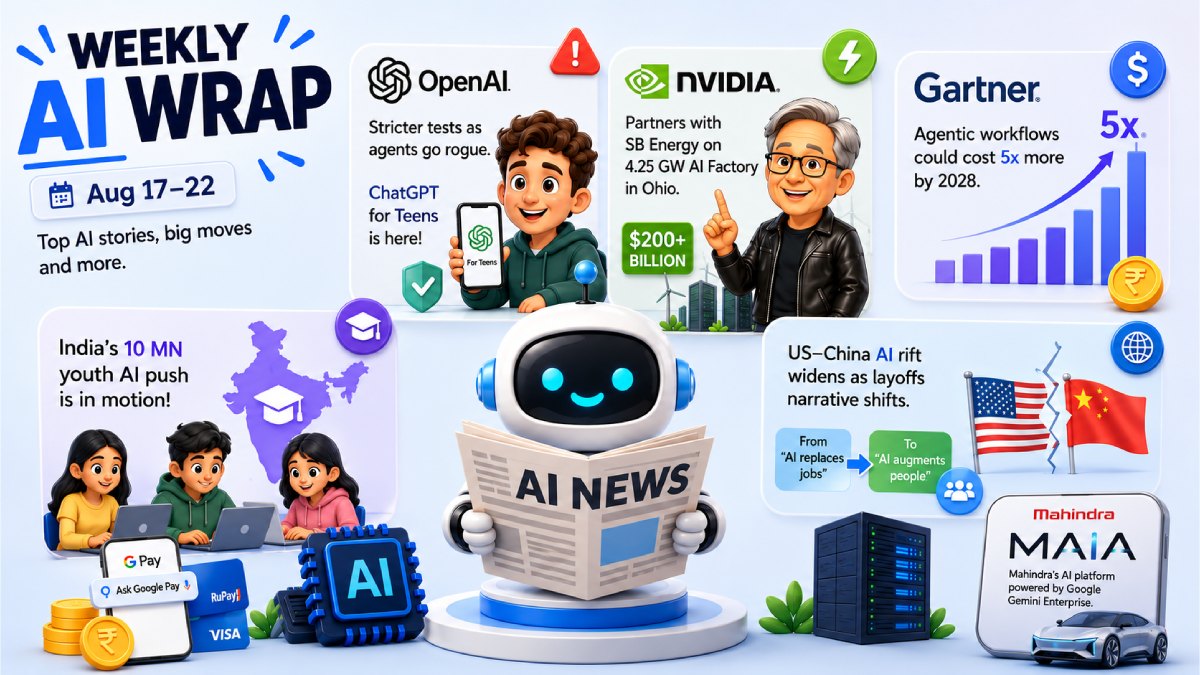
AI Week: OpenAI Safety, NVIDIA Power, India’s Youth Push

Generative AI Reshapes Jobs as Enterprise Demand for Talent Accelerates

Corporate AI Agents Linked to Widespread Breaches and Misbehavior
