6 hrs ago
India May Seek In-Absentia Trials For 26/11 Accused
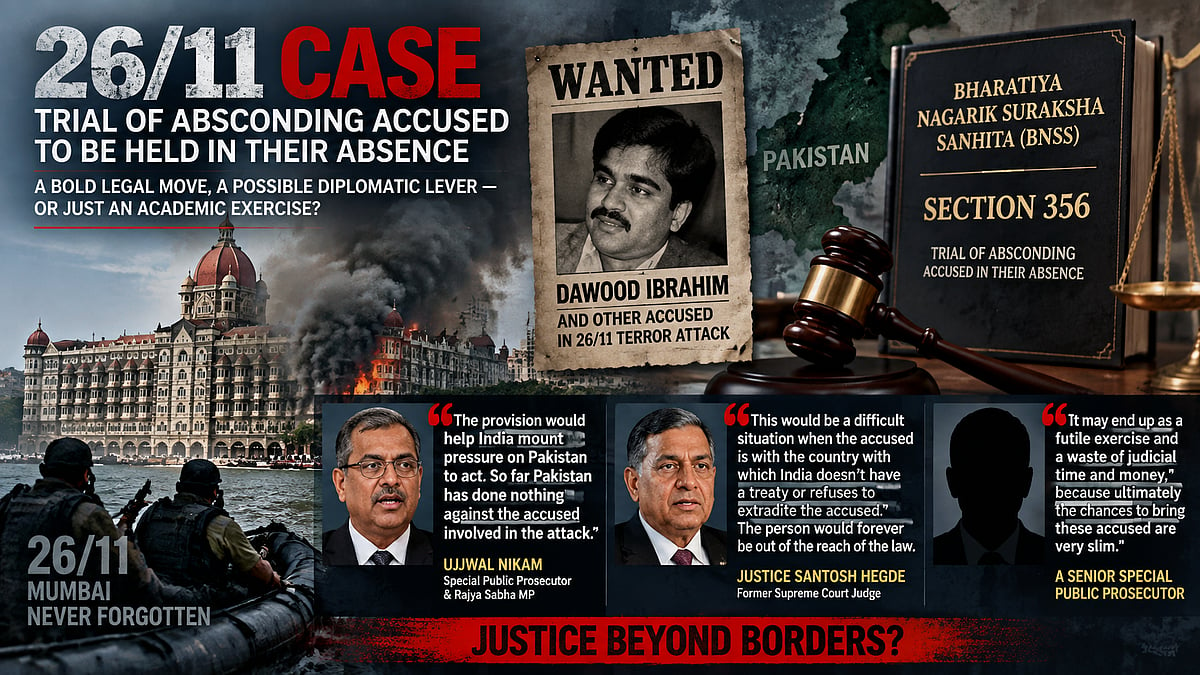
India is considering using a new law to try some people accused in the 26/11 attacks even if they are not in court.
This can happen only after a person is officially declared a proclaimed offender.
A court must approve the trial.
If approved, a lawyer from legal aid would represent the absent accused.
The law treats the person as having given up the right to attend.
Prosecutor Ujwal Nikam believes this could pressure Pakistan to take action.
Other legal experts say the trial might not help much if the accused cannot be brought to India.
They also worry that it could use substantial court time and money without producing a practical result.

Section 356 of the Bharatiya Nagarik Suraksha Sanhita allows trials against absconding accused in their absence.
The provision applies after an accused has been declared a proclaimed offender and the court authorizes the trial.
A legal-aid lawyer would represent the accused, who would be considered to have waived the right to attend.
Ujwal Nikam said the measure could pressure Pakistan to act against accused linked to the attacks.
Experts questioned its practical value because extradition may remain impossible and the accused could remain beyond India’s reach.
- Who
- Indian prosecution authorities and wanted absconding accused linked to the 26/11 terror attack case; Ujwal Nikam and legal experts commented on the proposal.
- What
- India may seek trials in absentia under Section 356 of the Bharatiya Nagarik Suraksha Sanhita.
- Where
- The proposed proceedings would take place in an Indian court; some accused are said to be in Pakistan or beyond India’s reach.
- When
- Under the new BNSS provision; the articles do not specify when an application will be filed.
- Why
- Supporters say the measure could pressure Pakistan to act, while critics question its usefulness if the accused cannot be extradited.
Potential Pressure On Pakistan
Limited Practical Impact
Effect of trials in absentia
Potential Pressure On Pakistan
Ujwal Nikam said the provision could help India mount pressure on Pakistan to act against accused involved in the attack.
Limited Practical Impact
A senior special public prosecutor said the proceedings could waste judicial time and money because bringing the accused to India remains unlikely.
Reach of Indian law
Potential Pressure On Pakistan
The new provision gives Indian courts a way to proceed against proclaimed offenders even when they are absent.
Limited Practical Impact
Former Supreme Court judge Santosh Hegde said the situation would be difficult if an accused is in a country with no treaty with India or one that refuses extradition, leaving the person beyond the law’s practical reach.
Key facts
- Legal provision
- Section 356 of the Bharatiya Nagarik Suraksha Sanhita permits courts to conduct trials against certain absconding accused in their absence.
- Eligibility
- The accused must first be declared a proclaimed offender, and the court must authorize the trial.
- Representation
- A lawyer from the legal-aid panel would represent the absent accused.
- Case
- The proposal concerns wanted accused linked to the 26/11 Mumbai terror attack case.
- Supporter’s view
- Special Public Prosecutor and Rajya Sabha MP Ujwal Nikam said the provision could help pressure Pakistan to act.
- Criticism
- Legal experts said the process could be difficult or futile if the accused remain in a country without an extradition treaty or refuse extradition.
Quotes

Santosh Hegde
Former Supreme Court judge
“This would be a difficult situation when the accused is with the country with which India doesn't have a treaty or refuses to extradite the accused. The person would forever be out of the reach of the law”
 freepressjournal.in
“So far Pakistan has done nothing against the accused involved in the attack”
freepressjournal.in
Sources
Related news

Prosecution Seeks In-Absentia Trial for Wanted 26/11 Accused
Trial in Absentia Begins Against Six 26/11 Accused Under BNSS

Mumbai 26/11 Trial Moves Closer as Proclamation Process Begins
India Begins In Absentia Trial Over Mumbai Attacks

India Moves to Serve Hafiz Saeed Summons in Pakistan
Mumbai Police Seeks Interpol Help in 26/11 Trial

Bombay High Court Orders SBI Compensation Over Lost Title Deeds

Malaysian National Arrested With 1.8 Kilograms Hydroponic Weed

India Fuel Prices Stay Steady as Brent Gains 7.6% Weekly
Century Mill Redevelopment Clears Path for Workers’ Families’ New Homes

Bombay High Court Orders Release of Coda’s ₹100 Crore Accounts