Archive · 19 May 2025
India Develops New Crop Varieties Through Genome Editing Technology

India has created new rice varieties using a special technique called genome editing.
This is like making small changes to the rice to make it grow better.
Scientists are trying to grow crops that are good against drought and flooding.
Some people are worried about the safety of these changes and how it might affect farmers.
The new rice and mustard varieties are made to improve yields and other factors.
The goal is to help farmers grow more food, even with changing weather.
But some people think the government is not being clear about all the details, so it's a bit controversial.

India developed new rice varieties using genome editing technology.
The Union Agriculture Minister made the announcement, with seeds available in months.
Two rice varieties (DRR Dhan 100, Pusa DST Rice 1) and one mustard variety (Malaviya Nidhi) have been developed.
Genome editing (SDN-1 and SDN-2) was used to create drought-resistant and high-yield crops.
There are concerns about data transparency, seed sovereignty, and the safety of gene-editing technology.
- Who
- Researchers at various institutions, guided by the ICAR, and BHU developed the varieties.
- What
- India developed new rice varieties using genome editing technology, and BHU released new crop varieties.
- When
- The news was announced recently, with seeds of the new varieties becoming available in the coming months and years.
- Where
- India, specifically Uttar Pradesh.
- Why
- To increase food production, address climate change, and reduce reliance on water, fertilizer, and pesticides.
Critics
Government/Researchers
ICAR Genome Editing Claims
Critics
Farmers demand transparent data and technologies that are tested in fields, not just press releases.
Government/Researchers
The ICAR stated genome-edited rice claims are premature and misleading and later expelled the farmers' representative.
Seed Sovereignty Concerns
Critics
Gene editing tools have Intellectual Property Rights (IPR) ownership, potentially compromising seed sovereignty.
Government/Researchers
The government is not transparent on IPRs, allegedly endangering seed and food sovereignty.
Safety and Precision of Technology
Critics
Gene editing is falsely portrayed as a precise and safe technology, potentially untrue.
Government/Researchers
The varieties are not genetically modified (GM) crops because the SDN-3 genome editing technique isn't used.
- New Crop Varieties
- Two rice varieties and one mustard variety.
- Release Date (BHU)
- May 13
- Technology Used
- Genome editing technology (SDN-1 and SDN-2).
- Genome Edited Rice Varieties
- DRR Dhan 100 (Kamala) and Pusa DST Rice 1
- BHU Varieties
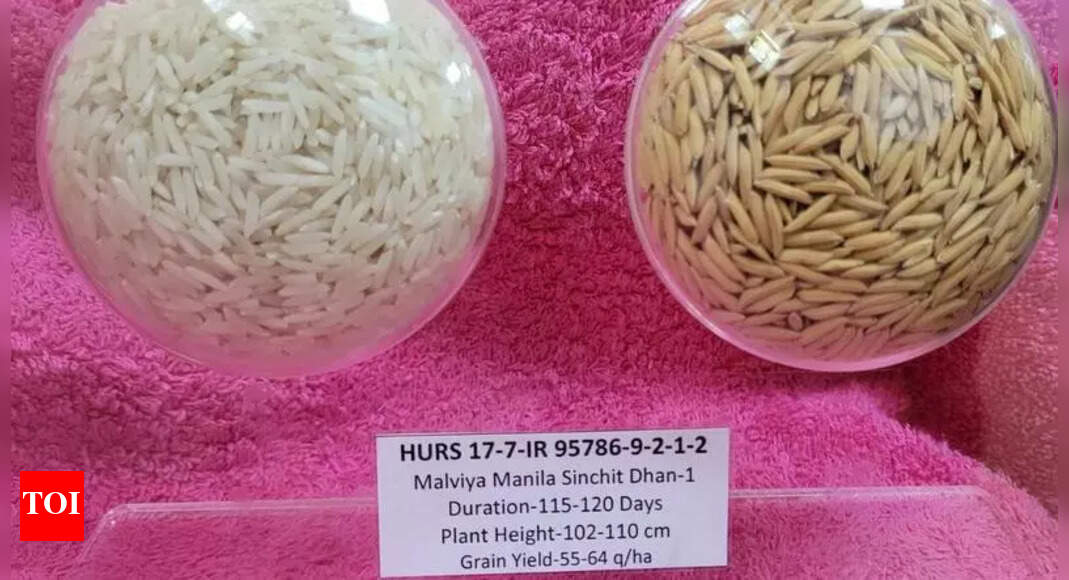
- Malaviya Manila Sinchit Dhan-1, Malviya Dhan 105 Sub-1, and Malviya Nidhi
- Malaviya Manila Sinchit Dhan-1 Maturity
- 115 to 120 days