

Archive · 1 Jun 2025
JWST Discovers Earliest Galaxy: MoM z14 Breaks Cosmic Records
Imagine a telescope that can see way back in time!
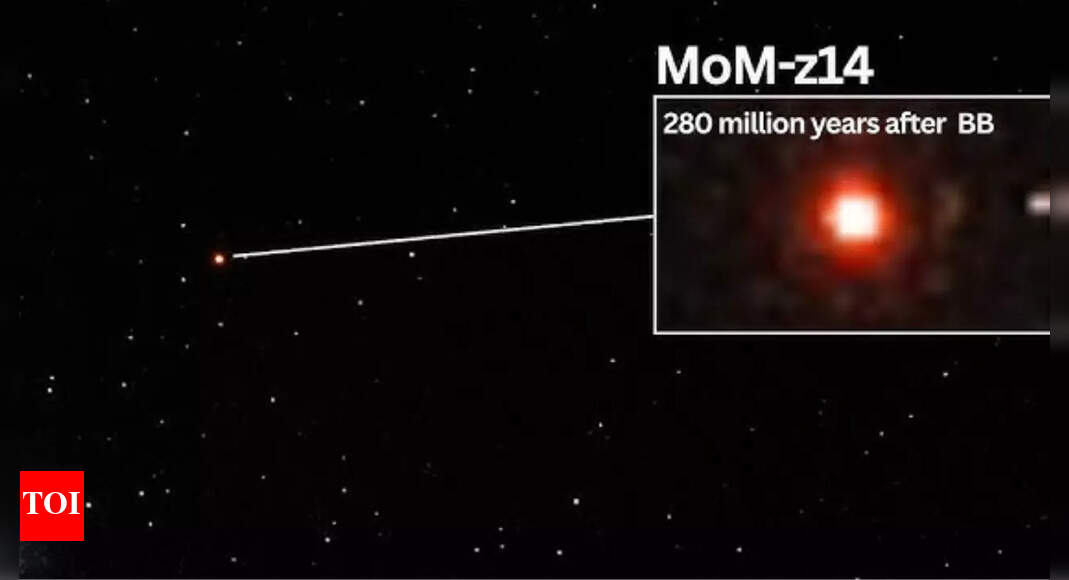
The James Webb Space Telescope (JWST) has found a super old galaxy called MoM z14.
This galaxy is from when the universe was just a baby, only 280 million years after it started.
It's so far away that the light from it has been stretched out, like a rubber band, making it 'redshifted.'
MoM z14 is much smaller than our own galaxy, the Milky Way, and it's making new stars super fast.
This discovery helps scientists learn how the first galaxies in the universe were made, and how they changed over time.

The James Webb Space Telescope (JWST) has discovered MoM z14, the most distant galaxy observed.
MoM z14 existed approximately 280 million years after the Big Bang.
The galaxy's redshift is z = 14.44, setting a new record for observation.
MoM z14 is about 50 times smaller than the Milky Way and rapidly forming stars.
The discovery provides insight into the early universe and galaxy formation.
- Who
- Scientists using the James Webb Space Telescope (JWST).
- What
- Discovered the earliest galaxy observed, named MoM z14.
- When
- Approximately 280 million years after the Big Bang.
- Where
- In the early universe.
- Why
- To understand the formation and evolution of early galaxies.
- Galaxy Name
- MoM z14
- Redshift
- z = 14.44
- Age
- 280 million years after the Big Bang
- Size
- Roughly 50 times smaller than the Milky Way
- Key Feature
- Rapid star formation