

Archive · 25 May 2025
Blue Light Exposure Increases Mutations in Yeast DNA
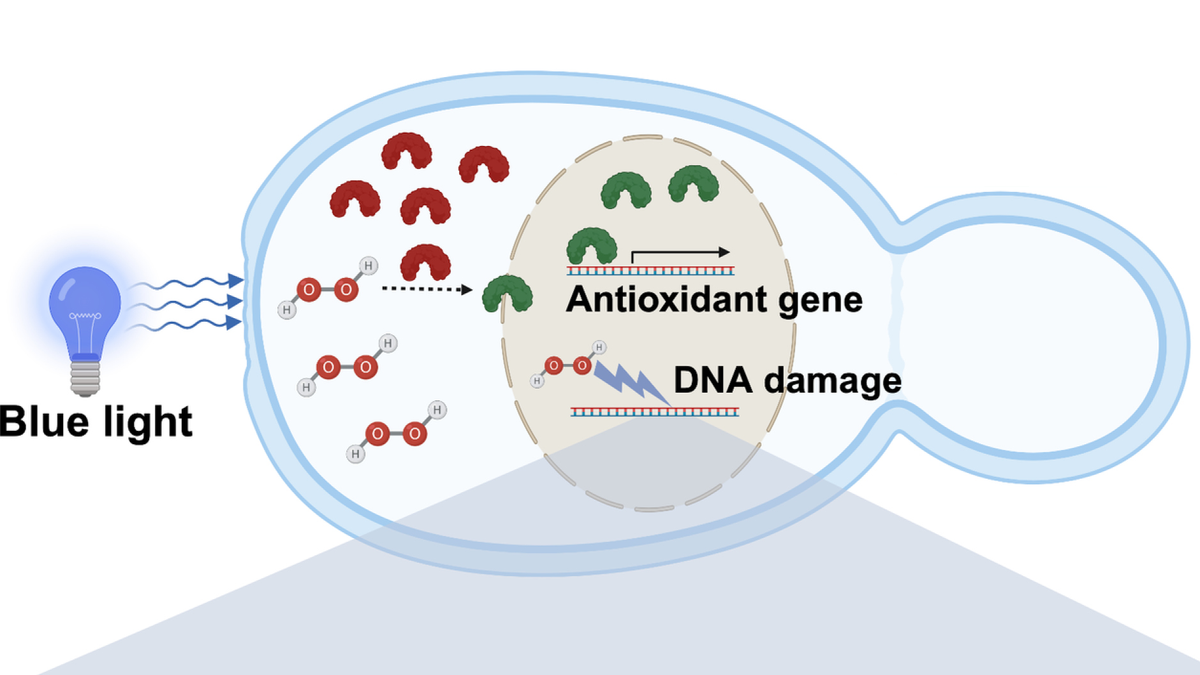
Imagine tiny yeast cells, like the ones that make bread rise.
Scientists looked at these cells and exposed them to different things, including blue light.
They found that blue light caused more mistakes in the yeast's DNA, like the cell losing genetic diversity.
This kind of mistake can be harmful.
The blue light created harmful molecules that damaged the DNA.
The team found that blue light induced unique kinds of DNA mutations, like it oxidised DNA bases causing errors in DNA copying.
Since yeast is similar to cells in other organisms, this suggests that blue light could be risky for them too.
The scientists are also exploring if blue light can be used to fight against harmful fungi.

Researchers found blue light increases genetic mutations in yeast.
The study used yeast cells grown in various conditions, including blue light exposure.
Blue light exposure led to the highest number of mutations.
The light caused DNA damage by producing reactive oxygen molecules.
The findings suggest a potential use of blue light as an antifungal agent.
- Who
- Researchers at the Indian Institute of Science Education and Research, Thiruvananthapuram.
- What
- Study shows blue light increases genetic mutations in yeast, potentially impacting other organisms.
- When
- Published May 25, 2025.
- Where
- Research conducted in the lab of Nishant K.T.
- Why
- To understand how environmental factors affect genetic mutations and to explore blue light as a potential antifungal agent.
- Lead Researchers
- Nishant K.T., Nikilesh Vijayan, Sameer Joshi, Praseetha Sarath
- Institution
- Indian Institute of Science Education and Research, Thiruvananthapuram
- Organism Studied
- Yeast
- Mutation Type
- Loss of heterozygosity (LOH)
- Cause of Damage
- Blue light generating reactive oxygen molecules
- Published In
- PLoS Genetics