

Archive · 5 Oct 2026
US Visa Bond Rule Covers 50 Countries, Excludes India
The United States has a rule that can ask some visitors to leave a large amount of money as a promise before getting a business or tourist visa.
The rule applies to eligible applicants using passports from 50 listed countries.
India is not on the list, but Bangladesh, Bhutan and Nepal are.
A consular officer decides whether a bond is required and whether it is $10,000, $15,000 or $20,000.
Paying the bond does not mean the person will definitely get a visa.
Applicants must wait for official instructions and pay through the government’s system.
Another person can pay, and the money may be returned if the traveler follows the rules.
Bondholders must use certain commercial airports and cannot enter or leave by land or sea.

The US visa-bond programme covers eligible B1/B2 applicants travelling on passports from 50 designated countries; India is not on the list.
A consular officer may set the bond at $10,000, $15,000 or $20,000 during the visa interview; paying does not guarantee visa approval.
Bangladesh, Bhutan and Nepal are included, with the articles reporting start dates of January 21 for Bangladesh and Nepal and January 1 for Bhutan.
Applicants must wait for official consular instructions, complete DHS Form I-352 and pay through Pay.gov; a third party may pay, and an eligible refund goes to the depositor.
Bondholders must use designated commercial airports or eligible preclearance locations and cannot use land or sea crossings, charter aircraft or general aviation.
- Who
- Eligible B1/B2 applicants travelling on passports from 50 designated countries; India is excluded.
- What
- Consular officers may require a $10,000, $15,000 or $20,000 visa bond.
- When
- The programme was made permanent under a final rule issued August 3, 2026; the State Department list was reported as updated in October 2026.
- Where
- The United States; the requirement applies regardless of where an affected applicant submits a visa application.
- Why
- The programme is linked to B1/B2 visa overstay data and is intended to encourage temporary visitors to maintain their status and depart as required.
Government rationale
Applicant requirements
Purpose of the bond
Government rationale
The State Department links the programme to B1/B2 overstay statistics and says it is intended to encourage visitors to maintain their status and depart as required.
Applicant requirements
Affected applicants may have to provide a substantial bond, and paying it does not guarantee visa approval.
Refund and compliance
Government rationale
The deposit may be returned when bond conditions are met, and the articles describe refunds in specified situations, including qualifying departures or visas that expire unused.
Applicant requirements
Refunds depend on complying with the bond and visa conditions; violations, including overstaying, can put the bond at risk and may be reviewed.
- Countries covered
- 50
- Visa categories
- B1/B2 business and tourist visas
- Bond amounts
- $10,000, $15,000 or $20,000, determined by a consular officer
- India
- Not included in the designated list
- South Asian countries included
- Bangladesh, Bhutan and Nepal
- Application and payment
- DHS Form I-352 and Pay.gov, only after a consular officer directs the applicant to post a bond
- Legal basis
- Section 221(g)(3) of the Immigration and Nationality Act
- Travel conditions
- Use designated commercial airports or eligible preclearance locations; land crossings, seaports, charter aircraft and general aviation are barred
Sources
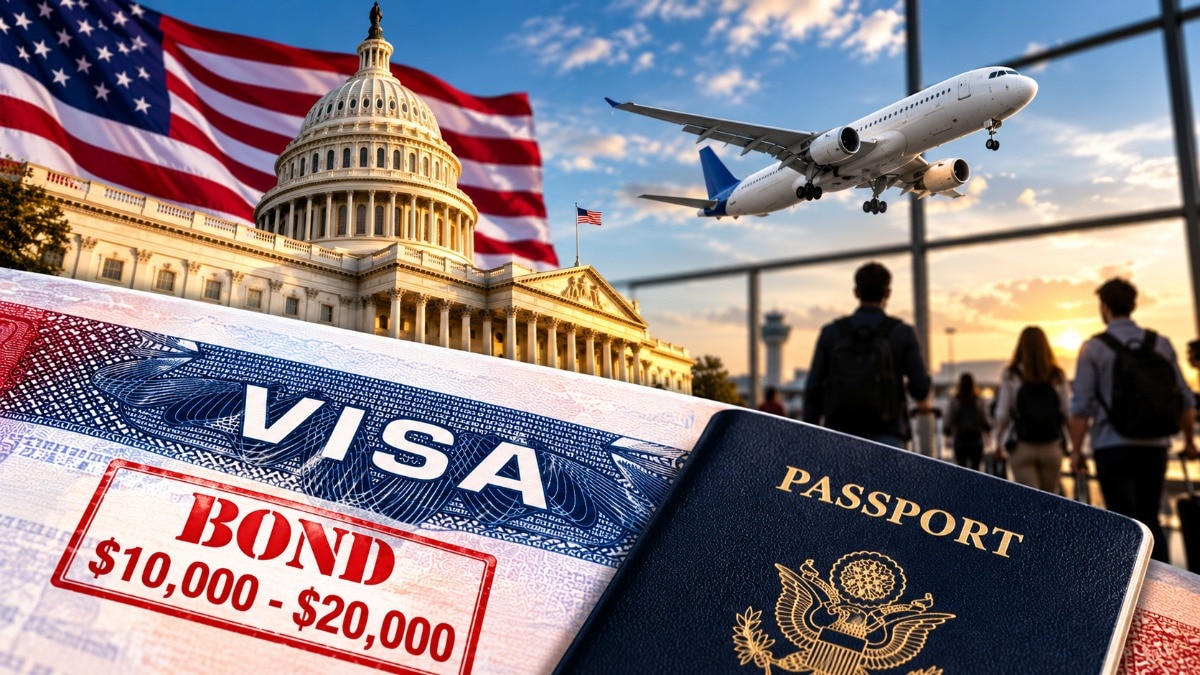
US Visa Bond: Is India safe from $20,000 deposit rule? Check full list of 50 countries

$20,000 US visa bond rule: Should Indians be worried? Check the complete list of affected countries
US demands up to $20,000 visa bond from 50 countries; India left out
US Visa Bond: India Exempt as 50 Countries Face Up to $20,000 Deposit

US visa bonds apply to 50 countries, India excluded