Archive · 5 Oct 2026
Uttar Pradesh Finds Wide Gaps Between Medicine Purchase Prices and MRPs
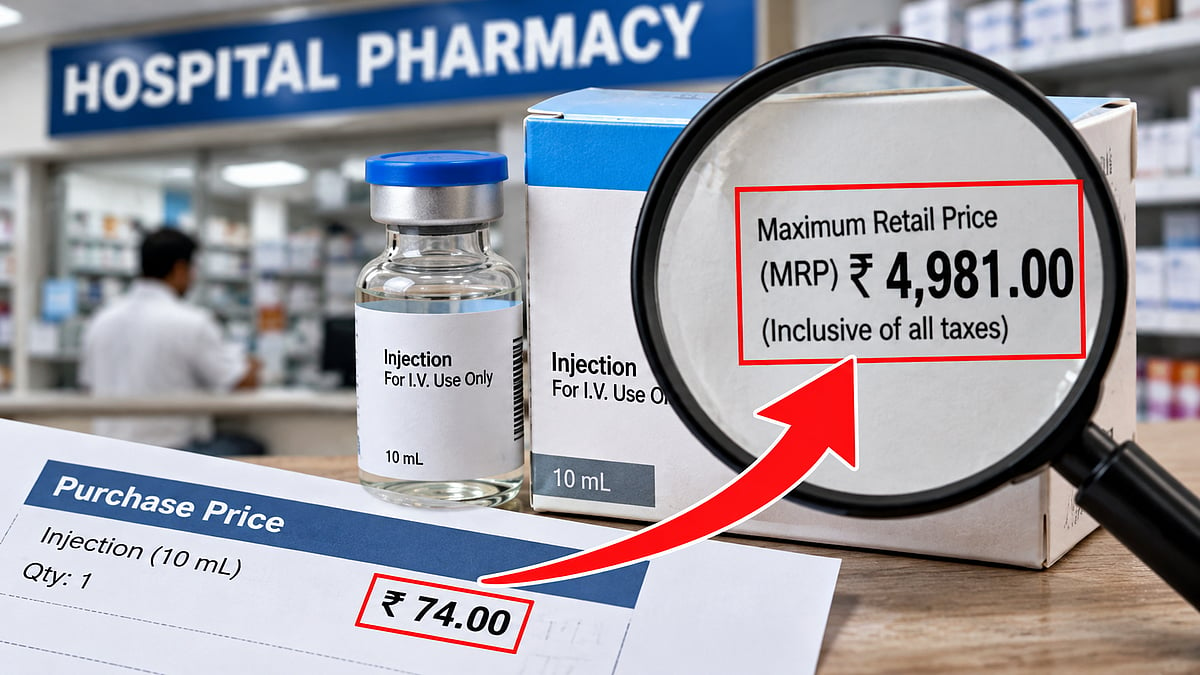
A government agency in Uttar Pradesh checked prices at hospital pharmacies.
It gathered information from 214 pharmacies and compared the purchase cost and printed price of 130 medicines.
For 36 medicines, the printed price was more than 10 times the purchase cost.
One injection was bought for ₹74.09 but had a printed price of ₹4,980.94.
The report also found large gaps for some other medicines and medical devices.
A high printed price does not mean the hospital keeps all the difference as profit.
Taxes, delivery and other costs may be included.
The agency is looking into why the gaps are so large.

The Uttar Pradesh Food Safety and Drug Administration examined 214 pharmacies at medical colleges and private hospitals.
It compared purchase prices and printed maximum retail prices for 130 medicines; 36 had MRPs more than 10 times their purchase prices.
Polymyxin-B injection had the largest reported gap: procured for ₹74.09 with an MRP of ₹4,980.94, about 67 times higher.
Other examples included an injection for serious liver disease priced at more than 54 times its purchase cost and caspofungin at about 26.5 times.
The agency is examining the reasons for the gaps; the report notes that the difference does not necessarily equal a hospital or pharmacy’s profit.
- Who
- The Uttar Pradesh Food Safety and Drug Administration (FSDA) conducted the examination.
- What
- It found large gaps between purchase prices and printed MRPs for some medicines sold through hospital pharmacies.
- Where
- Medical college and private hospital pharmacies across Uttar Pradesh.
- Why
- The agency is examining the reasons for the price gaps; the findings also raised questions about how MRPs and supply-chain margins are determined.
Patient and pricing concerns
Pricing context and qualifications
Effect of high printed prices
Patient and pricing concerns
Large gaps may add to patients’ bills, especially when medicines are available only through a hospital pharmacy or are needed during emergencies.
Pricing context and qualifications
The full difference between a purchase price and MRP is not necessarily profit; taxes, distribution costs, margins and other expenses may contribute.
Supply-chain margins
Patient and pricing concerns
The scale of the gaps raises questions about how MRPs are set and how much margin is built into the pricing chain.
Pricing context and qualifications
The FSDA says unusually high MRPs may allow substantial trade margins and discounts; it is examining the reasons for the gaps.
- Agency
- Uttar Pradesh Food Safety and Drug Administration (FSDA)
- Pharmacies examined
- 214
- Medicines analysed
- 130
- Medicines with MRP over 10 times purchase price
- 36
- Largest reported medicine price gap
- About 67 times
- Polymyxin-B example
- Procured for ₹74.09; printed MRP ₹4,980.94
- Medical-device examples
- A three-way stopcock cost ₹6.40 to procure and carried an MRP of ₹163; another device cost ₹20.95 and carried an MRP of ₹500