Archive · 2 Nov 2025
China Launches Shenzhou-21 with Youngest Astronaut and Mice to Tiangong Space Station

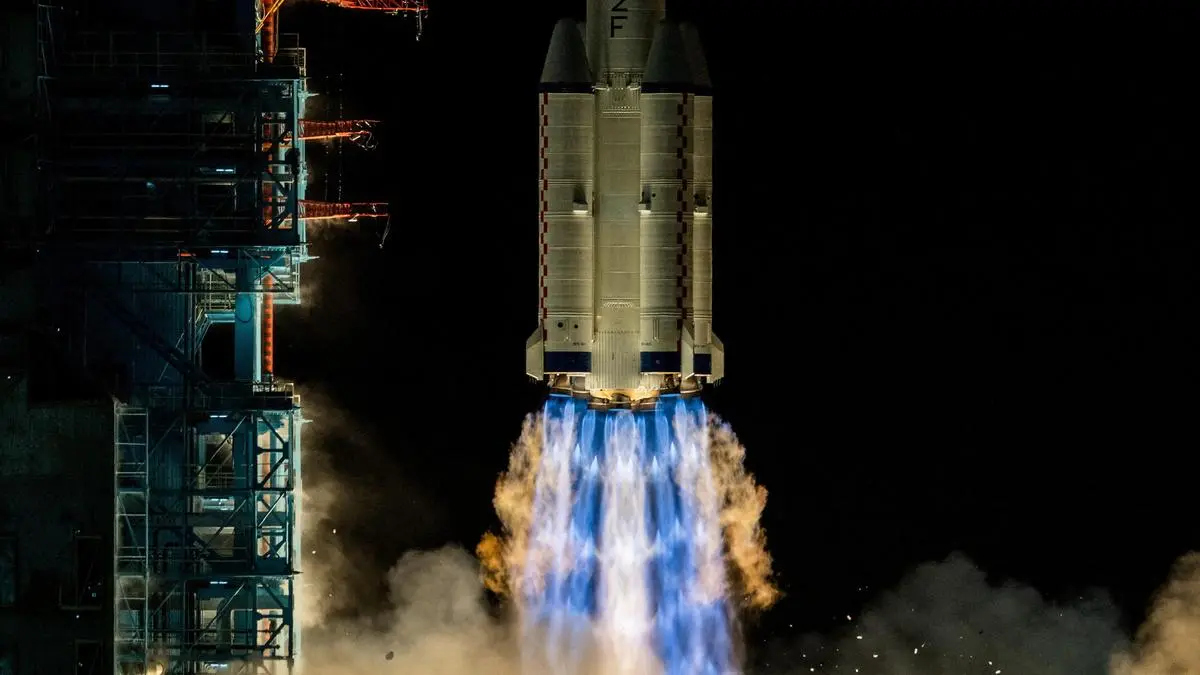
China has sent its newest space explorers, the Shenzhou-21 crew, into space on a big rocket.
This mission is special because it includes the youngest astronaut China has ever sent, who is only 32 years old!
They are also taking the first mice to live on China's space station, Tiangong.
These brave mice will help scientists learn about how animals grow and change in space.
The astronauts will live on the station for six months, working and doing important science.
They are taking over from another group of astronauts who have been there for a while.
This is one of many missions to China's space station, which is like a permanent home in orbit.
China is getting really good at space travel, sending younger astronauts and planning even more exciting missions.

China launched the Shenzhou-21 mission on a Long March-2F rocket from the Jiuquan Satellite Launch Centre.
The crew includes astronauts Zhang Hongzhang, Wu Fei (32, China's youngest astronaut), and Commander Zhang Lu.
The mission carries four laboratory mice for experiments on how weightlessness and confinement affect animal behavior.
The Shenzhou-21 crew will conduct 27 scientific experiments in areas like biotechnology, space medicine, and materials science.
This mission is part of China's space program, which aims to land astronauts on the Moon by 2030 and compete with the US and Russia.
- Who
- A crew of three Chinese astronauts, including Commander Zhang Lu, and first-time astronauts Zhang Hongzhang and Wu Fei (aged 32, China's youngest astronaut), along with four laboratory mice.
- What
- Launch and successful docking of the Shenzhou-21 spacecraft with the Tiangong space station.
- When
- Docked with Tiangong early Saturday, October 31, 2025, after launching on a Long March-2F rocket.
- Where
- Launched from the Jiuquan Satellite Launch Centre in northwest China, docking with the Tiangong space station.
- Why
- To dock with the Tiangong space station, with the crew to conduct scientific experiments (biotechnology, space medicine, materials science) and study the effects of weightlessness and confinement on the mice. This mission is part of China's ambition to compete in the global space race and establish a lunar presence.
China's Space Ambitions
International Competition
Space Race Goals
China's Space Ambitions
China aims to land astronauts on the Moon by 2030 and build a permanent lunar base, viewing its Tiangong space station as a central achievement.
International Competition
China's space program operates independently due to US national security concerns over its links to the military, leading it to build its own space station after being excluded from the ISS.
Lunar Exploration
China's Space Ambitions
China is actively pursuing lunar exploration with a fixed goal of a crewed Moon landing by 2030.
International Competition
The United States and Russia have long-established space programs, and China aims to compete with them, including on lunar missions.
- Mission Name
- Shenzhou-21
- Launch Date
- October 31, 2025
- Launch Vehicle
- Long March-2F rocket
- Launch Site
- Jiuquan Satellite Launch Centre, China
- Space Station
- Tiangong
- Crew Size
- 3 astronauts
- New Passengers
- 4 laboratory mice