

Archive · 7 Sep 2026
EOS-05 Completes First Orbit-Raising Manoeuvre En Route to GEO
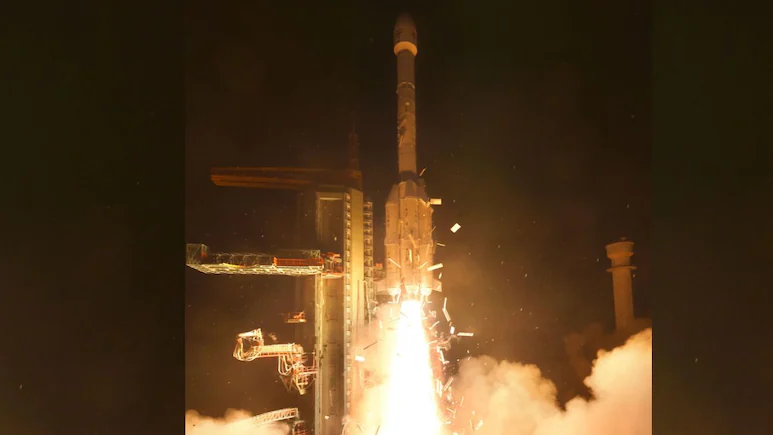
India launched a satellite called EOS-05 on September 4, 2026.
It was sent into a temporary orbit around Earth by the GSLV-F17 rocket.
The satellite then used its own engine to climb toward a higher orbit.
Its Liquid Apogee Motor fired for about one and a half hours on September 5.
After that, it reached a reported orbit of 20,000 kilometers by 31,129 kilometers.
More engine burns are planned before it reaches its final orbit.
In that orbit, EOS-05 will move along with Earth’s rotation and keep watching the same broad region.
It is designed to provide frequent images and continuous monitoring.
Its expected uses include border surveillance, weather tracking, disaster management, farming, and environmental observation.

India launched EOS-05 aboard GSLV-F17 from Sriharikota on September 4, 2026.
The satellite completed its first orbit-raising manoeuvre on September 5 at 8:19 p.m.
Its Liquid Apogee Motor fired for 5,406.4 seconds, or about 1.5 hours.
After the manoeuvre, EOS-05 was reported in an orbit measuring 20,000 km × 31,129 km; the articles differ on which figure represents apogee and perigee.
Further manoeuvres will move the satellite toward its intended geosynchronous orbit at 85.5° East, about 36,000 km above Earth.
- Who
- The Indian Space Research Organisation and its EOS-05 Earth observation satellite.
- What
- EOS-05 completed its first orbit-raising manoeuvre while traveling toward geosynchronous orbit.
- When
- The manoeuvre occurred on September 5, 2026, at 8:19 p.m.; the reports were published September 6.
- Where
- EOS-05 is being moved from a transfer orbit around Earth toward an operational orbit at 85.5° East.
- Why
- The satellite is intended to provide high-frequency Earth imaging, strategic surveillance, weather monitoring, disaster management, agricultural support, and environmental observation.
- Satellite
- EOS-05, an Earth observation spacecraft
- Launch
- GSLV-F17 from Sriharikota on September 4, 2026
- First manoeuvre
- September 5 at 8:19 p.m.; Liquid Apogee Motor burn lasted 5,406.4 seconds
- Reported post-manoeuvre orbit
- 20,000 km × 31,129 km; the articles differ in labeling apogee and perigee
- Target orbit
- Geosynchronous orbit at 85.5° East, approximately 36,000 km above Earth
- Satellite mass
- 2,367 kg, described as the heaviest satellite launched by a GSLV
- Expected operational life
- About nine years
- Planned uses
- Continuous Earth imaging, surveillance, weather and storm tracking, disaster management, agriculture, and environmental monitoring
