1 month ago
India's Offshore Mineral Extraction: Opportunities and Challenges
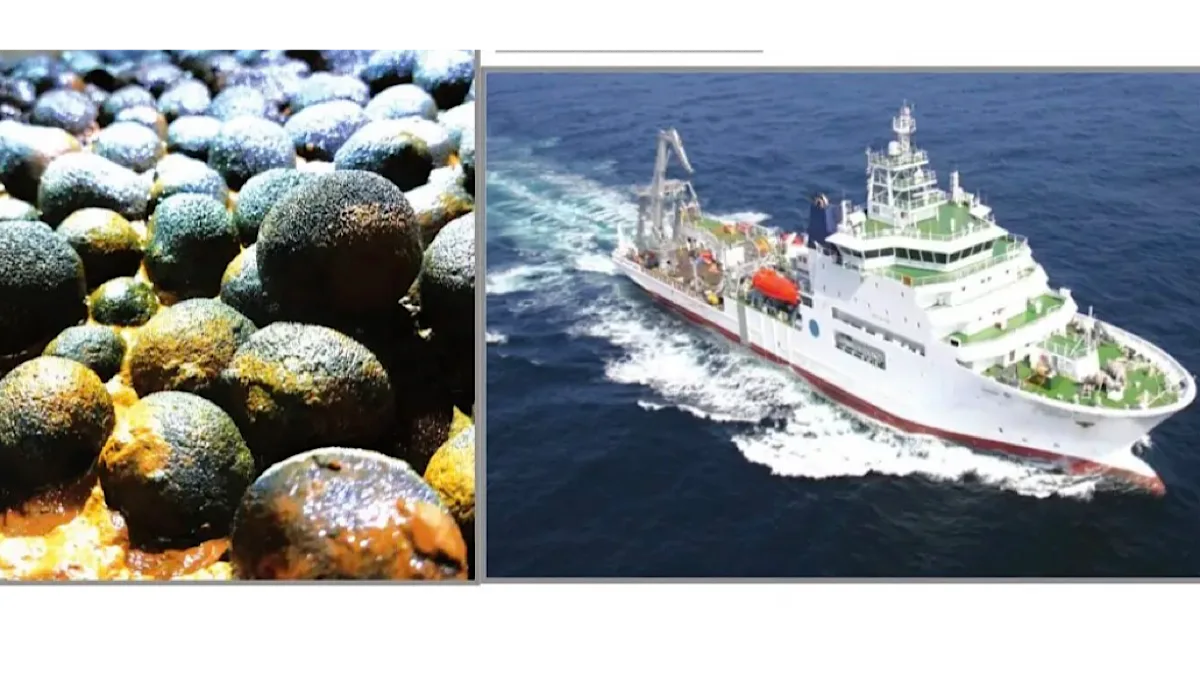
India has a lot of minerals in its oceans that could help the country.
These minerals are important for making steel, electronics, and other things.
The government has been studying these minerals for a long time and found lots of them, like lime mud, heavy minerals, and special metals.
But getting these minerals is hard and expensive.
It also needs special technology and can hurt the environment.
Some people think it's a good idea because it can create jobs and make India less dependent on other countries.
Others worry about the harm to marine life and the high costs.
The government is trying to make rules to make sure mining is done safely and responsibly.

India's Exclusive Economic Zone (EEZ) has vast untapped mineral resources, including lime mud, heavy minerals, and polymetallic nodules.
Offshore mining could reduce India's dependence on imports and support national priorities like infrastructure and energy security.
Technological and environmental challenges, as well as high capital costs, have hindered the development of offshore mineral extraction.
The Indian government has reformed the legal framework to attract investors and remove ambiguities in the sector.
Sustainable offshore mining, if scientifically regulated, could ease pressure on terrestrial ecosystems and provide economic benefits.
- Who
- India's Geological Survey of India (GSI) and other stakeholders
- What
- Exploration and potential extraction of offshore minerals
- Where
- India's Exclusive Economic Zone (EEZ) and offshore regions
- When
- Ongoing, with significant efforts since the early stages
- Why
- To meet growing demand for minerals, reduce import dependence, and support national priorities like infrastructure and energy security
Pro-Offshore Mining
Anti-Offshore Mining
Environmental Impact
Pro-Offshore Mining
Offshore mining, when regulated, can have a lower environmental impact compared to terrestrial mining, avoiding deforestation and freshwater depletion.
Anti-Offshore Mining
Offshore mining poses significant risks to marine ecosystems, including seabed disturbance and sediment plumes, which can harm benthic ecosystems.
Economic Viability
Pro-Offshore Mining
Offshore mining can generate substantial employment and economic benefits, supporting infrastructure development and reducing import dependence.
Anti-Offshore Mining
The high capital costs and long gestation periods make offshore mining economically unviable, especially without sustained public investment.
Key facts
- Exclusive Economic Zone (EEZ)
- Over 2 million square kilometres
- Lime Mud Deposits
- 154 billion tonnes off Gujarat and Maharashtra
- Heavy Mineral Placers
- 96 million tonnes along eastern and western continental shelves
- Construction-Grade Sand
- Close to a billion tonnes off the Kerala coast
- Polymetallic Nodules and Crusts
- Found in the Andaman and Lakshadweep Seas at depths of 1,000 to 1,500 metres
Sources
Related news

Joyalukkas Launches Primora Diamond Collection Worldwide

Jefferies sees 40% upside in Kalyan Jewellers shares

Ten Kautilya Students Secure Top Management Admissions Through IPMAT

Joyalukkas Launches Primora Diamond Collection Inspired by Hornbill Loyalty