

Archive · 26 Sep 2025
NASA Launches IMAP to Study the Sun's Protective Bubble
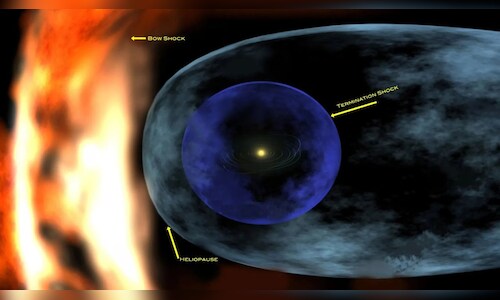
Imagine our Sun has a giant bubble around it, called the heliosphere, that protects Earth from dangerous stuff from space.
NASA just launched a new spaceship, IMAP, to study this bubble.
It travels nearly a million miles away to get a good look at the sun's activity.
IMAP will measure the sun's energy and particles to understand how it shields us.
The mission will provide early warnings of radiation storms, critical for astronaut safety on future trips to the Moon and Mars.
Scientists hope to learn how the sun influences space and how to prepare for space travel.

NASA launched the Interstellar Mapping and Acceleration Probe (IMAP) on September 24.
IMAP will study the heliosphere, the Sun's protective bubble.
The spacecraft will travel to Lagrange Point 1 (L1), nearly a million miles from Earth.
IMAP will analyze solar wind and other energetic particles.
The mission will offer advance warning for radiation storms and help prepare for future space missions.
- Who
- NASA
- What
- Launched the Interstellar Mapping and Acceleration Probe (IMAP) to study the heliosphere.
- When
- September 24
- Where
- Launched from Kennedy Space Center, Florida, going to Lagrange Point 1 (L1)
- Why
- To understand how the Sun protects Earth and to aid in future space missions.
- Mission Name
- Interstellar Mapping and Acceleration Probe (IMAP)
- Launch Date
- September 24
- Launch Location
- Kennedy Space Center, Florida
- Destination
- Lagrange Point 1 (L1)
- Distance to L1
- Nearly one million miles from Earth
- Mission Duration to L1
- About 108 days
- Primary Goal
- Study heliosphere