1 hr ago
Armani Enters Pivotal Year as Stake Sale Plans Advance
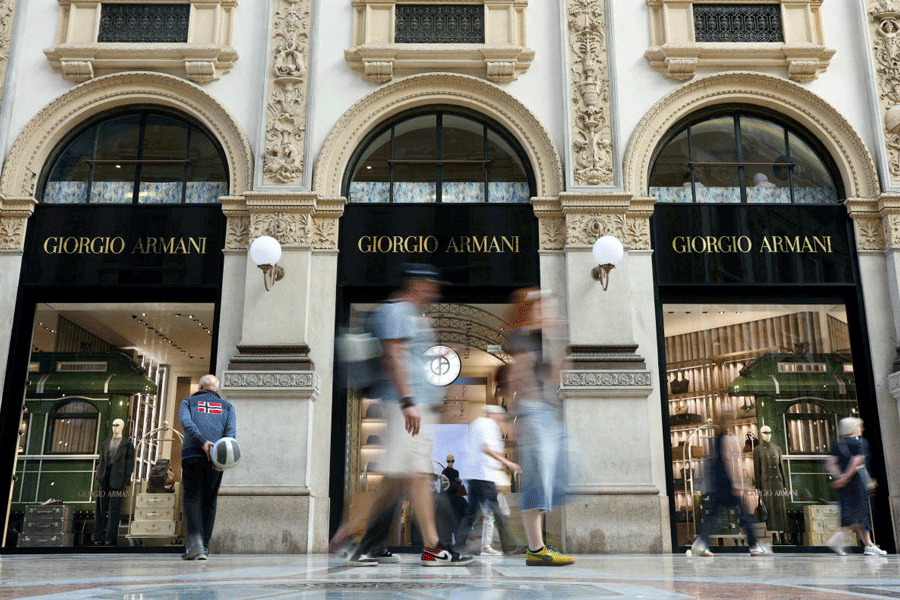
Giorgio Armani died on September 4, 2025, and left instructions about what should happen to his company.
He wanted about 15% of the company to be sold after 12 to 18 months.
A bigger sale or a stock-market listing could happen later.
The company spent the first year working on its leadership and governance.
Its sales fell slightly during that time.
The new chief executive wants to keep Armani’s elegant style while helping the company change.
Several large companies may be interested in buying part of Armani.
However, the sale might wait if the market does not offer a good enough price.
The company also needs to decide how to grow without depending completely on its founder’s legacy.

Giorgio Armani’s will calls for an initial sale of about 15% of Armani 12 to 18 months after his death.
The fashion group’s sales fell 2.8% at constant currencies to €2.2 billion over the last year.
CEO Giuseppe Marsocci is preparing a business plan focused on long-term brand identity rather than short-term fixes.
Potential buyers named in the will include LVMH, EssilorLuxottica and L’Oréal, although a sale could be delayed.
Advisers estimate Armani’s value at roughly €5 billion to €7 billion, while the group held €500 million in net cash at the end of 2025.
- Who
- Armani’s heirs, advisers and management, led by CEO Giuseppe Marsocci, are overseeing the next stage; potential buyers include LVMH, EssilorLuxottica and L’Oréal.
- What
- Armani is preparing for a possible initial sale of about 15% of the company, followed by a larger disposal or stock-market listing.
- Where
- The Italian fashion house Armani; the articles do not identify a specific location for the potential transaction.
- When
- The process follows Giorgio Armani’s death on September 4, 2025; the first sale was specified for 12 to 18 months afterward, with activity expected to accelerate in the coming weeks.
- Why
- The plan follows instructions in Giorgio Armani’s will and is intended to shape the company’s ownership and succession while preserving its brand identity.
Continuity and Founder Legacy
Evolution and Greater Autonomy
Future direction
Continuity and Founder Legacy
Management says Armani should remain faithful to Giorgio Armani’s long-term vision of essential, elegant, wearable clothing and attention to detail.
Evolution and Greater Autonomy
Consultants say continuity could become risky if it turns into inertia, and the company must develop a more autonomous decision-making system.
Timing of the stake sale
Continuity and Founder Legacy
People close to the matter say there is no pressure to complete a sale immediately, and the deadlines in the will are not strictly binding.
Evolution and Greater Autonomy
The process is expected to accelerate, and a transaction could proceed if market conditions support an adequate valuation.
Potential ownership structure
Continuity and Founder Legacy
An investment by a major luxury or licensing partner could help protect existing fashion, eyewear and beauty agreements.
Evolution and Greater Autonomy
A larger luxury group such as LVMH may prefer control, while a future initial public offering could complicate a takeover and preserve a different ownership path.
Key facts
- Founder
- Giorgio Armani died aged 91 on September 4, 2025.
- Initial sale
- His will specified a first sale of around 15% of the company 12 to 18 months after his death.
- Later ownership option
- The will called for a larger stake disposal or a bourse listing after the initial sale.
- Recent sales
- Armani’s sales declined 2.8% at constant currencies to €2.2 billion over the last year.
- Estimated valuation
- Bankers and advisers estimated the group’s value at about €5 billion to €7 billion.
- Net cash
- Armani had €500 million in net cash at the end of 2025.
- Financial adviser
- The company is reportedly working with Rothschild on the stake sale.
Quotes
Francesco Fiorese
Partner at consultancy Simon Kucher
“a succession model based on Giorgio Armani's legacy to a more autonomous system, capable of making its own decisions while still preserving the brand's identity.”
 telegraphindia.com
“The great challenge will be maintaining the balance between the identity that defines us and the inevitable evolution we will have to pursue.”
telegraphindia.com
Sources
Related news

Next Tata Chairman Faces Toughest Job, Management Professor Warns
N Chandrasekaran resigns as Tata Sons chairman ahead of AGM

Ambani succession plan faces scrutiny over Vantara wildlife sanctuary
Tata Sons faces most complex succession test after Chandrasekaran
Tata Sons Chairman Succession Delayed
Noel Tata Emerges as Key Power Broker in Tata Group

India Glycols Demerger Seen Unlocking Shareholder Value; Buy Maintained

Global FMCG Giants Boost Investments in India Amid Strong Demand

Telangana to Showcase Growth Vision in Davos
Amy Jackson's 2025: Family Joy and Career Milestones