

Archive · 16 Aug 2026
New Saudi-Pakistan-Turkey pact should worry US, ex-minister says
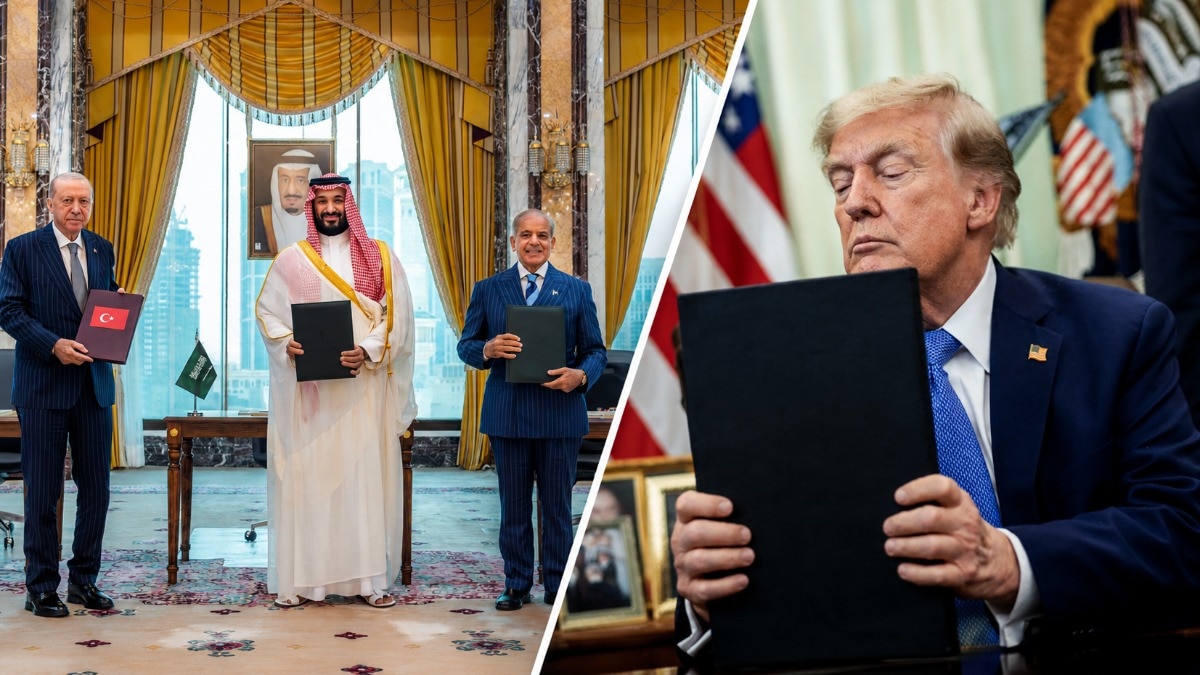
Three countries — Saudi Arabia, Pakistan and Turkey — agreed to help each other if one of them is attacked.
They signed this agreement in the city of Mecca.
The agreement works a bit like NATO, where an attack on one country is treated as an attack on all.
A former United Kingdom minister named Stewart said Saudi Arabia probably would not want to fight a war with India.
He also warned that the United States should be worried because it is not part of the plan.
Another expert, Campbell, said India's government stayed calm and played the deal down.
Some Indian news outlets called the pact an 'Islamic NATO'.
The experts are not sure the three allies would really defend each other, such as in a fight with Iran.
This agreement shows that some countries want to manage big security problems on their own.

Saudi Arabia, Pakistan and Turkey signed a joint defence agreement in Mecca on August 7 with a NATO-like clause treating an attack on one as an attack on all three.
Former UK minister Stewart said Saudi Arabia is unlikely to want to be drawn into a war with India.
Stewart warned the pact has no US imprint and should worry Washington because the US loses command and control.
Analysts questioned whether Turkey and Pakistan would defend Saudi Arabia against Iran, noting both have been softer on Tehran than Riyadh.
Strategist Campbell said India's government played down the pact, signalling New Delhi did not see it as Saudi Arabia abandoning India.
- Who
- Saudi Arabia, Pakistan and Turkey, who signed the agreement; former UK minister Stewart and British strategist Campbell analysed it.
- What
- A joint defence agreement with a NATO-like mutual attack clause, raising questions about India, Iran and the US role.
- When
- The agreement was signed on August 7.
- Where
- Mecca, Saudi Arabia.
- Why
- Ali Shihabi said the alliance reflects recognition that American deterrence has weakened and the Iranian threat must be managed by regional powers; Stewart said it should worry Washington because it has no US imprint.
Analysts and skeptics
Pact proponents and Washington framing
Burden sharing with Washington
Analysts and skeptics
Stewart said this is not burden sharing, because the pact has no US imprint, coordination or strategy and the US would lose command and control over the region.
Pact proponents and Washington framing
Attempts in the US portray the pact as a form of burden sharing that lets regional partners take on a larger share of defence responsibilities.
Threat to India
Analysts and skeptics
Indian media described the arrangement as an 'Islamic NATO', 'Muslim NATO' or 'Sunni NATO', suggesting a bloc aimed at India.
Pact proponents and Washington framing
India's government played the pact down, signalling it did not see the agreement as Saudi Arabia abandoning India and declining to give Pakistan the reaction it probably wanted.
Ability to act like NATO
Analysts and skeptics
Stewart said the alliance lacks NATO-style integration of systems and headquarters, and questioned whether Saudi Arabia or Turkey would intervene in an India-Pakistan conflict when neither joined the Yemen Houthi flare-up.
Pact proponents and Washington framing
Ali Shihabi said the alliance reflects recognition that American deterrence has weakened and the Iranian threat will increasingly need to be managed by regional powers.
- Agreement
- Joint defence agreement between Saudi Arabia, Pakistan and Turkey
- Date signed
- August 7
- Location
- Mecca, Saudi Arabia
- Key provision
- An attack on one country is considered an attack on all three (NATO-like clause)
- Turkey's status
- NATO member
- Analysts quoted
- Former UK minister Stewart; British strategist Campbell
- Saudi commentator
- Ali Shihabi, considered close to the Saudi royal court
- Media labels
- 'Islamic NATO', 'Muslim NATO' or 'Sunni NATO' in Indian media