

Archive · 16 Nov 2025
Astronauts Share Stunning Images of Frozen Lava Rivers on Mars Volcano
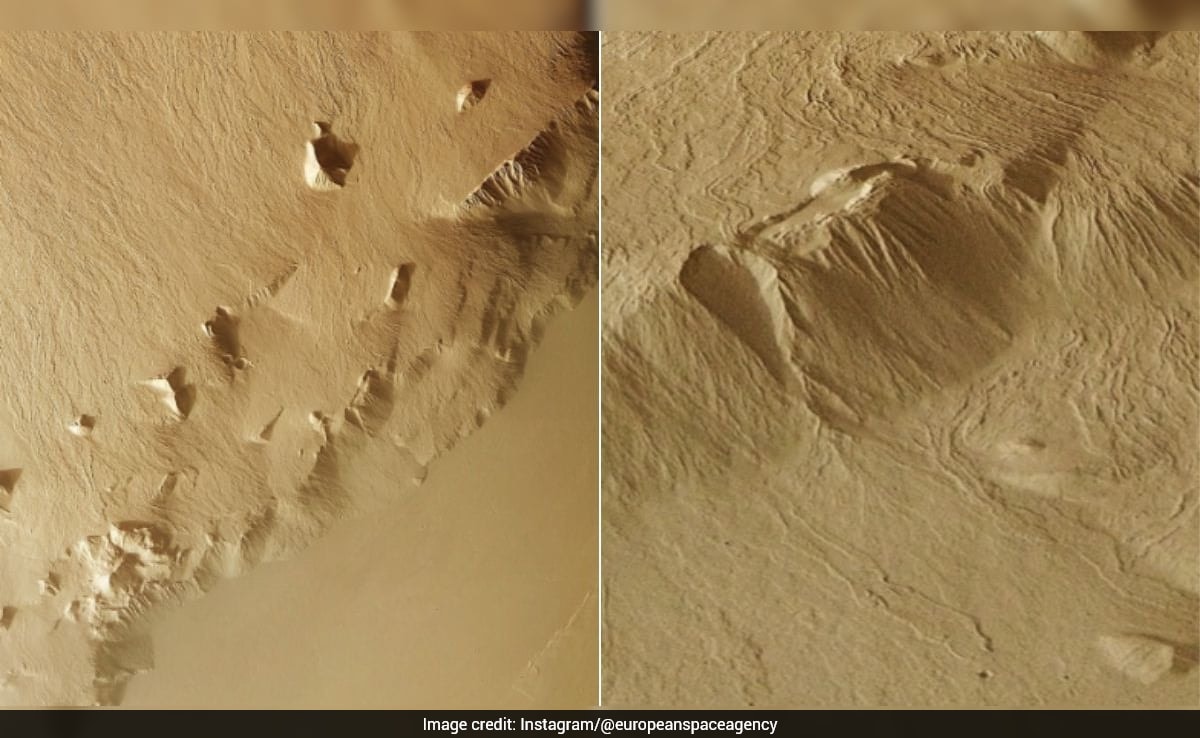
Imagine a giant volcano on Mars called Olympus Mons, which is super tall and wide, way bigger than any mountain on Earth!
Astronauts sent us amazing pictures of its bottom part.
These pictures show giant frozen rivers of lava that once flowed down the volcano.
There are also really high cliffs, and evidence of big landslides that sent rocks far away.
Scientists think this volcano is not active anymore and has been quiet for a very long time.
The surface looks quite new because lava flows kept smoothing it out.
It's like looking at a giant, old, frozen waterfall made of rock!

Stunning images of Olympus Mons, the solar system's largest volcano, have been shared by ESA.
The images reveal frozen lava rivers, steep cliffs, and traces of ancient collapses on the volcano's southeast flank.
Olympus Mons stands at 27 km high with a base over 600 km wide and is considered dormant.
A scarp, up to 9 km high, encircles the volcano, formed by massive landslides.
Evidence suggests a complex past involving lava flows, water, and possibly a horseshoe-shaped channel.
- Who
- European Space Agency (ESA) astronauts (via Mars Express orbiter)
- What
- Shared stunning images revealing frozen lava rivers, steep cliffs, ancient collapse traces, and a large scarp at the foot of Olympus Mons, the largest volcano in the solar system.
- When
- Recent (images shared recently, likely captured during ongoing Mars exploration)
- Where
- Olympus Mons, Mars (specifically its southeast flank and lower plains)
- Why
- To showcase the geological features and complex history of Mars' largest volcano.
- Volcano Name
- Olympus Mons
- Height
- 27 km
- Base Width
- Over 600 km
- Solar System Rank
- Largest volcano
- Discovery Year
- 1971
- Formation Period
- Around 3.5 billion years ago
- Current Status
- Dormant
- Scarp Height
- Up to 9 km