

Archive · 19 Jan 2026
Kerala's Debt-Ridden Economy: Myth vs Reality
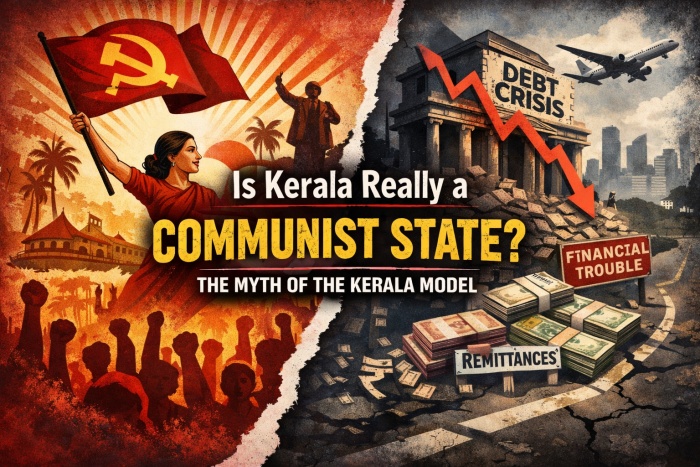
Kerala's government has been saying that they have ended extreme poverty and that their communist policies are working.
They show numbers like very low poverty and good health to support this.
But other people say this is not true.
They point out that Kerala is not really communist because it still has private businesses and depends on money from the central government.
They also say that Kerala's debt is very high and growing fast.
The Supreme Court even told Kerala that it is not managing its money well.
So, while Kerala is doing some good things, it might not be as successful as it claims, and it might be hiding some problems.

Kerala's government claims to have eradicated extreme poverty, but data shows poverty was already near zero before their recent programs.
Kerala is not a communist state as it operates within India's capitalist framework, with private property and markets.
The state's debt has tripled in ten years, reaching ₹4.5 lakh crore, with a debt-to-GDP ratio of 34%.
Kerala depends on central government financial relief and borrowing to cover expenses, raising concerns about fiscal mismanagement.
Critics allege data manipulation in poverty statistics and question the sustainability of Kerala's economic model.
- Who
- The Communist-led government of Kerala and its supporters
- What
- Claims of poverty eradication and communist success in Kerala
- When
- Recent years, with specific data from 2019-2021 (NFHS-5) and 2024 (Supreme Court borrowing case)
- Where
- Kerala, India
- Why
- To promote the 'Kerala Model' as a communist success story, despite economic and ideological discrepancies
- Extreme Poverty Rate (NFHS-5)
- 0.5%
- Total Public Debt (Projected 2024-25)
- ₹4.5 lakh crore
- Debt-to-GDP Ratio
- 34%
- Central Government Financial Relief (2024)
- ₹13,000 crore
- Poverty Reduction (2016-2021)
- 0.7% to 0.5%
- Initial Debt (2014)
- ₹1.6 lakh crore
- Scheduled Tribe Families (Discrepancy)
- 6,400 (claimed) vs 1 lakh (2011 Census)