

Archive · 11 Aug 2025
Interstellar Cloud May Have Reshaped Earth's Climate
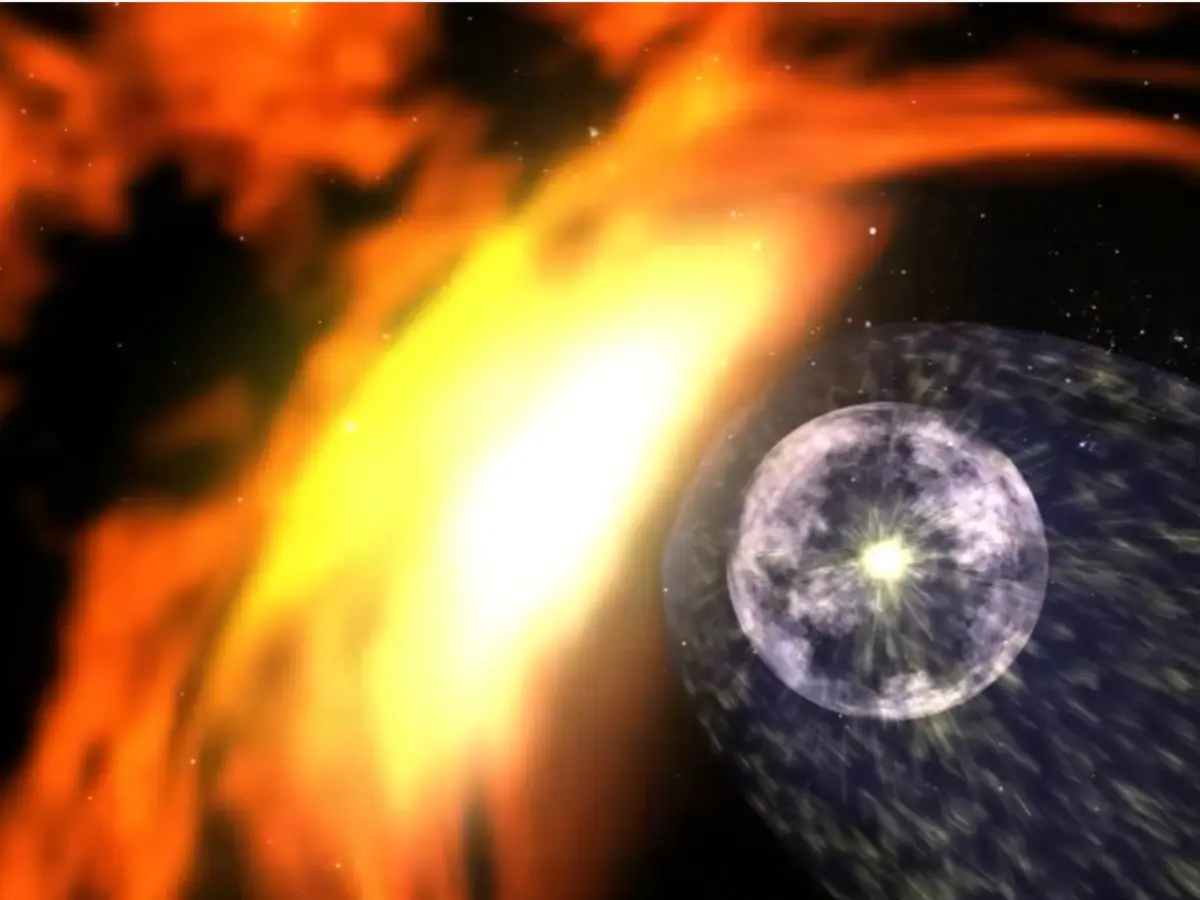
Imagine the Sun and Earth have a giant bubble around them that protects us from space stuff.
Scientists think that a long time ago, our solar system went through a really thick cloud in space.
This cloud squeezed the bubble, letting more space stuff get to Earth.
This could have changed the air and made the planet cooler.
Evidence like special particles found in ice and rocks supports this idea.
The scientists believe that this type of event could happen again.

A 2024 study suggests the solar system passed through a dense interstellar cloud.
This cloud encounter may have compressed the heliosphere, Earth's protective shield.
Geological traces of iron-60 and plutonium-244 support the theory of cosmic material reaching Earth.
The event could have altered Earth's atmospheric chemistry and caused global cooling.
Scientists estimate another such encounter could happen within the next million years.
- Who
- Scientists studying the impact of interstellar clouds on Earth.
- What
- The solar system may have passed through a dense interstellar cloud, impacting Earth's climate.
- When
- Millions of years ago and potentially again in the next million years.
- Where
- Through a dense interstellar cloud.
- Why
- To understand how interactions with interstellar clouds have shaped Earth's climate and could impact it in the future.
- Study Publication
- Nature Astronomy, 2024
- Interstellar Cloud Type
- Part of the Local Ribbon of Cold Clouds
- Particle Density in Cloud
- More than 1,000 times higher than current environment
- Shield Affected
- Heliosphere
- Evidence
- Iron-60 and Plutonium-244 isotopes
- Potential Climate Effect
- Global Cooling