48 mins ago
India's Intellectual Swaraj Faces Questions Over Government Control
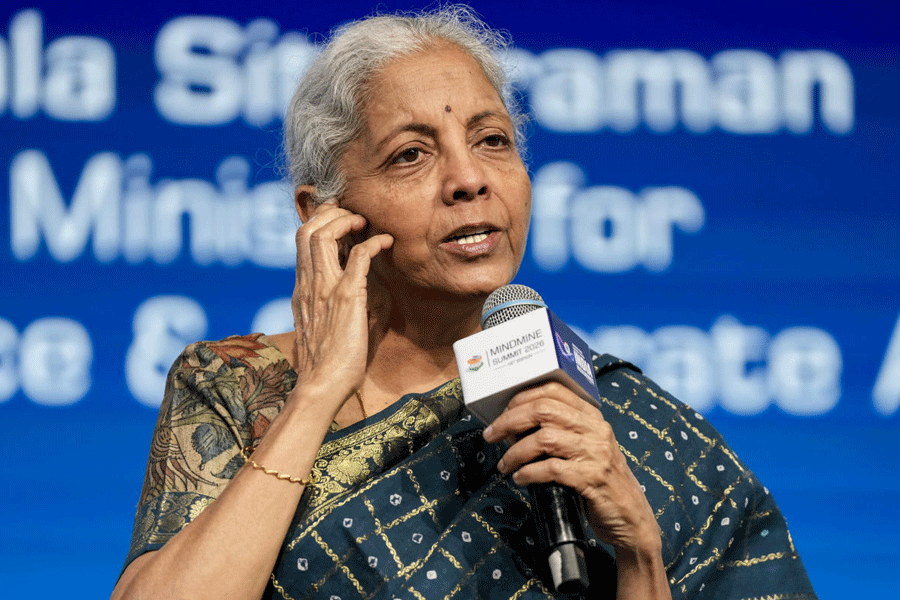
Nirmala Sitharaman said India is becoming more intellectually free.
She said people should be able to study India’s history and culture in many different ways.
She mentioned inscriptions, sea trade and mathematics as important subjects.
She also said India became economically independent in 1991.
In her view, intellectual freedom means using more archives, languages and viewpoints.
The editorial questions whether this freedom really exists today.
It says some people are punished or imprisoned for asking difficult questions.
It also says textbooks and universities may be increasingly shaped by the government.

Finance Minister Nirmala Sitharaman said India was gaining intellectual freedom to study its history and cultural heritage.
She cited inscriptions, maritime trade and mathematics as areas that could broaden historical understanding.
Sitharaman linked India’s economic independence to 1991 and said intellectual decolonisation was only now beginning.
She argued that wider archives, multiple languages and competing interpretations could define an age of intellectual swaraj.
The editorial disputes this vision, citing alleged penalties for questioning, textbook omissions and greater government influence in higher education.
- Who
- Union Finance Minister Nirmala Sitharaman and the editorial’s critics of the government’s approach.
- What
- A debate over the government’s idea of intellectual freedom, historical study and intellectual swaraj in India.
- Where
- At the Foundation for Indian Historical and Cultural Research in India.
- When
- The article does not specify when Sitharaman delivered the speech.
- Why
- Sitharaman presented intellectual decolonisation as expanding, while the editorial argued that government control and omissions may be limiting genuine intellectual freedom.
Government’s vision
Editorial’s criticism
Meaning of intellectual freedom
Government’s vision
Sitharaman said intellectual freedom gives Indians the right to understand their history and cultural heritage through wider archives, multiple languages and competing ideas.
Editorial’s criticism
The editorial argued that this vision appears more like a myth because the government may be limiting which questions, evidence and perspectives receive space.
Historical education
Government’s vision
Sitharaman supported rereading inscriptions and studying India’s maritime trade and contributions to mathematics as part of decolonising history.
Editorial’s criticism
The editorial said replacing textbooks while leaving out sections of history preferred by the government is not intellectual freedom.
Role of government in education
Government’s vision
Sitharaman presented the current period as the beginning of India’s intellectual freedom and decolonisation.
Editorial’s criticism
The editorial said the government is increasingly involved in higher-education administration, appointments, subjects and research, potentially producing the opposite of intellectual freedom.
Key facts
- Speaker
- Nirmala Sitharaman, India’s Union finance minister
- Speech venue
- Foundation for Indian Historical and Cultural Research
- Central concept
- Intellectual swaraj, or intellectual self-rule
- Economic independence
- Sitharaman said India gained economic independence in 1991
- Historical subjects cited
- Inscriptions, maritime trade and mathematics
- Editorial concern
- The government may be suppressing questions, omitting history and expanding influence over higher education
Sources
Related news
Sitharaman Calls for Wider Archives in India’s Decolonisation
Sitharaman Praises Bhyrappa, Urges Open Intellectual Debate
Amit Shah Calls for Indian Perspective on Historical Truth
BJP Rule and the Erosion of Academic Freedom in India

Amit Shah Urges Asiatic Society to Spread Indian Knowledge