

Archive · 10 Nov 2025
Sea Urchins Possess a Brain-Like Nervous System Throughout Their Bodies
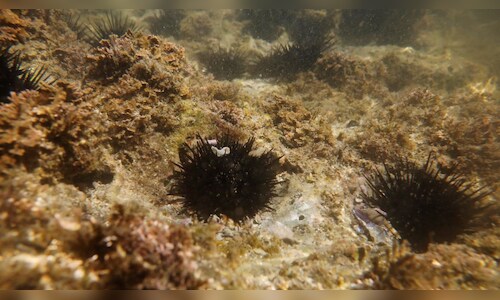
Imagine a creature that doesn't have one central brain like humans do.
Scientists found that sea urchins are like that!
Their nerves are spread all over their spiky bodies, acting like a brain for their entire being.
This is very different from how many other animals' brains are packed in one place.
They also found tiny parts in their skin that can see light, similar to what's in our eyes.
This amazing discovery shows us that nature is very creative.
It teaches us that brains don't always have to be a single organ to do complex jobs.
Sea urchins are helping us learn new things about how brains can be organized and how life evolves.

Scientists have discovered that sea urchins possess a distributed, brain-like nervous system throughout their entire body.
This contrasts with a centralized brain found in most animals, suggesting complex neurological organization is possible without a single brain organ.
Sea urchins also have light-sensitive cells covering their bodies, which express proteins found in human retinal components.
Researchers used advanced genetic and cellular analysis to map hundreds of different types of neurons in the sea urchins.
The findings challenge traditional notions of what constitutes a brain and how complex nervous systems can evolve.
- Who
- Scientists from the Museum fur Naturkunde Berlin and international collaborators
- What
- Discovered that sea urchins have a distributed, brain-like nervous system and light-sensitive cells across their bodies
- When
- Recent study (specific date not mentioned)
- Where
- Research conducted by teams from Berlin, Naples, Villefranche-sur-Mer, and Lyon; observed in sea urchins
- Why
- To understand how sea urchins manage drastic body-plan transformations from larval to adult stages
- Institution
- Museum fur Naturkunde Berlin and international collaborators
- Research Focus
- Sea urchin nervous system and body-plan transformation
- Key Findings
- Brain-like distributed nervous system, body-wide light-sensitive cells
- Methodology
- Single-cell and gene expression analysis
- Implication
- Complex neurological systems can evolve without a centralized brain