

Archive · 22 Jul 2026
100km asteroid explosion altered Moon and Earth 800mn years ago
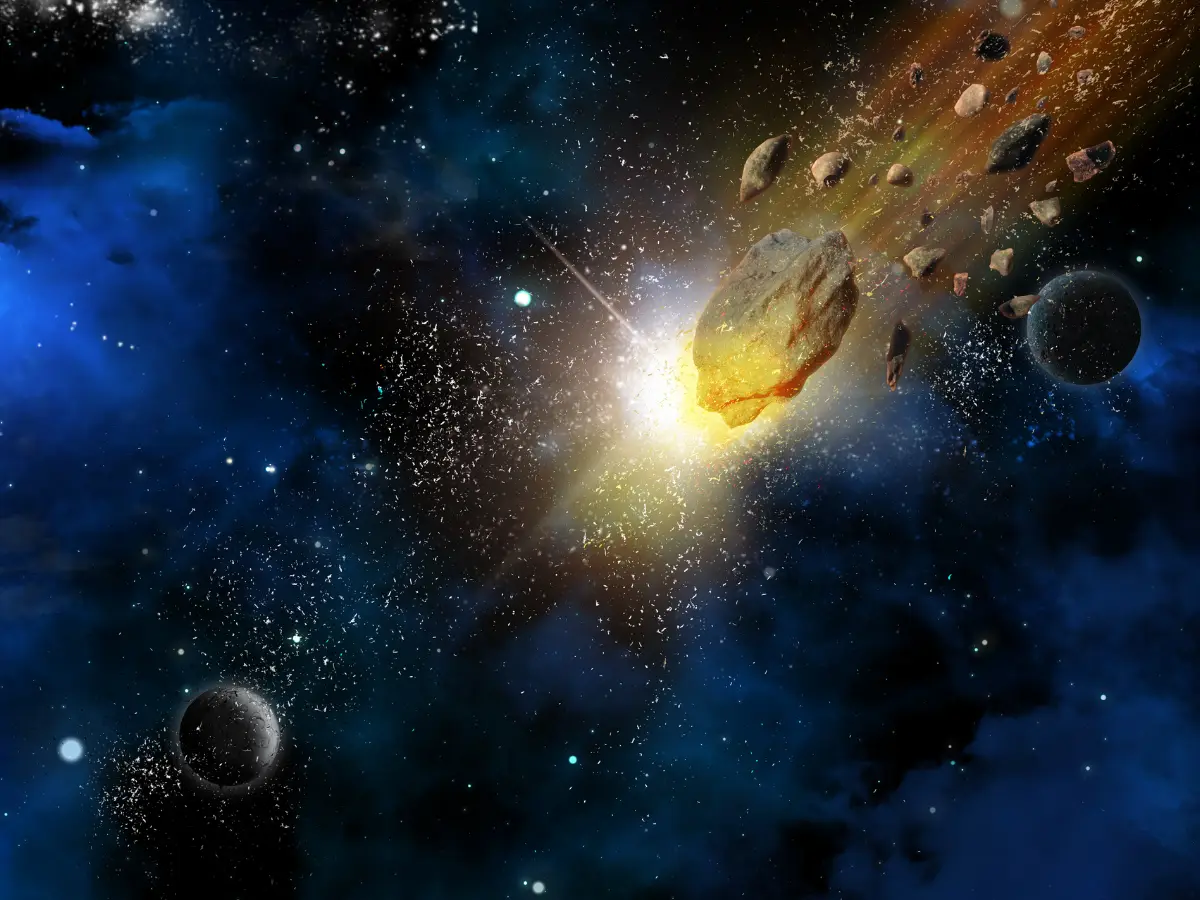
A long time ago, about 800 million years, a huge asteroid, about 100 kilometers wide, broke apart near a special point in space.
This point is near Jupiter and acts like a cosmic slingshot, sending pieces of the asteroid flying towards the inner solar system.
Over the next 150 million years, these pieces caused a lot of crashes on the Moon and Earth.
On the Moon, we see many craters from this time, like the big Copernicus crater.
On Earth, the crashes might have caused a lot of dust in the air, which messed up the carbon cycle and led to a big ice age called the 'Snowball Earth'.
Scientists think most of the asteroids near Earth today come from this big breakup.

A 100km asteroid broke apart near the 3:1 mean motion resonance with Jupiter 800 million years ago.
The breakup led to a significant increase in asteroid activity and crater formation on the Moon and Earth.
The Copernicus crater on the Moon and glass beads from Apollo samples date back to this event.
Earth experienced 20 times more collisions than the Moon, disrupting the carbon cycle and leading to the 'Snowball Earth' glaciation.
Most Near-Earth asteroids, like Ryugu and Bennu, are believed to have originated from this collision.
- Who
- Scientists and researchers
- What
- A 100km asteroid exploded near the 3:1 mean motion resonance with Jupiter, causing a significant increase in asteroid activity and crater formation on the Moon and Earth.
- When
- 800 million years ago
- Where
- Solar system, particularly affecting the Moon and Earth
- Why
- The asteroid broke into pieces near a gravitational escape point, leading to increased asteroid activity and impacts.
Asteroid Impact Theory
Alternative Explanations
Cause of Crater Spike
Asteroid Impact Theory
The spike in crater formation on the Moon and increased asteroid activity on Earth was caused by the breakup of a 100km asteroid near the 3:1 mean motion resonance with Jupiter.
Alternative Explanations
Some scientists propose that the crater spike could be due to other celestial events or variations in the solar system's dynamics.
- Asteroid Size
- 100 kilometers in diameter
- Time of Event
- 800 million years ago
- Key Asteroid Family
- Eulalia
- Notable Crater on Moon
- Copernicus crater
- Earth's Collision Rate
- 20 times that of the Moon
- Bitter Springs Anomaly
- Disruption in Earth's carbon cycle
- Yarkovsky Effect
- Non-gravitational thermal acceleration force