

Archive · 4 Oct 2026
GNWL Usually Leads Railway Waitlists, but Confirmation Isn’t Guaranteed
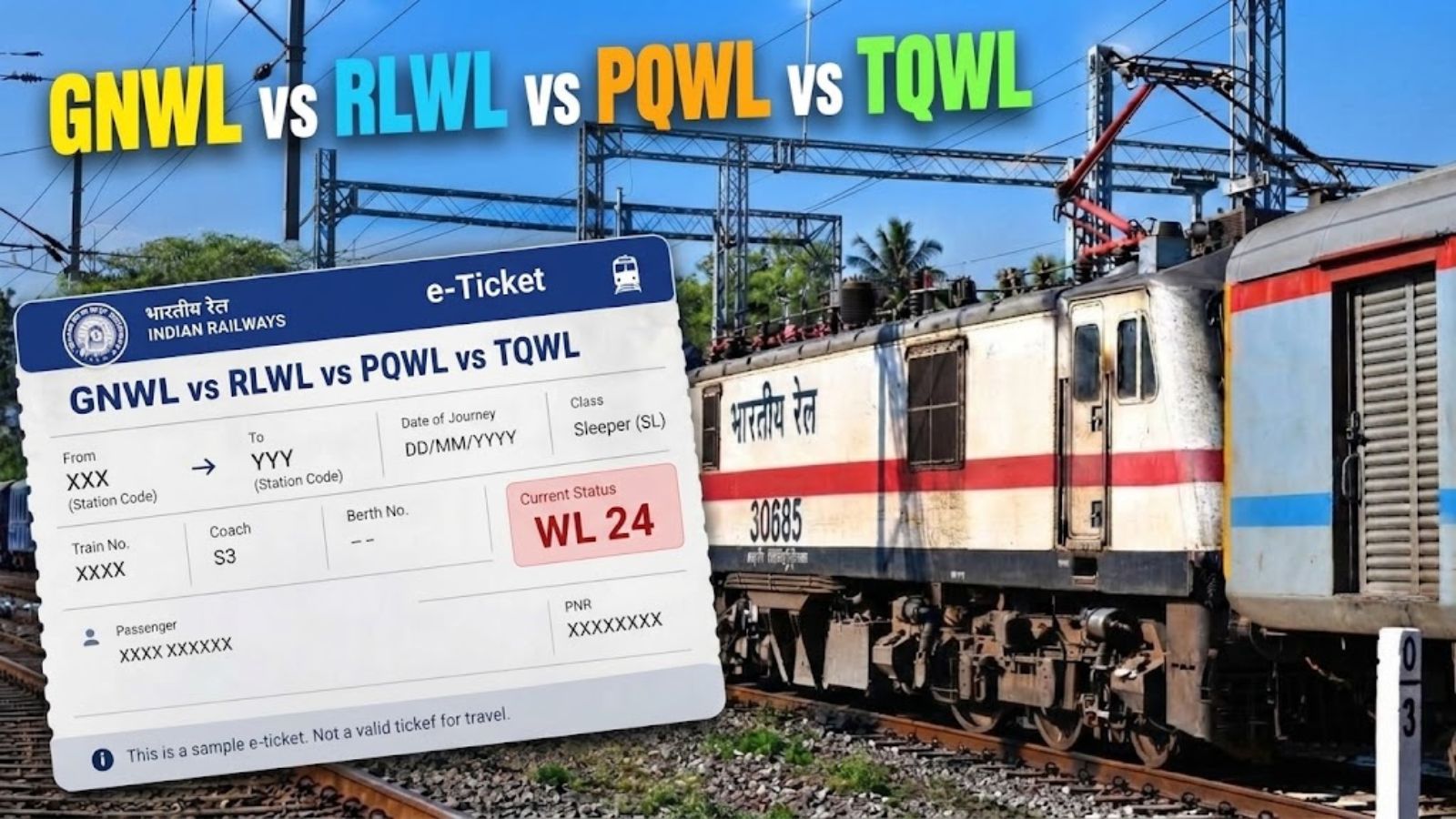
Train tickets can be wait-listed in different groups.
GNWL usually has the best position because it uses the main pool of seats.
RLWL and PQWL use smaller pools linked to certain stations or station pairs, so they can move differently.
TQWL is for people booking after Tatkal seats have filled, and it depends on that separate quota.
A smaller number does not always mean a better chance.
The train, route, travel date, class and cancellations all matter.
Indian Railways’ RailOne app gives an AI prediction about whether a ticket may be confirmed.
That prediction can help, but it is not a promise.

GNWL generally has the strongest position because it draws on the main accommodation pool and is cleared ahead of RLWL and PQWL.
RLWL and PQWL use smaller, restricted quota pools, so their movement depends on cancellations and availability within those pools.
TQWL is tied to the separate Tatkal quota, and its confirmation depends on Tatkal berths and cancellations.
A waitlist number alone does not determine the outcome; train, class, route, travel date, demand, cancellations and time before departure also matter.
RailOne offers an AI-based confirmation prediction reported to have improved from 53% to 94%, but the prediction is only an estimate.
- Who
- Passengers with wait-listed Indian Railways tickets.
- What
- The article explains how GNWL, RLWL, PQWL and TQWL differ and how their confirmation chances are affected.
- When
- Before and while waiting for a train ticket to be confirmed; no publication date is stated.
- Where
- Indian Railways train reservations in India.
- Why
- The waitlist categories use different quotas and accommodation pools, so equal waitlist numbers may have different prospects.
Waitlist category matters
A waitlist number is not a guarantee
How to compare waitlists
Waitlist category matters
GNWL generally has a structural advantage over RLWL and PQWL because it uses the main accommodation pool and is cleared ahead of them.
A waitlist number is not a guarantee
Category alone cannot establish which ticket will confirm; a high GNWL number is not automatically safer than a low RLWL number, and TQWL follows its own quota.
Using confirmation predictions
Waitlist category matters
RailOne’s AI-based prediction can help passengers assess whether a wait-listed ticket may be confirmed; reported accuracy has risen to 94%.
A waitlist number is not a guarantee
The prediction is only an estimate based on trends, and actual confirmation can differ.
- GNWL
- General Waiting List; generally has the strongest position and is cleared ahead of RLWL and PQWL.
- RLWL
- Remote Location Waiting List; applies to certain intermediate or remote stations and relies on a separate, smaller pool.
- PQWL
- Pooled Quota Waiting List; shares limited seats among certain intermediate-station combinations.
- TQWL
- Tatkal Quota Waiting List; applies after Tatkal quota seats are booked and depends on Tatkal availability and cancellations.
- Factors affecting confirmation
- Train, class, route, travel day or season, demand, cancellations, quota releases, extra coaches and time before departure.
- RailOne prediction
- The article reports that prediction accuracy improved from 53% to 94%; the result remains indicative, not guaranteed.